The discovery, explained · Chemist no. 79 of 350
Wilkinson's Catalyst and the Sandwich Structure of Ferrocene: Geoffrey Wilkinson's Discovery
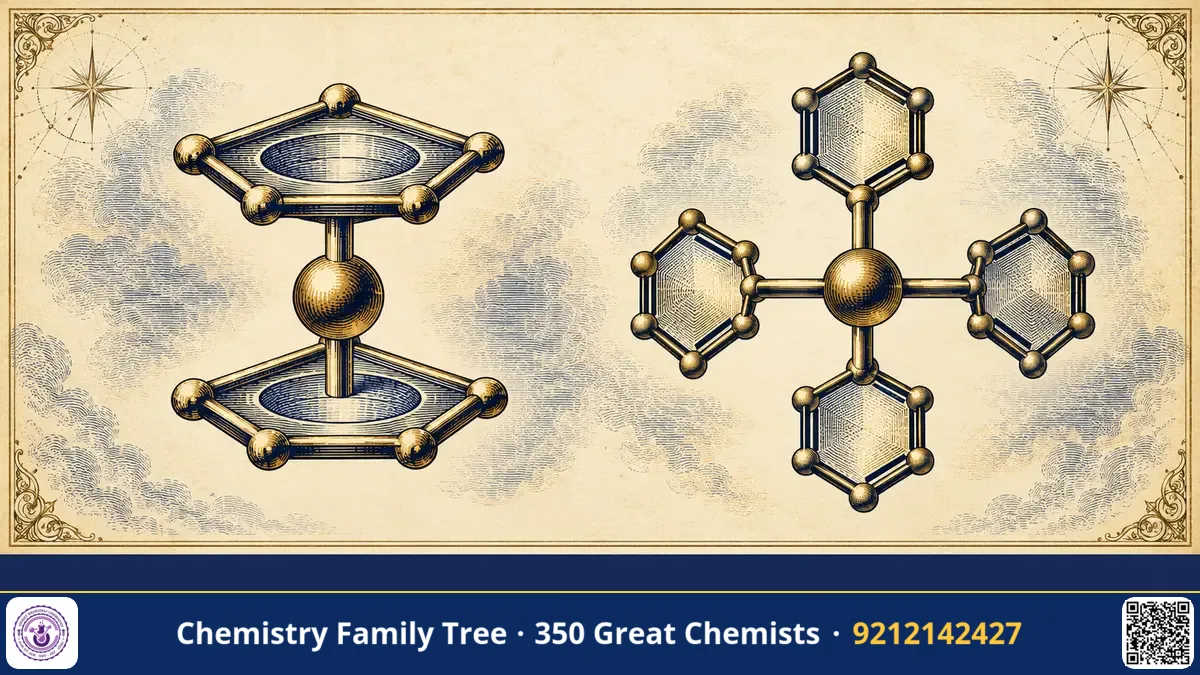
Open any modern organic synthesis lab and you will find reactions that run at room temperature, in a single flask, under a balloon of hydrogen, with a pale red-orange catalyst dissolved in the solvent. That catalyst, RhCl(PPh3)3, is called Wilkinson's catalyst. Its inventor, Geoffrey Wilkinson, also helped solve one of the most puzzling structures of the 1950s: the iron compound ferrocene, in which an iron atom sits between two flat rings like the filling in a sandwich. These two contributions opened the field of modern organometallic chemistry and led to the Nobel Prize in Chemistry in 1973, shared with Ernst Otto Fischer. If you are preparing for IIT-JAM, CSIR-NET or GATE, almost every idea in this blog (18-electron rule, oxidative addition, migratory insertion, hapticity) is a regular exam topic.
The Scientific Problem Before the Discovery
Before the 1950s, chemists knew metal-carbon compounds such as Grignard reagents (R-MgX), zinc alkyls and Zeise's salt, K[PtCl3(C2H4)]. Most of them were reactive and were thought to contain ordinary two-centre, two-electron metal-carbon sigma bonds. Then in 1951, two groups (Kealy and Pauson, and separately Miller, Tebboth and Tremaine) obtained an unexpectedly stable orange solid with the formula Fe(C5H5)2. It resisted air, heat up to high temperatures, and strong acids and bases.
The first proposed structure had each cyclopentadienyl ring attached to iron through a single carbon atom (a sigma bond). That structure could not explain the great stability. It also could not explain why the molecule behaved as if it had no dipole moment and gave very simple spectra. The problem was clear: what kind of bonding makes an iron-carbon compound this stable?
The Discovery / Experiment — Step by Step
In 1952, at Harvard University, Wilkinson worked with R. B. Woodward and co-workers (including Rosenblum and Whiting). They suggested that the iron atom lies between two parallel cyclopentadienyl rings, with all ten carbon atoms bonding to the metal. Their evidence was a set of simple but clever observations:
- Diamagnetism: ferrocene is diamagnetic, consistent with a low-spin Fe(II), d6, in a symmetric environment.
- Infrared spectrum: only one C-H stretching band was seen, which means all ten C-H bonds are equivalent.
- Zero dipole moment: consistent with a symmetrical sandwich.
- Aromatic-like reactions: ferrocene undergoes Friedel-Crafts acylation and sulphonation like benzene, which suggested that the rings keep their delocalised pi system.
Ernst Otto Fischer in Munich reached the same sandwich idea independently, and X-ray crystallography soon confirmed it. The name "ferrocene" was suggested by Woodward's group, with "-ocene" now used for all such sandwich compounds (nickelocene, cobaltocene, ruthenocene).
The second great discovery came in the mid-1960s, after Wilkinson moved to Imperial College London. Working with his group, he found that rhodium(III) chloride reacts with excess triphenylphosphine in boiling ethanol to give a red-violet solid:
RhCl3·3H2O + 3 PPh3 (excess, ethanol, reflux) → RhCl(PPh3)3
Ethanol or excess phosphine acts as the reducing agent, and the product is a 16-electron, square-planar Rh(I) complex. It catalyses the hydrogenation of simple alkenes at room temperature and 1 atm of H2, in solution. Earlier hydrogenation catalysts such as Pd/C or Raney nickel were heterogeneous (solid in liquid), but this one was homogeneous and could be tuned with ligands.
The Chemistry Behind It
Bonding in ferrocene
Each cyclopentadienyl ring (Cp-) is a 6-pi-electron aromatic anion that donates six electrons. Iron(II) is d6. So the count is 6 (Fe2+) + 6 + 6 = 18 valence electrons, which is the closed-shell "18-electron rule" configuration, similar to a noble gas. In the language of hapticity, each ring is η5-bound. The rings can rotate with a very low barrier, around 4 kJ/mol in the gas phase.
Wilkinson's catalyst cycle
The overall reaction is simple:
RCH=CH2 + H2 → RCH2CH3 (catalyst: RhCl(PPh3)3)
The cycle has four classic organometallic steps:
- Ligand dissociation: RhCl(PPh3)3 loses one PPh3 in solution to give the active 14-electron species RhCl(PPh3)2.
- Oxidative addition of H2: Rh(I) becomes Rh(III) dihydride, RhH2Cl(PPh3)2. The oxidation state rises by 2 and the coordination number rises by 2.
- Alkene coordination and migratory insertion: the alkene binds, then inserts into the Rh-H bond to give an alkyl hydride.
- Reductive elimination: the C-H bond forms, the alkane leaves, and Rh(I) is regenerated.
Because both hydrogens add to the same face of the double bond, the hydrogenation is a syn addition. Less hindered, monosubstituted alkenes react fastest; tetrasubstituted alkenes react very slowly. Importantly, the catalyst reduces C=C bonds but leaves C=O, nitro and ester groups untouched, which is called chemoselectivity.
Applications Today
- Pharmaceutical synthesis: selective alkene hydrogenation in multi-step drug synthesis where other groups must be preserved.
- Asymmetric catalysis: replacing PPh3 by chiral phosphines led to enantioselective hydrogenation, and the same idea underlies industrial production of L-DOPA, used for Parkinson's disease, using a rhodium catalyst.
- Hydroformylation: Wilkinson also developed rhodium-phosphine catalysts for converting alkenes to aldehydes with CO and H2 at lower pressure than cobalt processes, and this is used in industry to make butyraldehyde from propene.
- Ferrocene derivatives: used as fuel additives, redox standards in electrochemistry (the Fc/Fc+ couple), and in sensors and drug candidates such as ferroquine, an antimalarial candidate.
Exam Corner — 5 Likely Points
- Wilkinson's catalyst is RhCl(PPh3)3: Rh(I), d8, square planar, 16 electrons.
- Ferrocene is Fe(η5-C5H5)2: 18 electrons, diamagnetic, Fe(II), D5d (staggered) or D5h (eclipsed) symmetry.
- Key steps of the hydrogenation cycle: oxidative addition of H2, migratory insertion, reductive elimination.
- Count electrons: Cp is a 5-electron donor in the neutral covalent method and 6 in the ionic method; the final total remains 18.
- Hydrogenation with this catalyst is homogeneous, syn, and shows chemoselectivity for less hindered C=C.
Common Misconceptions
- "Ferrocene has iron bonded to just one carbon of each ring." Wrong. All five carbons of each ring bond to iron (η5).
- "Wilkinson's catalyst is a Rh(III) complex." It is Rh(I) in the resting state. Rh(III) appears only inside the cycle, after oxidative addition.
- "Homogeneous catalysis is always better than heterogeneous." It is more selective and tunable, but separating the catalyst from the product is harder and rhodium is costly.
Quick Revision Box
- Ferrocene sandwich structure proposed in 1952 by Wilkinson and Woodward; independently by E. O. Fischer.
- Fe(C5H5)2 has 18 valence electrons and is diamagnetic.
- Wilkinson's catalyst: RhCl(PPh3)3, from RhCl3·3H2O and excess PPh3.
- Cycle: oxidative addition, alkene binding, migratory insertion, reductive elimination.
- Syn addition of H2 across C=C at room temperature and about 1 atm.
- Nobel Prize in Chemistry 1973 shared with E. O. Fischer.
FAQ
Why is ferrocene so stable?
Its 18-electron closed shell, strong overlap between the metal d orbitals and the ring pi orbitals, and the aromatic stability of the Cp rings all contribute to its stability.
Why does Wilkinson's catalyst need to lose a phosphine?
The 16-electron starting complex is coordinatively saturated enough that H2 and the alkene bind poorly. Losing PPh3 creates a vacant site for them.
Is Wilkinson's catalyst used for aromatic ring hydrogenation?
No. It is selective for isolated, unhindered C=C bonds. Benzene rings and carbonyl groups are normally left alone under its mild conditions.
Why was the 1973 Nobel Prize shared?
Both Wilkinson and Fischer pioneered the chemistry of organometallic "sandwich" compounds, and the prize recognised their separate but parallel work on this class.
Published by ABC Chemistry — IIT-JAM | CSIR-NET | GATE Chemistry Coaching. Visit abcchemistry.com
About the chemist
Geoffrey Wilkinson
1921-1996 · United Kingdom · Nobel Chemistry 1973
Organometallic sandwich compounds; Wilkinson's catalyst