Biography · Chemist no. 233 of 350
Georg Agricola: The Physician Who Wrote the Book on Mining
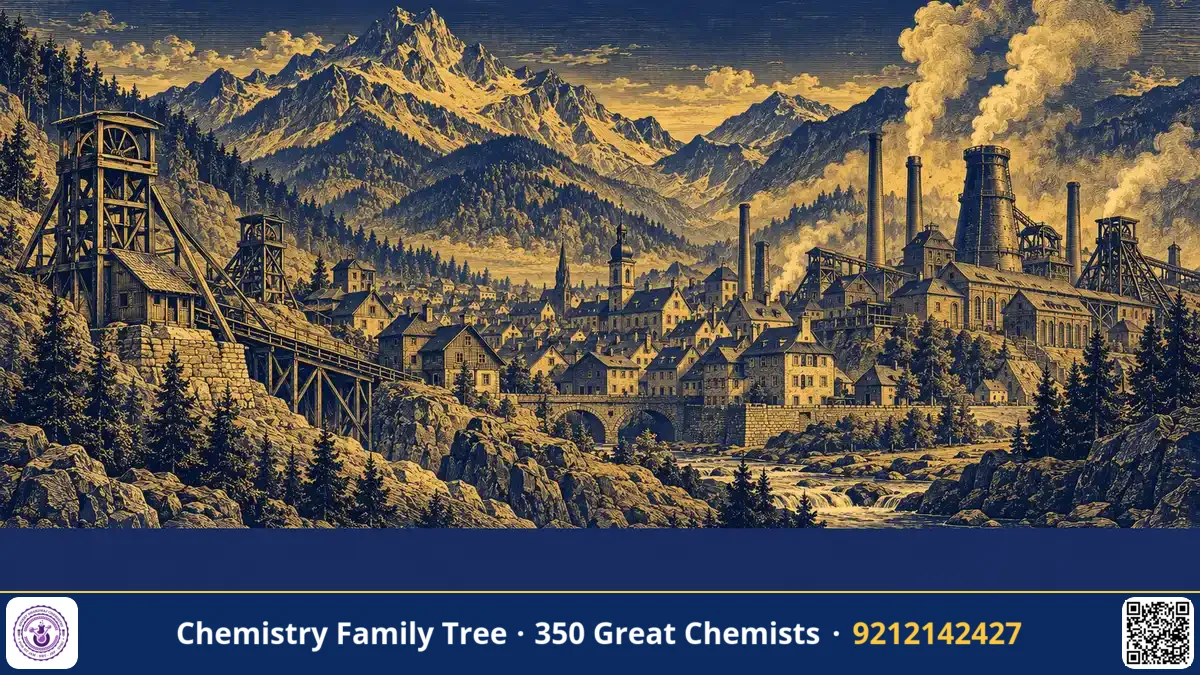
Georg Agricola (1494–1555) was a scholar, physician, town official and keen observer of the mining world of Saxony and Bohemia. He is remembered as the "father of mineralogy" and as the author of De Re Metallica, the great treatise on mining and metallurgy that appeared in 1556, a year after his death. His one-line legacy: he replaced legend with careful observation in the study of minerals and metals.
Early Life and Family
He was born Georg Bauer on 24 March 1494 in Glauchau, Saxony, in what is now Germany. Bauer means "farmer", and he later Latinised it to Agricola, as many Renaissance scholars did with their names. His father is thought to have been a cloth dyer or weaver, and the family was of modest means. Glauchau was not itself a major mining centre, but the Erzgebirge (Ore Mountains) lay close by, and mining was the dominant industry of the region. Detailed records of his childhood are limited, and anything beyond these basics is uncertain.
Education and Mentors
He studied classics, philosophy and philology at the University of Leipzig from about 1514, where he learned Latin and Greek well. He then taught Greek and Latin at a school in Zwickau, and became a rector there. He returned to study, and between about 1523 and 1526 he studied medicine, natural science and philosophy in Italy, in cities including Bologna, Venice and Padua. In Venice he worked with the Aldine Press, helping with the editing of Greek medical texts, which exposed him to ancient authors such as Galen and Hippocrates. He was friends with Erasmus, the leading humanist of the age, who later encouraged his writings; the connection with Erasmus is well attested through correspondence.
Career Timeline
| Year | Event |
|---|---|
| 1494 | Born in Glauchau, Saxony. |
| c. 1514 | Begins studies at the University of Leipzig. |
| c. 1518 | Teaches Greek and Latin in Zwickau. |
| c. 1523–1526 | Studies medicine and science in Italy. |
| 1527 | Becomes town physician of Joachimsthal in Bohemia, a silver-mining boomtown. |
| 1530 | Publishes Bermannus, a dialogue on mining and minerals. |
| 1533 | Moves to Chemnitz in Saxony as town physician. |
| 1546 | Publishes De Natura Fossilium and other works on geology and mining; appointed burgomaster of Chemnitz. |
| 1550 | Elected burgomaster of Chemnitz again (served several terms in the 1540s and 1550s). |
| 1555 | Dies in Chemnitz on 21 November. |
| 1556 | De Re Metallica published posthumously in Basel. |
Major Scientific Contributions
- Mineral classification: De Natura Fossilium groups minerals according to properties such as colour, hardness, lustre, solubility and behaviour in fire.
- Mining engineering: shafts, ventilation, pumps and water-powered machines in De Re Metallica.
- Assaying and smelting: full descriptions of testing ores, roasting, smelting, liquation and refining.
- Geology of ore veins: he proposed that ore veins form from circulating waters, not from mystic influences, and his theory of ore genesis was ahead of its time, though not entirely accurate.
- Naming and terms: he coined or standardised many Latin terms, including the use of "fluor" for fluorspar-type minerals, a word that later gave fluorine its name through fluorite.
A short example from his methods: roasting galena, 2PbS + 3O₂ → 2PbO + 2SO₂, followed by reduction, PbO + C → Pb + CO. Explore the details in our discovery post on Agricola.
Awards, Honours and Nobel Prize
Nobel Prizes did not exist, and Agricola received no international awards. His honours were civic: he served as town physician and was elected burgomaster (mayor) of Chemnitz more than once, which shows the trust of his fellow citizens. His lasting recognition is scholarly. De Re Metallica was reprinted and translated into German, Italian and later English, and he is still called the father of mineralogy in textbooks of geology and metallurgy.
Personality, Struggles and Lesser-Known Facts
- A Catholic in a Lutheran land. Saxony turned Protestant during his life, while Agricola remained Catholic. This brought tensions and, after his death, a dispute over his burial. Reports say he was interred in Zeitz, away from Chemnitz, because of local opposition.
- Friend of humanism. His relationship with Erasmus shows how classical scholarship and practical science could meet.
- Twenty years of writing. He spent a long time preparing De Re Metallica, and the illustrations were prepared by artists under his guidance.
- Serving two roles. He worked as a physician and a politician while writing, and he often had to defend his time on science against his civic duties.
- Writing with care for miners. The book discusses accidents and diseases among miners and suggests protective measures such as ventilation and face coverings.
Legacy and Influence on Modern Chemistry
The authority of De Re Metallica was such that Robert Boyle and many later chemists used it as a working reference. Its chapters on assaying shaped analytical chemistry before the balance-based quantitative methods of the 18th century. Mineralogy, metallurgy and economic geology all trace their formal beginnings to his work. For Indian students, the importance is concrete: the extraction-of-metals chapters in your syllabus follow the same logical flow of ore dressing, roasting, smelting and refining.
Lessons for Students
- Go and see. Agricola learned by visiting mines and speaking to workers.
- Describe precisely. Clear terminology is the first step of any science.
- Combine scholarship with practice. He joined classical learning to hands-on observation.
- Value the worker's knowledge. Great science often starts by documenting craft knowledge honestly.
Quick Facts Box
- Born: 24 March 1494, Glauchau, Saxony (born Georg Bauer)
- Died: 21 November 1555, Chemnitz
- Nationality: German (Saxon)
- Field: Mineralogy, metallurgy, medicine
- Famous for: De Re Metallica (1556), De Natura Fossilium (1546)
- Nobel Prize: None (pre-dates the prize)
FAQ
Who translated De Re Metallica into English?
Herbert Clark Hoover and Lou Henry Hoover published a well-known English translation in 1912.
Did Agricola work as a miner?
No. He was a physician and scholar, but his position in Joachimsthal and Chemnitz placed him close to mining.
Why is the book published after his death?
It was complete by about 1550, but illustrations and printing took time; it was published in Basel in 1556.
Was he a contemporary of Paracelsus?
Yes. Both lived in the early 16th century, but Agricola preferred careful description over the mystic theory favoured by Paracelsus.
Published by ABC Chemistry — IIT-JAM | CSIR-NET | GATE Chemistry Coaching. Visit abcchemistry.com
About the chemist
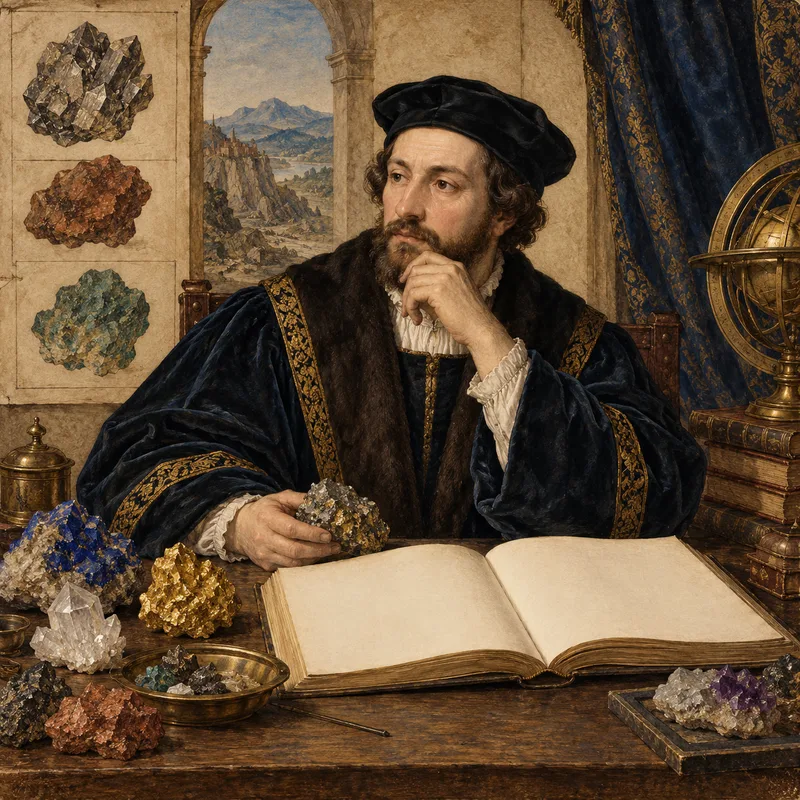
Georg Agricola
1494-1555 · Germany
Father of mineralogy; De re metallica