The discovery, explained · Chemist no. 233 of 350
Georg Agricola and De Re Metallica: Writing Down How Metals Are Made
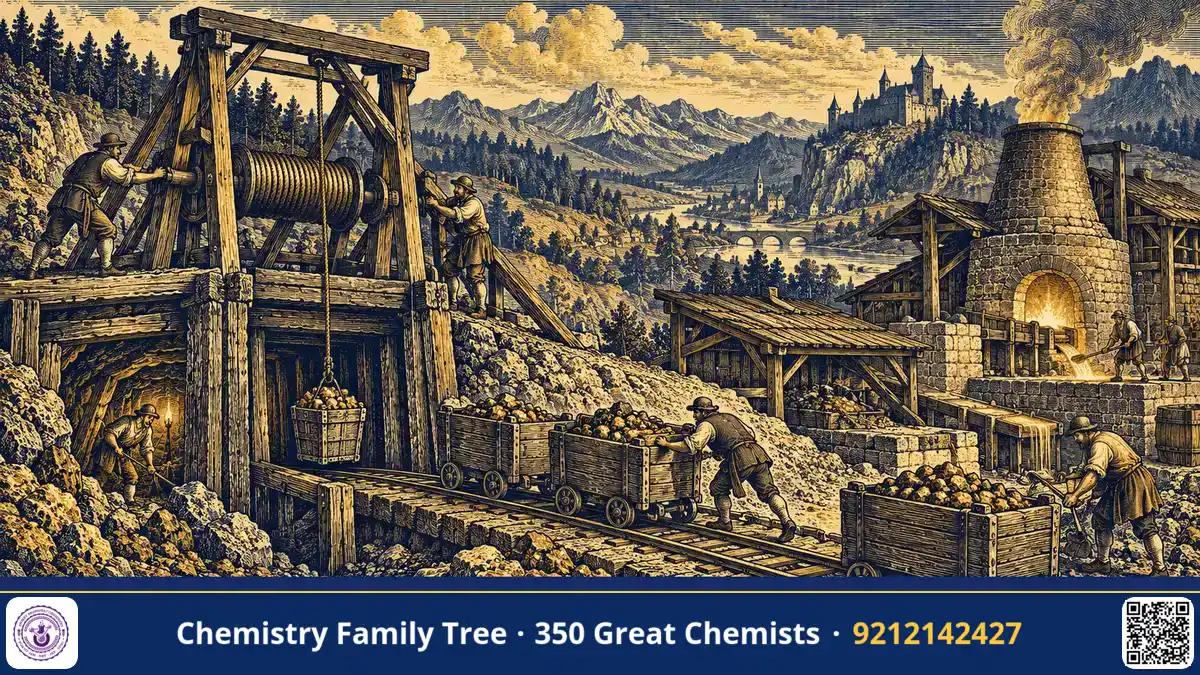
Before a metal reaches a chemistry lab or an Indian factory, it must be found, dug out, concentrated and smelted. In 1556, a book appeared that explained every one of these steps in careful detail, with more than a hundred woodcut illustrations: De Re Metallica ("On the Nature of Metals") by Georg Agricola. It stayed the standard reference on mining and metallurgy for almost two centuries. A decade earlier, his De Natura Fossilium (1546) had set out a practical way of describing minerals by their physical properties. Together they helped separate mineral science from myth, and they sit at the root of mineralogy and extractive metallurgy.
The Scientific Problem Before the Discovery
In the early 1500s, mining knowledge lived in the heads of miners and was passed on by apprenticeship. Scholars wrote about minerals using the ancient Greek and Roman authors, especially Aristotle and Pliny, and they often repeated myths: that metals grow in the earth like plants, that spirits guard ore veins, that a forked hazel rod can find metal. Meanwhile, alchemical writers explained metals through philosophical principles. There was no clear, shared vocabulary for minerals, no organised account of mining, and no systematic account of assaying, the testing of ores for metal content. This made it hard to compare methods or teach them.
The Discovery: Step by Step
Agricola's contribution is not a single new substance but a new way of studying matter: direct observation in the mining district of Joachimsthal (now Jáchymov in the Czech Republic) and Chemnitz in Saxony, followed by clear written description.
Step 1: Classifying minerals by properties
In De Natura Fossilium he described minerals by measurable or observable characters: colour, lustre, transparency, hardness, taste, smell, solubility, behaviour on heating, and specific gravity (he compared weights of equal volumes). He also divided "fossils" (the old word for anything dug up) into simple and compound substances, including earths, stones, gems, metals and "compounds". This was a major step towards a descriptive scheme based on tests, not on legend.
Step 2: Describing the ore deposit
In De Re Metallica he explained how veins occur, how to prospect, how shafts and tunnels are driven, how water is pumped out, and how air is supplied to workings. He criticised divining rods and relied on geology and experience.
Step 3: Preparing the ore
The ore is crushed (by stamp mills driven by water wheels), washed and sorted so that the heavy metal-bearing grains are separated from lighter rock. This is gravity separation, the same idea used in jigs and shaking tables today.
Step 4: Assaying
The book describes assay methods in which a weighed sample is heated with fluxes in a crucible, and the metal button obtained is weighed. For silver and gold ores, he describes lead collection and cupellation, where lead absorbs the precious metal and is then oxidised away.
Step 5: Roasting, smelting and refining
He gave careful descriptions of furnaces, bellows, fluxes and the separation of metals from each other. This included liquation, a process in which lead is used to remove silver from copper, as well as parting of gold from silver with acids.
The Chemistry Behind It
Agricola did not know the modern theory, but the reactions he describes are the foundations of extractive metallurgy and can be written as equations.
- Roasting a sulfide ore: 2ZnS + 3O₂ → 2ZnO + 2SO₂. Roasting converts a sulfide to an oxide.
- Smelting an oxide with carbon: ZnO + C → Zn + CO (at high temperature, zinc distils off); Fe₂O₃ + 3CO → 2Fe + 3CO₂ in an iron blast furnace.
- Fluxes: a flux combines with the gangue (unwanted rock) to form slag. CaO + SiO₂ → CaSiO₃. This removes silica from the metal.
- Cupellation: 2Pb + O₂ → 2PbO; the silver stays unreacted because it is a noble metal.
- Gravity separation: works because the density of ore minerals such as galena (PbS, about 7.5 g/cm³) is much greater than that of quartz (about 2.65 g/cm³).
Ellingham diagram thinking, now taught in GATE metallurgy and inorganic chemistry, explains why carbon can reduce some oxides but not others: it depends on the free-energy change ΔG = ΔH − TΔS at the smelting temperature.
Applications Today
The sequence of mining, ore dressing, roasting, smelting and refining is still the template for producing metals. In India, the same flow is seen at Hindustan Zinc's Zawar operations in Rajasthan, in iron and steel plants of Odisha and Jharkhand, and in the aluminium industry, where bauxite is purified by the Bayer process and reduced by the Hall–Héroult process. Assay and hallmarking practice, mineral identification with density and hardness, and froth flotation (which replaced simple gravity methods for fine ores) all continue what Agricola described. His attention to health risks, for example dust diseases of miners, also anticipates modern occupational safety.
Exam Corner
- De Re Metallica (1556): classic illustrated treatise on mining and metallurgy; published after Agricola's death in 1555.
- De Natura Fossilium (1546): first systematic classification of minerals by physical properties.
- Roasting converts sulfide ores into oxides (with SO₂ evolved); calcination heats carbonates/hydroxides in limited air to give oxides.
- Flux + gangue → slag. Acidic gangue (SiO₂) needs a basic flux (CaO); basic gangue needs an acidic flux (SiO₂).
- Cupellation purifies silver or gold from lead; the process is oxidative.
Common Misconceptions
- "Agricola was a miner." He was a physician and scholar who observed mining closely.
- "Roasting and calcination are the same." Roasting is heating in excess air, usually for sulfides; calcination is heating, often in limited air, mainly for carbonates and hydrates.
- "He discovered new elements." His value lies in recording and organising knowledge, not in identifying new elements.
Quick Revision Box
- Georg Agricola (1494–1555), German scholar, "father of mineralogy".
- De Natura Fossilium (1546): minerals classified by properties.
- De Re Metallica (1556): mining, assaying, smelting, refining.
- Roasting: sulfide → oxide; smelting: oxide + C → metal.
- Flux + gangue → slag.
- Cupellation: Pb oxidised away, noble metal remains.
FAQ
Why is Agricola called the father of mineralogy?
Because he created the first systematic, evidence-based description of minerals, and gave them a classification based on observable properties.
Was De Re Metallica translated into English?
Yes. A well-known English translation was published in 1912 by Herbert Hoover, later a US president, and his wife Lou Henry Hoover, both of whom had mining backgrounds.
Was Agricola his real name?
He was born Georg Bauer. Agricola is the Latin form of "farmer", and Bauer means farmer or peasant in German.
Why does this matter for chemistry exams?
Questions on metallurgy (roasting, smelting, flux, slag, refining) follow the steps he described, so understanding the sequence helps with extraction-of-metals chapters.
Published by ABC Chemistry — IIT-JAM | CSIR-NET | GATE Chemistry Coaching. Visit abcchemistry.com
About the chemist
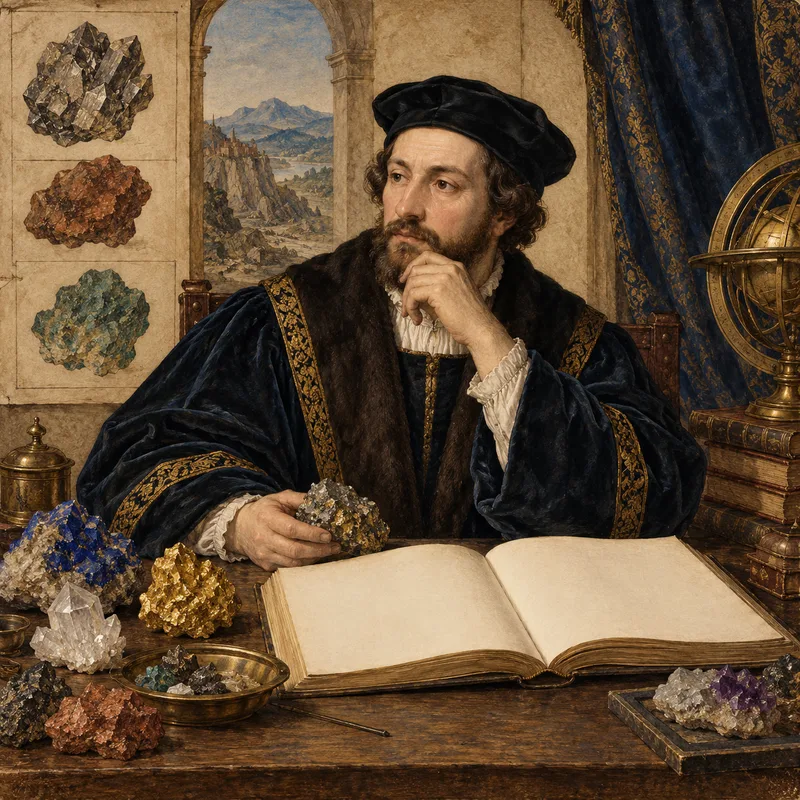
Georg Agricola
1494-1555 · Germany
Father of mineralogy; De re metallica