Biography · Chemist no. 234 of 350
Georg Ernst Stahl: The Physician Behind the Phlogiston Theory
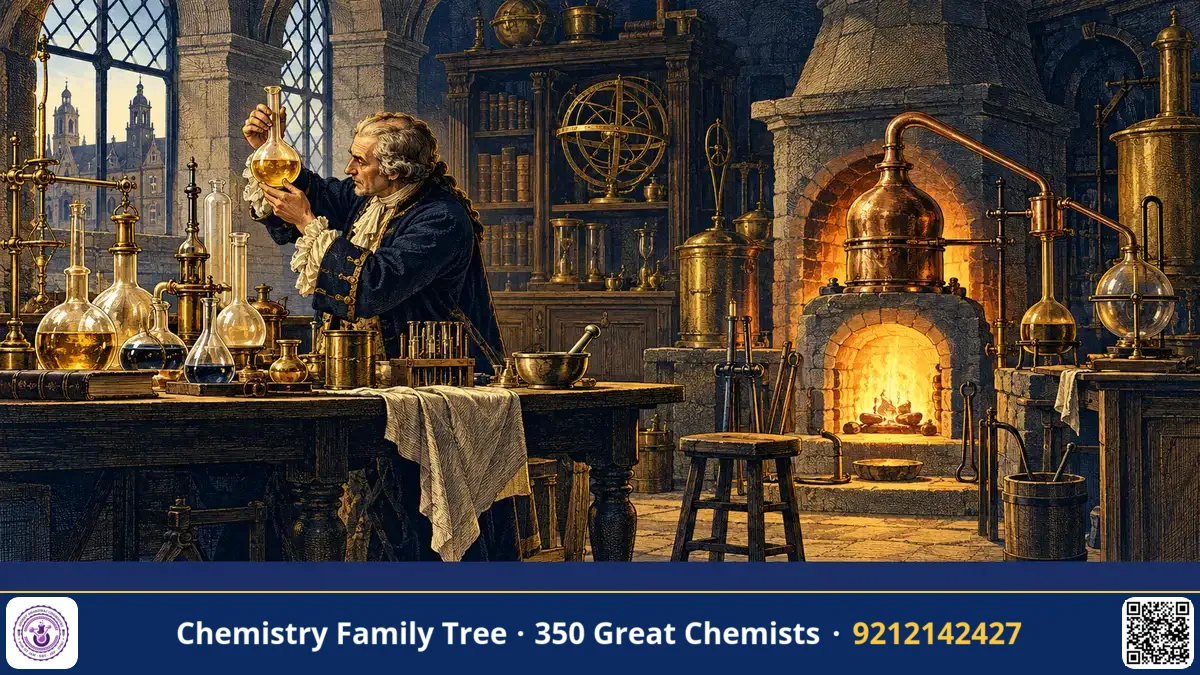
Georg Ernst Stahl (1659–1734) was a German physician and chemist whose name is tied to the phlogiston theory, the dominant explanation of burning and rusting for roughly a century. He was also a forceful thinker in medicine, who argued that living beings are directed by the soul and cannot be treated merely as machines. One line sums him up: he gave chemistry its first great unifying theory, and by being wrong in a fruitful way he prepared the path for Lavoisier.
Early Life and Family
Stahl was born on 22 October 1659 in Ansbach, in the Franconian region of what is now Bavaria. His father, Johann Lorenz Stahl, was a church official in the Lutheran church of the town. He grew up in a devout Lutheran environment, and the Pietist movement of the period, which stressed personal faith and practical charity, strongly influenced him. These religious convictions are important for understanding his later medical views, which gave the soul a central role in the body.
Education and Mentors
He studied medicine at the University of Jena from 1679. His main teacher there was Georg Wolfgang Wedel, a professor of medicine and chemistry, who introduced him to chemical ideas, including those of Johann Joachim Becher, whose book Physica subterranea would later give Stahl the seed of his phlogiston theory. He received his medical degree in 1684 and began teaching at Jena, giving lectures on chemistry and medicine. His early students and his work on practical chemistry quickly made his reputation.
Career Timeline
| Year | Event |
|---|---|
| 1659 | Born in Ansbach. |
| 1679 | Begins medical studies at Jena. |
| 1684 | Receives his medical degree and begins lecturing. |
| 1687 | Appointed court physician to Duke Johann Ernst of Saxe-Weimar. |
| 1694 | Appointed professor of medicine at the new University of Halle, where he taught together with Friedrich Hoffmann. |
| 1697 | Publishes Zymotechnia fundamentalis, in which he sets out his views on fermentation and phlogiston. |
| 1716 | Called to Berlin as personal physician to King Frederick William I of Prussia. |
| 1723 | Publication of his major chemistry work, Fundamenta chymiae dogmaticae et experimentalis (a related collected volume appeared in 1723). |
| 1734 | Dies in Berlin on 14 May. |
Major Scientific Contributions
- Phlogiston theory: combustion and calcination release phlogiston. See our discovery blog for the full explanation, including the equation-level comparison with oxygen theory.
- Theory of fermentation: in Zymotechnia he treated fermentation and putrefaction as processes of internal motion in matter, and worked on the chemistry of brewing and related technologies.
- Chemical practice: he distinguished chemical combination from simple mechanical mixing, and he wrote on salts, acids and metals. He made well-regarded statements about the difference between a mixt (compound) and an aggregate.
- Animism in medicine: he argued that the rational soul (anima) governs the body's processes, and that disease results from disturbances of the soul's directing action. This competed with the mechanical medicine of his colleague Hoffmann.
- Metallurgy and assaying: his early works dealt with the chemistry of metals and the calcination processes that later fed into phlogiston theory.
Awards, Honours and Nobel Prize
Nobel Prizes did not exist in his time. Stahl's honours were professional: he held a chair at Halle, a major new university, and served as personal physician to the Prussian king, which was a high post. He was also appointed to the Prussian medical administration. His chemical theory was taught across Europe throughout the eighteenth century, and his name is a standard entry in histories of science.
Personality, Struggles and Lesser-Known Facts
- Rivalry with Hoffmann. Though both were at Halle, the two men held opposing views in medicine. Hoffmann supported mechanical explanations, whereas Stahl insisted on the soul. They are described as having drifted apart.
- A difficult writer. His Latin was dense, and contemporaries and later chemists described his writing as obscure and sometimes combative.
- Pietist convictions. His religious outlook influenced his refusal to treat the body as a pure machine.
- Prussian service. His appointment in Berlin was a major career move, and he remained there for the remainder of his life.
- The word phlogiston. He did not invent the word, but his work gave it a central role in chemistry.
Legacy and Influence on Modern Chemistry
Stahl's phlogiston theory shaped the work of Joseph Black, Henry Cavendish, Joseph Priestley and Carl Wilhelm Scheele, all of whom made major discoveries (carbon dioxide, hydrogen, oxygen) while thinking in phlogiston language. Lavoisier's decisive rejection of the theory in the 1770s–1780s created modern chemistry, but it was built on the data these chemists collected. In medicine, his insistence on the unity of the living organism has been seen as an early form of vitalism and, in a different reading, a forerunner of holistic approaches. The history of phlogiston is regularly cited in philosophy of science as a model of how scientific theories rise and fall.
Lessons for Students
- A wrong theory can still be useful. It can organise evidence and direct experiments.
- Mass matters. The theory fell when precise weighing was applied.
- Be ready to revise. Today's accepted explanation may also be refined tomorrow.
- Explain clearly. Stahl's difficult style limited his influence in his own time.
Quick Facts Box
- Born: 22 October 1659, Ansbach, Franconia
- Died: 14 May 1734, Berlin
- Nationality: German (Prussian service)
- Field: Chemistry and medicine
- Famous for: Phlogiston theory, animism in medicine
- Nobel Prize: None (pre-dates the prize)
FAQ
Where did Stahl teach?
He taught at Jena and then held a professorship at Halle from 1694 until he moved to Berlin in 1716.
Who proposed the idea before Stahl?
Johann Joachim Becher proposed terra pinguis, a combustible earthy principle. Stahl developed it into the phlogiston theory.
Why is Stahl important if his theory was wrong?
Because it was the first theory that connected combustion, calcination and smelting, and testing it produced the discoveries that led to modern chemistry.
Did Stahl discover any element?
No element is credited to him. His influence lies in theory.
Published by ABC Chemistry — IIT-JAM | CSIR-NET | GATE Chemistry Coaching. Visit abcchemistry.com
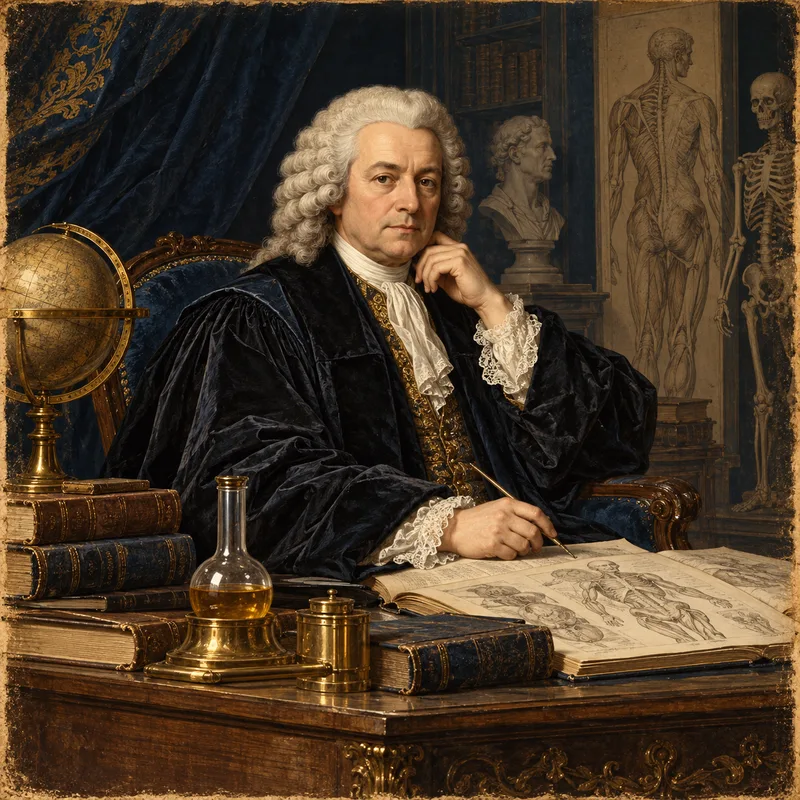
About the chemist
Georg Ernst Stahl
1659-1734 · Germany
Phlogiston theory