The discovery, explained · Chemist no. 234 of 350
Georg Ernst Stahl and Phlogiston: The Wrong Theory That Built Modern Chemistry
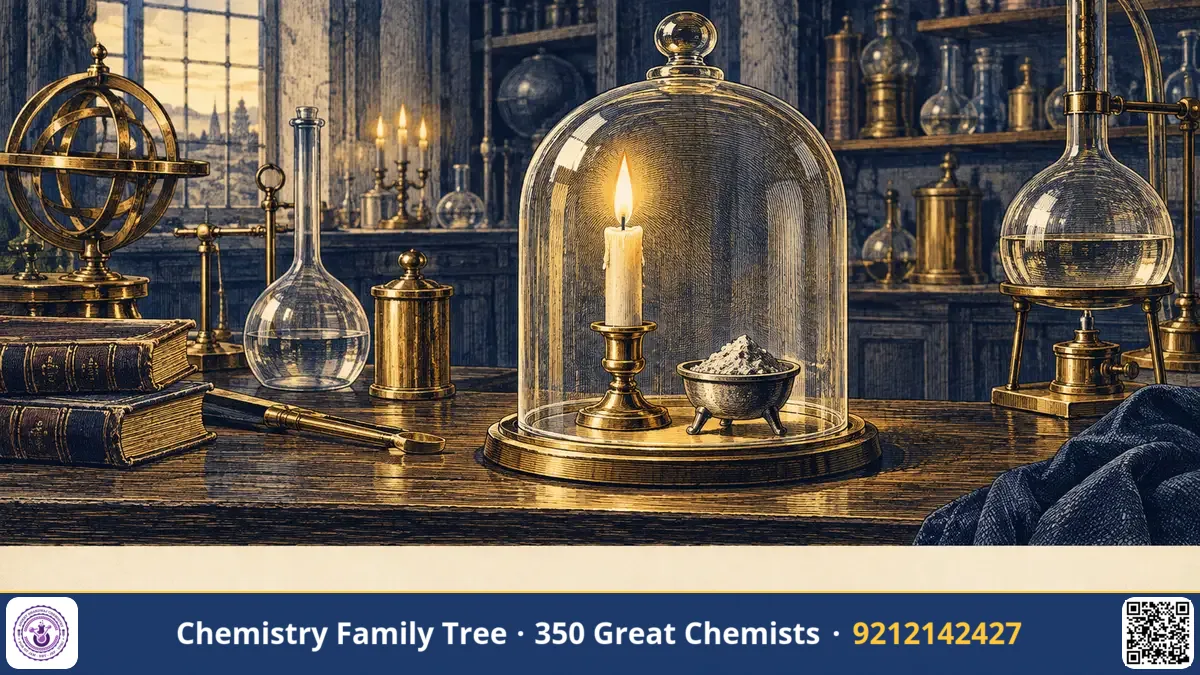
Why does wood burn? Why does iron rust? Why does a candle go out in a closed jar? For about a hundred years, chemists answered with a single word: phlogiston. The idea was developed and popularised by the German chemist and physician Georg Ernst Stahl in the early 1700s. It turned out to be wrong, and Lavoisier's oxygen theory replaced it in the 1780s. But the phlogiston theory deserves your attention for two reasons. First, it was the first broad theory that tied together combustion, calcination of metals and respiration. Second, the effort to test it led directly to the discovery of oxygen, hydrogen and the foundations of quantitative chemistry.
The Scientific Problem Before the Discovery
By 1700, chemists could observe many facts without a unifying explanation. Combustibles such as wood, charcoal, oil and sulfur burn and are consumed. Metals heated in air change into crumbly powders called calces (what we call oxides). Mineral ores can be turned into metals by heating them with charcoal. Fire seems to need air, and animals die in closed spaces. Earlier ideas included Paracelsus's tria prima, in which combustibility came from the principle "sulfur", and Johann Joachim Becher's "terra pinguis" (fatty earth), which was a combustible earthy principle in matter. Stahl needed a clear, simple account that could link all these facts.
The Discovery: The Phlogiston Theory Step by Step
Step 1: Becher's idea becomes Stahl's theory
Stahl took Becher's terra pinguis, renamed it phlogiston (from the Greek phlogistos, "burnt" or "inflammable") and developed it in his book Zymotechnia fundamentalis (1697) and later works. According to the theory, every combustible substance contains phlogiston. Burning is the release of phlogiston into the air.
Step 2: Explaining combustion
Wood = ash + phlogiston. When wood burns, the phlogiston leaves, and the ash remains. A substance that burns very well, like charcoal, must be nearly pure phlogiston, because it leaves very little ash.
Step 3: Explaining the calcination of metals
Metal = calx + phlogiston. Heating a metal drives off its phlogiston and leaves the calx. This explained why metals share properties such as lustre and malleability: they all contain phlogiston.
Step 4: Explaining smelting
Calx + charcoal (rich in phlogiston) → metal. The calx takes up phlogiston from the charcoal and is restored to a metal. This was an elegant reversible scheme, and it matched what smelters did.
Step 5: The role of air
Air was thought to act as the carrier that absorbs phlogiston. A candle burning in a closed jar stops when the air becomes saturated with phlogiston and cannot take up any more.
The Chemistry Behind It
Compare the phlogiston picture with the real chemistry. In modern terms:
- Phlogiston: metal → calx + phlogiston (phlogiston is lost).
- Oxygen theory: 2Mg + O₂ → 2MgO (oxygen is gained).
- Smelting: calx + charcoal → metal. Modern: ZnO + C → Zn + CO; the oxide is reduced, and carbon is oxidised. What phlogiston theory described as "phlogiston transfer" is close to the idea of electron transfer in redox reactions, only with the direction reversed. Phlogiston loss corresponds to oxidation, and gain corresponds to reduction.
The theory failed on weight. When magnesium or tin is heated in air, the calx weighs more than the metal, although the metal is supposed to lose phlogiston. Some supporters argued that phlogiston had negative weight or a levity; others said weight was not a fundamental property. Lavoisier's careful weighing in closed vessels in the 1770s showed that the mass gain equals the mass of air consumed, and he identified the active part of air as oxygen. He also showed that combustion of hydrogen gives water. Joseph Priestley, a committed phlogistonist, ironically provided the key experiment by preparing "dephlogisticated air" (oxygen) from mercuric oxide: 2HgO → 2Hg + O₂. Henry Cavendish's "inflammable air" (hydrogen) was thought by some to be phlogiston itself.
Applications Today
No one applies phlogiston theory today, but its structure survives in the language of redox. Teachers often use it to explain how a wrong theory can still be productive: it organised data, made predictions and guided experiments. In industry, the processes it described, roasting ores and reducing oxides with carbon, are the core of metallurgy in India's iron, zinc and copper industries, and the study of oxidation and corrosion (rusting, tarnish, fire safety) is a direct descendant of the questions Stahl asked. The theory is also a classic case study in the philosophy of science, used to discuss paradigm shifts as described by Thomas Kuhn.
Exam Corner
- Phlogiston theory: burning and calcination release phlogiston; the theory was proposed by Stahl (developing Becher's idea).
- Failure point: the calx of a metal weighs more than the metal, which contradicts loss of phlogiston.
- Lavoisier replaced it with the oxygen theory of combustion; his work on mass conservation in closed vessels was decisive.
- Priestley prepared oxygen by heating HgO (2HgO → 2Hg + O₂) but called it dephlogisticated air.
- Remember: modern oxidation (loss of electrons / gain of oxygen) is roughly the reverse of phlogiston loss in direction, since loss of phlogiston = gain of oxygen.
Common Misconceptions
- "Phlogiston theory was stupid." It fitted the facts known at the time and was the first theory to connect combustion, calcination and respiration.
- "Lavoisier discovered oxygen." Priestley and Scheele prepared it earlier; Lavoisier explained its role.
- "Stahl invented the word phlogiston." The term was used before him (it appears in earlier writings); he made it central to a general theory.
Quick Revision Box
- Phlogiston theory: combustible substances contain phlogiston, released on burning.
- Source: Becher's terra pinguis, systematised by Stahl.
- Metal → calx + phlogiston; calx + charcoal → metal.
- Weight gain on calcination contradicted the theory.
- Replaced by Lavoisier's oxygen theory in the 1770s–1780s.
- Priestley's "dephlogisticated air" = oxygen.
FAQ
What exactly was phlogiston?
It was a hypothetical fire-like substance supposed to be present in all combustible materials and released when they burn. It does not exist.
Why did the theory last so long?
It explained many observations simply, and its failures could be explained away. Accurate gas chemistry and precise weighing were needed to overturn it.
Did Stahl do any experimental work?
Yes. He worked on metallurgy, fermentation (his term "zymotechnia"), salts and acids, and was an experienced practical chemist.
Is phlogiston the same as electrons?
No, but some textbooks note that the phlogiston picture of something being transferred in redox reactions has a loose resemblance to electron transfer. It is only an analogy.
Published by ABC Chemistry — IIT-JAM | CSIR-NET | GATE Chemistry Coaching. Visit abcchemistry.com
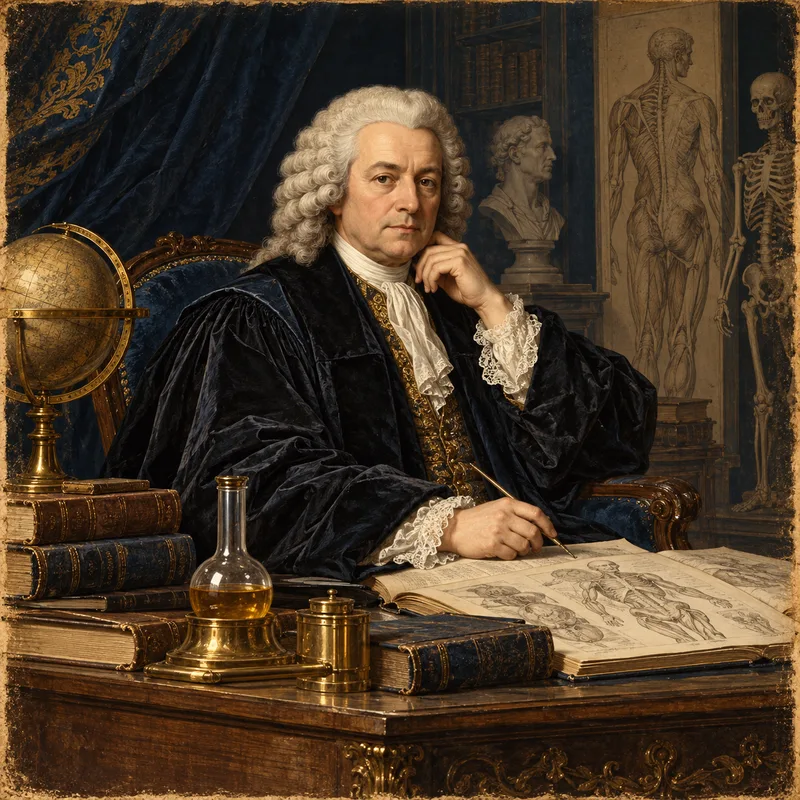
About the chemist
Georg Ernst Stahl
1659-1734 · Germany
Phlogiston theory