Biography · Chemist no. 60 of 350
Georg Wittig: The German Chemist Who Replaced C=O with C=C
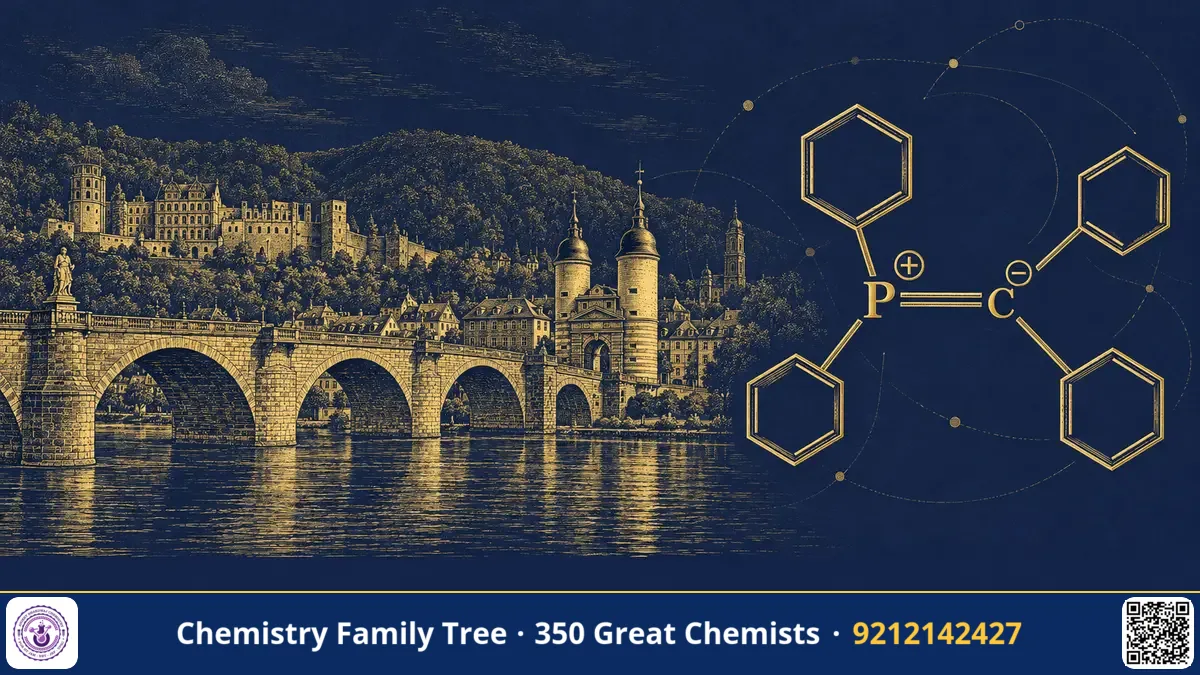
Georg Friedrich Karl Wittig (1897-1987) was a German organic chemist who introduced one of the most useful reactions in the synthesis of alkenes, the Wittig reaction. He also suggested benzyne as an intermediate and discovered the Wittig rearrangement of ethers. He won the Nobel Prize in Chemistry in 1979, together with Herbert C. Brown, when he was 82 years old. His life is a reminder that important discoveries can come late in a career: he was 57 when his most famous reaction was published. This biography tells his story and highlights what students can learn from it.
Early Life and Family
Wittig was born on 16 June 1897 in Berlin, Germany. His father, Gustav Wittig, was a professor at the School of Applied Arts in Kassel, and the family moved to Kassel when Georg was young; he grew up and went to school there. The family atmosphere was artistic, and he was interested in the arts and music as well as science. As a young man he also developed a deep love of nature and travel. His youth was shaped by the First World War, which interrupted his studies.
Education and Mentors
Wittig began studying chemistry at the University of Tübingen and then moved to the University of Marburg, where his studies were interrupted by military service during the First World War. After the war he completed his doctorate at Marburg in 1923 under Karl von Auwers, an organic chemist known for his work on stereochemistry and spectroscopy. He stayed on at Marburg and finished his Habilitation in 1926. In the 1920s and 30s he studied organolithium and organometallic compounds, and the stereochemistry of molecules, building the knowledge that led to his later discoveries.
Career Timeline
| Year | Event |
|---|---|
| 1897 | Born in Berlin (16 June) |
| 1923 | Doctorate at Marburg under Karl von Auwers |
| 1926 | Habilitation at Marburg |
| 1932 | Professor at the Technical University of Braunschweig |
| 1937 | Professor at the University of Freiburg |
| 1942 | Proposed benzyne as an intermediate |
| 1944 | Professor at the University of Tübingen |
| 1954 | Published the Wittig reaction with Georg Geissler |
| 1956 | Appointed to the chair at the University of Heidelberg |
| 1979 | Nobel Prize in Chemistry, shared with Herbert C. Brown |
| 1987 | Died in Heidelberg (26 August) |
Major Scientific Contributions
1. The Wittig reaction
The reaction of a phosphonium ylide with an aldehyde or ketone to give an alkene and triphenylphosphine oxide:
R2C=O + Ph3P=CHR' → R2C=CHR' + Ph3P=O
It fixes the position of the double bond precisely and can control E/Z geometry. The companion discovery post explains the mechanism in detail.
2. Benzyne
Wittig suggested that a reactive intermediate, 1,2-didehydrobenzene or benzyne, forms when fluorobenzene reacts with phenyllithium to give biphenyl. He trapped the intermediate with furan in a Diels-Alder reaction. Benzyne now appears in every textbook as the intermediate in the elimination-addition mechanism of nucleophilic aromatic substitution with strong bases such as NaNH2. Its formation was demonstrated convincingly by labelling experiments by J. D. Roberts in 1953.
3. Wittig rearrangement
Treatment of ethers with strong bases such as organolithium compounds leads to rearrangement to alkoxides, for example benzyl ethers to secondary alcohols after workup. Variants are the [1,2]- and the [2,3]-Wittig rearrangement.
4. Organolithium and "ate" complexes
Wittig carried out pioneering studies on metalation and halogen-metal exchange with organolithium reagents. These are now basic ideas in organometallic chemistry, used every day in the preparation of aryllithium and alkyllithium compounds.
Awards, Honours and Nobel Prize
The Nobel Prize in Chemistry 1979 was shared between Herbert C. Brown and Georg Wittig "for their development of the use of boron- and phosphorus-containing compounds, respectively, into important reagents in organic synthesis". Wittig was 82 and was one of the oldest chemists to receive the prize at that time. He also received honorary doctorates from several universities and was recognised by scientific academies and societies, but the Nobel Prize remains the highlight of his career.
Personality, Struggles and Lesser-Known Facts
- Late success: His most famous reaction was published at age 57, and his Nobel Prize came 25 years later. Persistence mattered more than speed in his career.
- War and disruption: His career spanned two world wars. His studies were interrupted by the first, and the second disrupted German universities. He moved between several institutions, including Braunschweig, Freiburg and Tübingen, before settling in Heidelberg.
- Cultured scientist: Growing up in an artistic family, he stayed interested in culture and the arts all his life.
- Credit to co-workers: He often acknowledged his students and co-workers, including Georg Geissler, who carried out the early Wittig reaction experiments.
- Unexpected path: The ylide chemistry grew from his study of what happens when quaternary ammonium compounds are treated with strong bases. He then asked the same question about the phosphorus analogues, and a famous reaction was born.
Legacy and Influence on Modern Chemistry
The Wittig reaction is one of the most used reactions for alkene formation. It is used in making vitamin A, carotenoids, pheromones and countless drug and natural product intermediates. Its variants, such as Horner-Wadsworth-Emmons and the Schlosser modification, extended its scope. The idea of ylides also led to sulfur ylide chemistry (Corey-Chaykovsky epoxidation). Benzyne chemistry is now used to build complex aromatic compounds. Wittig's work shows how heteroatoms such as phosphorus can serve as design elements for new organic transformations.
Lessons for Students
- Ask "what if" questions: Wittig asked what would happen if phosphorus replaced nitrogen in known ammonium chemistry.
- Do not rush: His best-known reaction came at 57, and his Nobel Prize at 82.
- Trust good experiments: Benzyne was first a proposal, then confirmed by labelling experiments by others.
- Remember the arts: A broad background in culture can enrich scientific imagination.
Quick Facts Box
- Born: 16 June 1897, Berlin, Germany
- Died: 26 August 1987, Heidelberg, Germany
- Nationality: German
- Field: Organic and organometallic chemistry
- Famous for: Wittig reaction, Wittig rearrangement, benzyne
- Nobel Prize: Chemistry 1979 (shared with Herbert C. Brown)
FAQ
When was the Wittig reaction discovered?
It was published in 1954 by Georg Wittig and Georg Geissler, while Wittig was at the University of Tübingen.
Why did Wittig share the Nobel Prize with Brown?
Brown was honoured for boron reagents and Wittig for phosphorus reagents. Both developed new reagents that became essential in organic synthesis.
What is benzyne?
Benzyne is a highly reactive intermediate with a formal triple bond in a benzene ring. Wittig proposed it in 1942, and it appears in the elimination-addition mechanism of aryl halides with strong bases.
Where did Wittig spend most of his career?
He held professorships at Braunschweig, Freiburg, Tübingen and, from 1956, Heidelberg, where he stayed until retirement.
Published by ABC Chemistry — IIT-JAM | CSIR-NET | GATE Chemistry Coaching. Visit abcchemistry.com
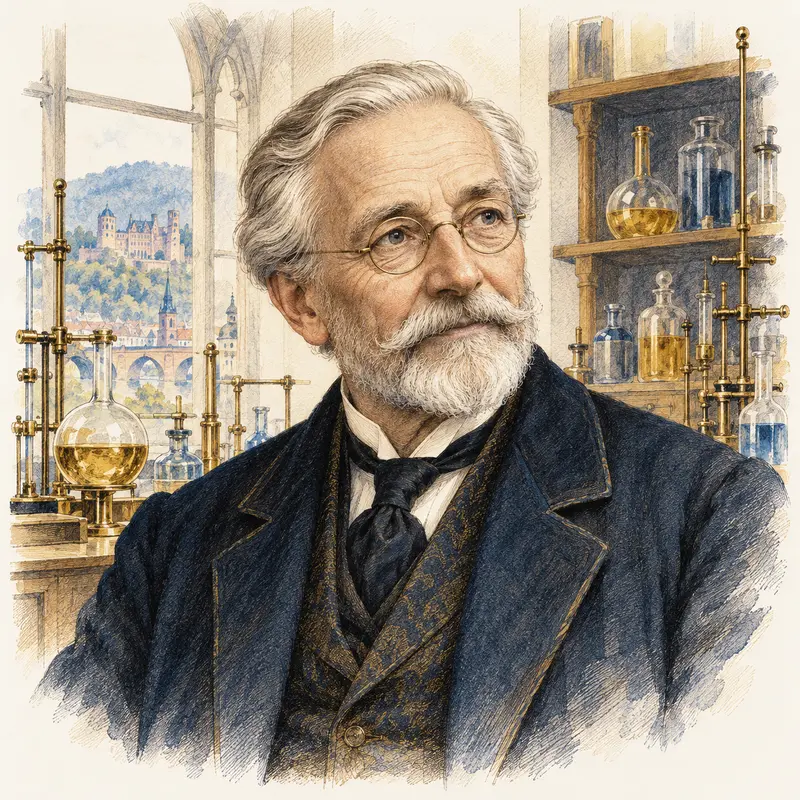
About the chemist
Georg Wittig
1897-1987 · Germany · Nobel Chemistry 1979
Wittig reaction