The discovery, explained · Chemist no. 60 of 350
The Wittig Reaction: Turning Aldehydes and Ketones into Alkenes with Precision
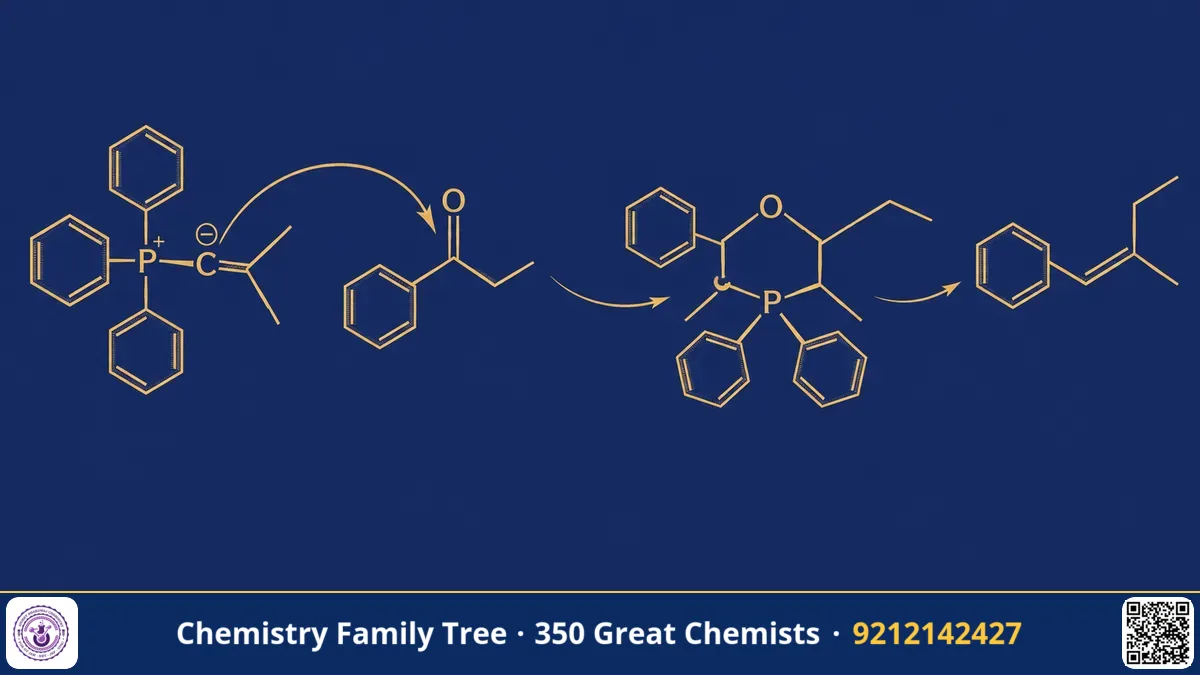
Making a carbon-carbon double bond exactly where you want it is one of the most important tasks in organic synthesis. Before 1954 the common methods, such as dehydration of alcohols or dehydrohalogenation, gave mixtures of isomeric alkenes because the double bond could end up in several positions. Then the German chemist Georg Wittig and his co-worker Georg Geissler reported a reaction in which a carbonyl group (C=O) is replaced by C=C, with the double bond forming at exactly the position where the carbonyl was. The Wittig reaction won Wittig the Nobel Prize in Chemistry in 1979, shared with Herbert C. Brown. It is among the top named reactions for JAM, NET and GATE.
The Scientific Problem Before the Discovery
Elimination reactions follow Zaitsev's rule, so a mixture of alkenes is common, and the position of the double bond depends on conditions. The Grignard reaction followed by dehydration also gives mixtures and sometimes rearrangements. Chemists wanted a method that would convert C=O directly to C=C at a fixed position, preferably under mild conditions and with some control over cis/trans geometry. Wittig had been studying organolithium compounds and quaternary ammonium salts, and wondered about the analogous phosphorus compounds and what they would do.
The Discovery: Step by Step
- Phosphonium salts: Wittig prepared phosphonium salts by reacting triphenylphosphine with an alkyl halide. This is an SN2 reaction of the phosphorus lone pair.
- Ylide formation: Treating the salt with a strong base (such as phenyllithium or n-butyllithium) removes a proton from the carbon next to phosphorus and gives a neutral species with adjacent positive and negative charges, called a phosphonium ylide (or phosphorane).
- Reaction with a carbonyl compound: Wittig and Geissler found that methylenetriphenylphosphorane reacts with benzophenone to give 1,1-diphenylethene and triphenylphosphine oxide. This was published in 1953-1954.
- Generalisation: The reaction worked with a wide range of aldehydes and ketones, and the position of the new double bond is exactly fixed.
Ph3P + CH3Br  →  [Ph3P+-CH3] Br-          (phosphonium salt)
[Ph3P+-CH3] Br- + BuLi  →  Ph3P=CH2 ↔ Ph3P+-CH2-   (ylide) + BuH + LiBr
Ph3P=CH2 + Ph2C=O  →  Ph2C=CH2 + Ph3P=O
The Chemistry Behind It
Mechanism
- The nucleophilic carbon of the ylide attacks the electrophilic carbonyl carbon. This forms a dipolar intermediate (betaine) or, as most modern evidence suggests under salt-free conditions, goes directly through a [2+2] cycloaddition.
- A four-membered ring, the oxaphosphetane, containing P, C, C and O is formed.
- The ring collapses, breaking the C-P and C-O bonds in a retro-[2+2] step, to give the alkene and triphenylphosphine oxide.
The driving force of the reaction is the formation of the very strong phosphorus-oxygen double bond in Ph3P=O. This is a typical example of the "oxophilicity" of phosphorus.
Stereochemistry (E/Z selectivity)
| Type of ylide | Group on carbanion carbon | Main product |
|---|---|---|
| Non-stabilised | Alkyl, H | Z (cis) alkene |
| Semi-stabilised | Aryl, vinyl | Mixture of E and Z |
| Stabilised | C=O, CO2R, CN | E (trans) alkene |
Stabilised ylides are less reactive and the reaction is reversible, giving the more stable E isomer. For non-stabilised ylides, the reaction is under kinetic control and gives cis-oxaphosphetane and hence the Z alkene. The Schlosser modification uses extra lithium base at low temperature to obtain the E alkene from non-stabilised ylides.
Examples
cyclohexanone + Ph3P=CH2  →  methylenecyclohexane + Ph3P=O
PhCHO + Ph3P=CH-CO2Et    →  PhCH=CH-CO2Et (E, ethyl cinnamate) + Ph3P=O
Note that methylenecyclohexane, an exocyclic alkene, cannot easily be made by elimination, since the more stable endocyclic alkene (1-methylcyclohexene) would form instead. The Wittig reaction gives the less stable product selectively.
Limitations
- Triphenylphosphine oxide is a by-product that must be separated from the product.
- Hindered ketones with stabilised ylides react slowly.
- Poor atom economy, since a large phosphorus by-product is formed.
Related Wittig chemistry
Wittig also discovered the Wittig rearrangement, in which an ether is deprotonated by a strong base and rearranges to an alkoxide ([1,2]-shift, or [2,3] for allylic ethers), and he proposed benzyne (1,2-didehydrobenzene) as a reactive intermediate in 1942. The related Horner-Wadsworth-Emmons reaction uses phosphonate carbanions and gives mostly E-alkenes, with a water-soluble by-product that is easy to remove.
Applications Today
- Vitamin A manufacture: The industrial synthesis of vitamin A (retinol/retinyl acetate) at BASF uses a Wittig reaction between a C15 phosphonium salt and a C5 aldehyde.
- Carotenoids: β-carotene, used as a food colour and vitamin A precursor, is made industrially on a large scale using a Wittig-type coupling.
- Insect pheromones: Z-alkenes such as the housefly sex pheromone muscalure, (Z)-tricos-9-ene, are made by Wittig reaction with non-stabilised ylides. These are used in eco-friendly pest traps.
- Drug and natural product synthesis: The reaction is used in steroid, prostaglandin and leukotriene chemistry and in countless total syntheses.
- Polymer and dye chemistry: Conjugated molecules for dyes and fluorescent materials are built with Wittig-type reactions.
Exam Corner
- Wittig reaction: aldehyde or ketone + phosphonium ylide → alkene + Ph3P=O.
- Ylide preparation: Ph3P + RCH2X → phosphonium salt; strong base (BuLi, NaH, NaNH2) → ylide.
- Non-stabilised ylide gives Z-alkene; stabilised ylide gives E-alkene.
- Intermediate: oxaphosphetane (four-membered ring).
- The double bond forms exactly where the C=O was, so Wittig reaction is useful for making exocyclic alkenes.
Common Misconceptions
- "The ylide is a free carbanion." It is a resonance hybrid of ylide (P+-C-) and ylene (P=C) forms and is neutral overall.
- "The driving force is alkene formation." The main driving force is the very strong P=O bond formed in the by-product.
- "Wittig gives only trans alkenes." Non-stabilised ylides usually give cis (Z) alkenes.
Quick Revision Box
- Wittig reaction (1954): carbonyl → alkene using phosphonium ylide.
- By-product: triphenylphosphine oxide; driving force: strong P=O bond.
- Four-membered oxaphosphetane intermediate.
- Non-stabilised → Z; stabilised → E; Schlosser modification gives E.
- Industrial use: vitamin A and β-carotene at BASF.
- Wittig shared the 1979 Nobel Prize in Chemistry with H. C. Brown.
FAQ
What is a phosphonium ylide?
It is a neutral molecule with a negatively charged carbon directly attached to a positively charged phosphorus atom. It acts as a carbon nucleophile.
Why is a strong base needed?
The C-H protons next to the phosphonium group are only weakly acidic, so strong bases such as n-BuLi or NaH are needed for simple alkyl ylides. Stabilised ylides need only weaker bases such as NaOH or K2CO3.
What is the Wittig reaction used for in industry?
Mainly in the synthesis of vitamin A, carotenoids and other conjugated alkenes.
How is Wittig different from Grignard reaction?
A Grignard reagent adds to C=O to give an alcohol, whereas a Wittig reagent replaces C=O by C=C to give an alkene.
Published by ABC Chemistry — IIT-JAM | CSIR-NET | GATE Chemistry Coaching. Visit abcchemistry.com
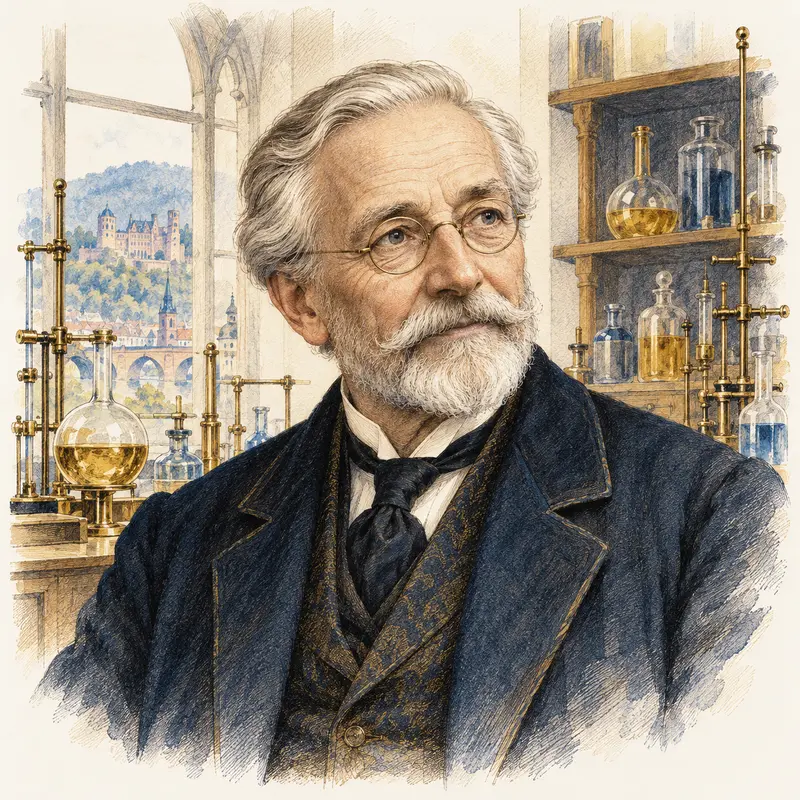
About the chemist
Georg Wittig
1897-1987 · Germany · Nobel Chemistry 1979
Wittig reaction