Biography · Chemist no. 119 of 350
George de Hevesy: Hungarian Pioneer of the Radioactive Tracer
George de Hevesy (1885-1966), born György Hevesy in Budapest, was a Hungarian radiochemist who spent his life in several European countries. He invented the radioactive tracer method, co-discovered the element hafnium, and started neutron activation analysis. He received the Nobel Prize in Chemistry for 1943, awarded in 1944. His legacy is nuclear medicine and all the labelled-atom experiments of modern biochemistry.
Early Life & Family
He was born on 1 August 1885 in Budapest, Hungary, as one of the children of a wealthy and well-regarded Hungarian Jewish family of landowners and industrialists. His father, Lajos Bischitz, and his mother, Eugenie (Jenny) Schossberger, came from prominent families. The family name was changed to Hevesy (and later the form "de Hevesy" was used abroad). He grew up in comfortable conditions and received an education at the Piarist Gymnasium in Budapest, a respected school of the Catholic Piarist order.
Later in life he married Pia Riis, a Danish woman, in 1924. The couple settled in Denmark, and they had four children. His family life was linked closely with Copenhagen, where he spent many years.
Education & Mentors
De Hevesy studied at the University of Budapest for a year, and then went to Berlin for a short period before moving to the University of Freiburg in Germany. He earned his doctorate in 1908 in physical chemistry. After that he worked at the Technical University of Zürich for a short time, and then in Karlsruhe with Fritz Haber, later a Nobel laureate (1918).
The most important mentor for his future work was Ernest Rutherford. In 1911 he went to Manchester to work in Rutherford's laboratory, where radioactivity and the atomic nucleus were at the centre of research. In Manchester he met Niels Bohr, and a friendship began which later took him to Copenhagen. A later teacher and partner was Friedrich Paneth in Vienna.
Career Timeline
| Year | Event |
|---|---|
| 1885 | Born in Budapest, Austria-Hungary |
| 1908 | Doctorate at Freiburg |
| 1911-1913 | Works with Rutherford in Manchester |
| 1913 | With Friedrich Paneth in Vienna, uses radium D as an indicator for lead |
| 1920 | Joins Niels Bohr's institute in Copenhagen |
| 1923 | Discovers hafnium with Dirk Coster |
| 1926 | Professor of physical chemistry at Freiburg |
| 1934 | Leaves Germany and returns to Copenhagen |
| 1935 | Uses phosphorus-32 for studies in biology |
| 1936 | With Hilde Levi, introduces neutron activation analysis |
| 1943 | Flees Denmark to Sweden |
| 1944 | Receives the Nobel Prize in Chemistry (for 1943) |
| 1943-1966 | Works at Stockholm University and its institutes |
| 1966 | Dies in Freiburg, West Germany |
Major Scientific Contributions
De Hevesy's work has three main strands, which are explained in our discovery post on tracers and hafnium.
- The tracer principle. From the failure to separate radium D from lead, he developed the idea of using radioactive isotopes to follow chemical and biological processes.
- Hafnium. With Dirk Coster, he found element 72 by X-ray spectroscopy and confirmed Bohr's idea that it is a homologue of zirconium and not a rare earth.
- Biological tracer studies. He used deuterium, phosphorus-32 and other isotopes to measure the turnover of water, bone and phosphates in living bodies and the synthesis of DNA.
- Neutron activation analysis. A very sensitive analysis for trace elements, introduced with Hilde Levi.
- X-ray fluorescence analysis. He also worked on the use of X-ray spectra for chemical analysis and on rare earths.
Awards, Honours & Nobel Prize
The Nobel Prize in Chemistry for 1943 was awarded to George de Hevesy "for his work on the use of isotopes as tracers in the study of chemical processes". Because of the Second World War, it was reserved for a year and presented in 1944. He was elected a Foreign Member of the Royal Society and received other prizes, including the Copley Medal of the Royal Society in 1949, and the Atoms for Peace Award in 1959. The element hevesium has not been named, but the Hevesy Medal is awarded for achievements in nuclear and radioanalytical chemistry.
Personality, Struggles & Lesser-Known Facts
- Medals in acid. When German forces occupied Denmark in 1940, de Hevesy dissolved the gold Nobel medals of Max von Laue and James Franck in aqua regia, because it was illegal to take gold out of Germany and the medals could expose their owners. He left the solution on a shelf in Bohr's institute. After the war, the gold was recovered from the solution, and the Nobel Foundation recast the medals and returned them to the winners.
- A tale of the boarding house. A story often told is that in Manchester he suspected his landlady of serving leftover food, and secretly added a radioactive tracer to a meal he left. A few days later it was detected in a new dish, which proved his suspicion. The tale shows how the tracer principle works, though it is anecdotal.
- Persistent failure turned to success. The year-long failure to separate radium D from lead led to the tracer method.
- Escape from the Nazis. Because of his Jewish family background, he left Freiburg in 1934 after the Nazi laws, and later fled Denmark for Sweden in 1943.
- A cosmopolitan life. He worked in Hungary, Germany, Switzerland, England, Austria, Denmark and Sweden, and spoke several languages.
Legacy & Influence on Modern Chemistry
The tracer method is one of the most widely used ideas in chemistry, biology and medicine. Without it, we would not have PET scans, thyroid treatment with iodine-131, the study of metabolic pathways with carbon-14,. Neutron activation analysis is used in forensic science, archaeology and environmental monitoring. The element hafnium is used in nuclear reactor control rods and in modern computer chips. In India, nuclear medicine and isotope laboratories, including those at the Bhabha Atomic Research Centre, work on the same foundation.
Lessons for Students
- A failed experiment can hold a new idea. His inability to separate two substances showed that they were chemically identical.
- Learn across disciplines. He moved among chemistry, physics, biology and medicine.
- Be resourceful in difficult times. He protected the medals with simple chemistry.
- Choose good teachers and partners. Rutherford, Bohr and Coster all shaped his path.
Quick Facts Box
- Born: 1 August 1885, Budapest, Austria-Hungary
- Died: 5 July 1966, Freiburg im Breisgau, West Germany
- Nationality: Hungarian
- Field: Radiochemistry, physical chemistry
- Famous for: Radioactive tracer method, discovery of hafnium
- Nobel: Chemistry, 1943 (presented 1944)
FAQ
What happened to the Nobel medals that de Hevesy dissolved?
After the war the gold was precipitated from the aqua regia solution and returned to the Nobel Foundation, which recast the medals for Laue and Franck.
Who discovered hafnium?
Dirk Coster and George de Hevesy found it in Copenhagen in 1923 by X-ray spectroscopy.
Which scientist guided de Hevesy in Manchester?
Ernest Rutherford, who gave him the problem of separating radium D from lead.
What is the practical use of his tracer method today?
Nuclear medicine imaging and therapy, reaction mechanism studies, agriculture and environmental research.
Published by ABC Chemistry — IIT-JAM | CSIR-NET | GATE Chemistry Coaching. Visit abcchemistry.com
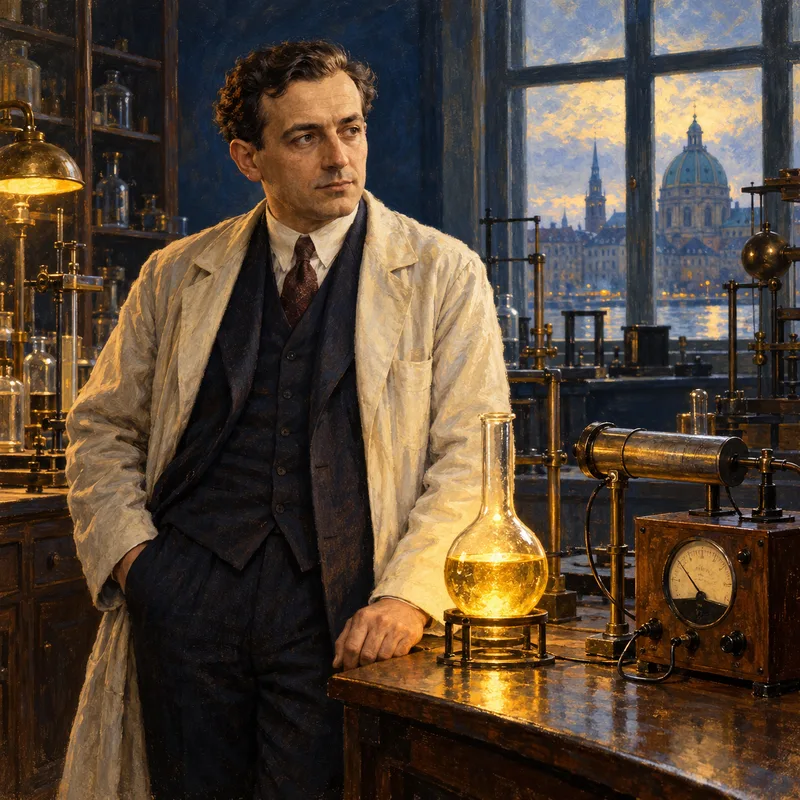
About the chemist
George de Hevesy
1885-1966 · Hungary · Nobel Chemistry 1943
Radioactive tracers, hafnium discovery