The discovery, explained · Chemist no. 119 of 350
George de Hevesy: How a Radioactive Atom Became a Spy Inside Living Things
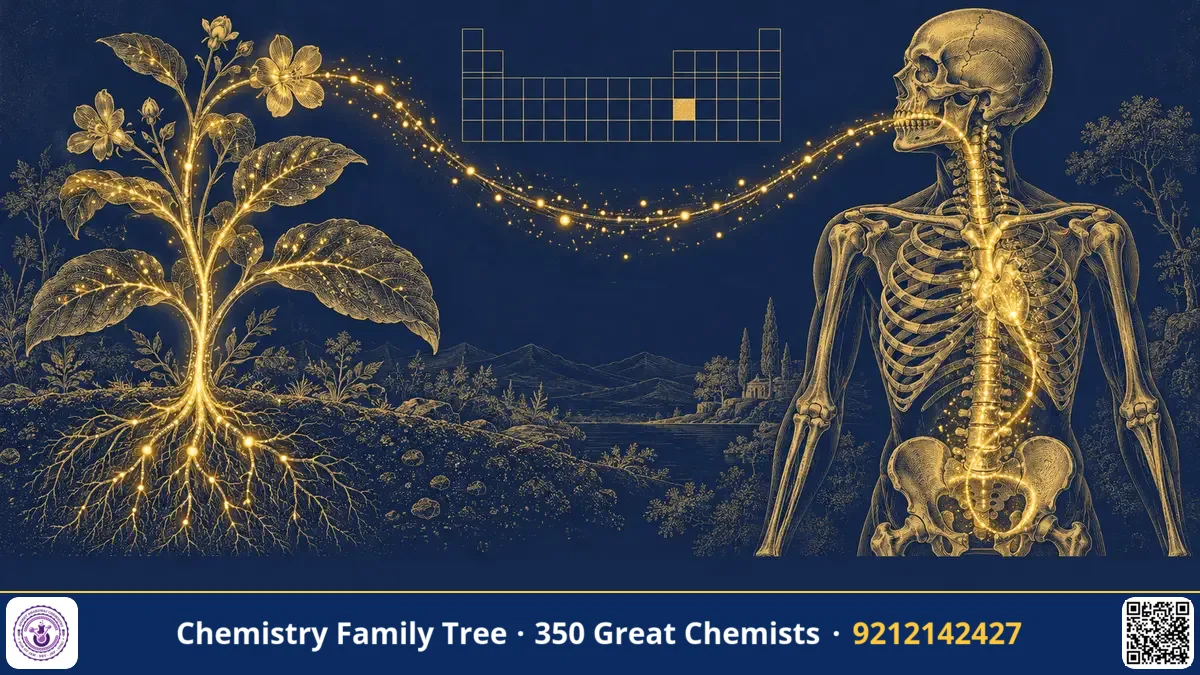
How can a scientist follow one atom of phosphorus as it travels through a plant, a rat or the human body? The answer is to make that atom radioactive, so that its position can be detected from outside with a counter. This is the radioactive tracer method, and it was invented by the Hungarian chemist George de Hevesy in the years around 1913. He also took part in the discovery of the element hafnium (atomic number 72) in 1923 and started the technique that we now call neutron activation analysis. For "his work on the use of isotopes as tracers in the study of chemical processes" he received the Nobel Prize in Chemistry for 1943. This post explains how the tracer idea works and where it is used.
The Scientific Problem Before the Discovery
In the early years of the twentieth century, radioactivity was a new field. Rutherford and Soddy had shown that radioactive elements change into other elements, and by 1910 chemists had found dozens of radioelements with different half-lives, with names such as radium D, radium E, thorium B and so on. Many of them could not be separated from ordinary elements by any chemical method. For example, radium D (later identified as lead-210) always stayed with ordinary lead.
- Chemists could not tell whether these were different elements or simply forms of known ones.
- This puzzle was solved only when Soddy proposed the idea of isotopes in 1913: atoms with the same atomic number, so the same chemistry, but different atomic mass.
- A separate problem existed in biology and chemistry. If you add salt to water, you cannot see where individual atoms go. Ordinary balances and chemical analysis could only give total amounts and could not distinguish an "old" atom from a "new" one of the same element.
The Discovery: Step by Step
From a failed separation to a new method
In 1911 de Hevesy came to Manchester to work with Ernest Rutherford. Rutherford gave him a task: to separate radium D from a large amount of lead that had been given to him. De Hevesy tried many chemical methods for more than a year and failed. The failure was the discovery. Radium D and lead are chemically inseparable because they are isotopes of the same element.
De Hevesy then saw the opportunity. If radium D is chemically identical to lead, then it can be mixed with ordinary lead and used as a marker. The tiny radioactivity tells where the lead goes, while the chemistry follows that of lead. In 1913 de Hevesy and Friedrich Paneth, working in Vienna, used radium D to measure the very low solubility of lead sulfide and lead chromate, which was too small to determine by usual chemical analysis.
Rules of the tracer method
- Choose a radioactive isotope of the element to be studied (for example, phosphorus-32 or iodine-131).
- Mix a small amount with the ordinary element, so that the chemical behaviour is not changed by the tracer.
- Introduce the mixture into the system: a solution, a plant, an animal.
- Detect the radiation with an electroscope, Geiger counter or scintillation counter at different places and times.
- Calculate how much of the labelled material has moved, and where.
Applications by de Hevesy himself
In the 1920s de Hevesy used radioactive lead to follow the uptake of lead in bean plants, one of the first biological tracer experiments. In the 1930s, using heavy water (deuterium oxide) and later radioactive phosphorus-32 (made in the cyclotron), he showed that the atoms of the body are in constant exchange. The phosphorus in bone is not fixed but is replaced slowly, and the water in the human body is renewed with a half-time of a few days. This overturned the belief that bone and tissue are static. Phosphorus-32 decays by beta emission with a half-life of 14.3 days:
³²₁₅P → ³²₁₆S + β⁻ + antineutrino (t½ = 14.3 days)
Hafnium
In the early 1920s the Bohr model of the atom suggested that element 72 should be like zirconium (Group 4), not a rare earth, as many chemists believed. In Copenhagen de Hevesy and the Dutch physicist Dirk Coster examined zirconium ores from Norway and Greenland using X-ray spectroscopy. Moseley's law relates the frequency of the characteristic X-rays to atomic number:
√ν = a (Z − b)
They found the expected X-ray lines of element 72 and named the new element hafnium after Hafnia, the Latin name of Copenhagen. Hafnium is always found with zirconium in minerals because lanthanide contraction makes their ionic radii nearly equal (Zr⁴⁺ 0.72 Å and Hf⁴⁺ 0.71 Å), so their chemistry is very similar.
Neutron activation analysis
In 1936 de Hevesy and Hilde Levi showed that when a sample is placed in a neutron beam, some atoms capture neutrons and become radioactive, for example dysprosium and europium. The radiation then identifies and measures the element, even at extremely low concentration. This is neutron activation analysis (NAA).
¹⁶⁴Dy + n → ¹⁶⁵Dy* → ¹⁶⁵Ho + β⁻ (radioactive, measured by its decay)
The Chemistry Behind It
Why tracers work. Chemical behaviour is determined by electrons, so isotopes of an element have almost the same chemistry. This means a radioactive atom is carried along with ordinary atoms of the same element. The small differences in mass give a kinetic isotope effect, which is large only for hydrogen and its isotopes, and is small for heavier elements.
Isotope dilution. If a known amount of a radioactive isotope is added to an unknown amount of the same element in a sample, the dilution of the activity gives the total amount: if a sample has activity A₀ in mass m₀ of tracer and after mixing the specific activity is S, then the unknown mass is found from the loss of specific activity. This method is valuable when an element cannot be separated completely.
Half-life. Radioactive decay obeys first-order kinetics, N = N₀e^(−λt), with t½ = 0.693/λ. Good tracers have a half-life long enough for the experiment but short enough that the patient or sample is not exposed to radiation for long.
Applications Today
- Nuclear medicine. Technetium-99m is used in millions of diagnostic scans each year, iodine-131 treats hyperthyroidism and thyroid cancer, and fluorine-18 is the label in PET scans with fluorodeoxyglucose (FDG). India's Bhabha Atomic Research Centre produces medical isotopes.
- Agriculture. Phosphorus-32 helps to study how crops take up fertiliser.
- Chemistry. Isotopic labelling with ¹⁴C, ²H and ¹⁸O is used to find the mechanisms of reactions, for example showing that the oxygen in an ester comes from the acid or the alcohol.
- Environment and archaeology. Neutron activation analysis finds trace elements in pottery, hair, meteorites and pollutants.
- Industry. Hafnium is used in control rods of nuclear reactors, because it absorbs neutrons well, and in high-temperature alloys and microchip insulators (hafnium oxide).
Exam Corner
- Hafnium (Z = 72) was discovered in 1923 by Coster and de Hevesy using X-ray spectra; its name comes from Hafnia (Copenhagen).
- Zr and Hf have almost equal sizes because of the lanthanide contraction, so they are very difficult to separate.
- A radioactive tracer has the same chemical behaviour as the ordinary isotope; the detection is by radiation.
- Phosphorus-32 is a β⁻ emitter with t½ = 14.3 days; iodine-131 has t½ about 8 days.
- De Hevesy's Nobel Prize in Chemistry was awarded in 1944 for the 1943 prize, for the use of isotopes as tracers.
Common Misconceptions
- "Tracer doses are dangerous." Tracer amounts are extremely small. The dose is chosen to give a measurable signal at minimum radiation exposure.
- "Hafnium is a rare earth element." It is a d-block metal in Group 4, below zirconium. Many chemists once believed it to be a rare earth, which delayed its discovery.
- "Isotopes of the same element differ in chemical properties." Their chemical properties are nearly identical. Only physical properties that depend on mass, such as diffusion rate or vibration frequency, differ.
Quick Revision Box
- Radioactive tracer method: de Hevesy and Paneth, 1913.
- Hafnium: Z = 72, discovered 1923 with Dirk Coster by Moseley-type X-ray analysis.
- Failed attempt to separate radium D from lead led to the tracer idea.
- Neutron activation analysis: de Hevesy and Levi, 1936.
- Isotope dilution gives the amount of an element in a mixture.
- Nobel Prize in Chemistry for 1943, awarded in 1944.
FAQ
What is a radioactive tracer?
It is a small amount of a radioactive isotope added to a system to follow the movement of the same element or compound by detecting its radiation.
Why is hafnium so similar to zirconium?
The 4f electrons poorly shield the nuclear charge, which gives the lanthanide contraction. This makes Hf⁴⁺ nearly the same size as Zr⁴⁺.
Is de Hevesy's Nobel Prize in Chemistry or in Medicine?
It is the Nobel Prize in Chemistry. Although the tracer method is vital in medicine, the prize recognised the chemical use of isotopes.
How does neutron activation analysis work?
A sample is exposed to neutrons, some nuclei become radioactive, and the gamma rays or beta particles they emit act as a fingerprint of the element.
Published by ABC Chemistry — IIT-JAM | CSIR-NET | GATE Chemistry Coaching. Visit abcchemistry.com
About the chemist
George de Hevesy
1885-1966 · Hungary · Nobel Chemistry 1943
Radioactive tracers, hafnium discovery