Biography · Chemist no. 165 of 350
George Olah: Complete Life and Legacy of the Carbocation Chemist
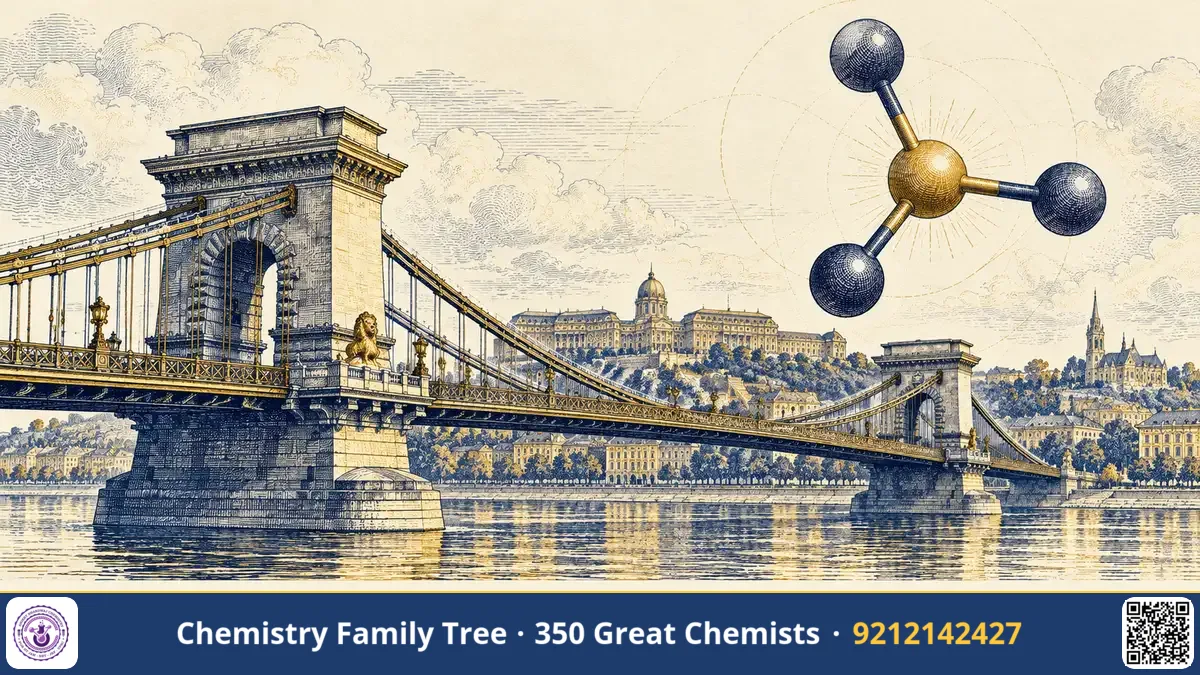
George Andrew Olah (1927–2017) was a Hungarian-born American organic chemist who made the invisible visible. Carbocations, the positively charged intermediates that every organic chemistry student draws, were thought to exist only for fleeting moments. Olah showed that in superacids they can be kept stable and studied by NMR. For this work he received the 1994 Nobel Prize in Chemistry on his own. In his later years he promoted the idea of a "methanol economy." His story, from a refugee fleeing Hungary in 1956 to a Nobel laureate in Los Angeles, is one of the most inspiring in modern chemistry.
Early Life and Family
George Olah (Hungarian name: Oláh György) was born on 22 May 1927 in Budapest, Hungary. He grew up in the city and attended the Piarist Gymnasium (high school), a respected Catholic school in Budapest. Even as a teenager he was interested in chemistry. He survived the difficult years of the Second World War in Budapest and then began his university studies in the post-war period, when Hungary was rebuilding under hard conditions.
Education and Mentors
Olah studied at the Technical University of Budapest. He worked under Géza Zemplén, a leading carbohydrate chemist, and obtained his doctorate in 1949. He then stayed at the university as a lecturer and professor of organic chemistry, and later worked at the Central Chemical Research Institute of the Hungarian Academy of Sciences. During these years he began research on Friedel–Crafts reactions and on fluorination, which led naturally to his interest in cations. His early work in Budapest on organic fluorine chemistry, including the use of boron trifluoride and hydrogen fluoride, prepared him for later work with strong Lewis acids.
Career Timeline
| Year | Event |
|---|---|
| 1927 | Born in Budapest, Hungary |
| 1949 | Doctorate, Technical University of Budapest |
| 1956 | Left Hungary after the uprising |
| 1957 | Joined Dow Chemical in Sarnia, Ontario, Canada |
| 1965 | Moved to Case Western Reserve University, Cleveland, Ohio |
| 1960s | Observed stable carbocations in superacids (magic acid) |
| 1977 | Joined the University of Southern California, Los Angeles |
| 1991 | Became director of the Loker Hydrocarbon Research Institute at USC |
| 1994 | Awarded the Nobel Prize in Chemistry |
| 2017 | Died on 8 March in Beverly Hills, California |
Major Scientific Contributions
Olah's greatest contribution is the direct observation and characterisation of carbocations in superacid media. Using SbF₅ and magic acid (HSO₃F–SbF₅), he prepared stable solutions of the tert-butyl cation and many others, and recorded their NMR spectra. He showed that simple alkyl cations are planar and sp² hybridised, and he gave experimental support to the idea of non-classical ions with three-centre, two-electron bonds, especially the 2-norbornyl cation, a subject of a famous debate with Herbert C. Brown, who favoured classical structures.
His other contributions include:
- Carbonium ions: Showing that alkanes, even methane, can be protonated in superacid to give five-coordinate species like CH₅⁺.
- Friedel–Crafts chemistry: A detailed study of the intermediates and mechanisms of these classical reactions.
- Superacid catalysis: Using strong acids to carry out hydrocarbon reactions under mild conditions.
- Methanol economy: A concept developed with Alain Goeppert and G. K. Surya Prakash in which methanol, made from carbon dioxide and hydrogen, serves as a fuel and a chemical feedstock.
- Textbooks and training: More than a thousand publications and many students who became leaders in organic chemistry.
Awards, Honours and Nobel Prize
The Nobel Prize in Chemistry 1994 was awarded to George A. Olah "for his contribution to carbocation chemistry." It was a Chemistry prize awarded to him alone. He also received the Priestley Medal of the American Chemical Society (2005), and was a member of the US National Academy of Sciences and the Hungarian Academy of Sciences, among many honours.
Personality, Struggles and Lesser-Known Facts
- Refugee scientist: After the 1956 Hungarian uprising was crushed, he left Hungary with his wife Judith and their family and went to Canada, with a determination to continue his research.
- The candle story: The name "magic acid" came from the day a piece of candle dissolved in the acid, a story that shows how a casual observation can reveal the power of a method.
- A famous scientific debate: His discussions with Nobel laureate H. C. Brown about the 2-norbornyl cation were intense and long-running, though always scientific. Later data from many methods supported the non-classical picture.
- Industry experience: He worked at Dow Chemical in Canada before returning to academia, and had a strong sense of practical applications.
- Long productive life: He continued working into his late eighties, and published on energy and carbon dioxide recycling in his last years.
Legacy and Influence on Modern Chemistry
Olah's work changed organic chemistry from a subject based on inferred intermediates to one with directly observed species. His carbocation studies explain rearrangements, SN1 and E1 reactions, electrophilic aromatic substitution and polymerisation. Superacid chemistry is applied in the oil industry for converting hydrocarbons to higher-octane fuels. His methanol economy proposal tries to answer two modern problems at once: how to use carbon dioxide and how to store renewable energy in liquid form. Whether or not it is adopted worldwide, it has influenced work on CO₂ hydrogenation and fuel cells in many countries, including India, where methanol blending in fuel has been discussed. For Indian students, the organic mechanism chapters in JAM, NET and GATE are better understood when you remember that these species have been observed.
Lessons for Students
- Make the unobservable observable. Choose conditions that change the lifetime of a species.
- Persist through change. Olah rebuilt his career after leaving his homeland.
- Welcome debate. Disagreement with strong opponents sharpened the evidence.
- Link basic and applied science. Studies of cations led to useful catalysts and later to ideas about energy.
Quick Facts Box
- Born: 22 May 1927, Budapest, Hungary
- Died: 8 March 2017, Beverly Hills, California, USA
- Nationality: Hungarian-born American
- Field: Organic chemistry, physical organic chemistry
- Famous for: Stable carbocations in superacids; magic acid; methanol economy
- Nobel: 1994, Chemistry (awarded alone)
FAQ
Why did Olah leave Hungary?
He left in 1956 after the Hungarian uprising was suppressed, and moved to Canada with his family.
Where did Olah work in the United States?
At Case Western Reserve University in Cleveland, and from 1977 at the University of Southern California in Los Angeles.
What is the methanol economy?
A proposal to use methanol, made from carbon dioxide and hydrogen, as a fuel and as a raw material for chemicals.
Was the Nobel Prize shared?
No. George Olah received the 1994 Nobel Prize in Chemistry alone.
Published by ABC Chemistry — IIT-JAM | CSIR-NET | GATE Chemistry Coaching. Visit abcchemistry.com
About the chemist
George Olah
1927-2017 · United States · Nobel Chemistry 1994
Carbocation chemistry, superacids