The discovery, explained · Chemist no. 165 of 350
George Olah and Superacids: Seeing Carbocations That Others Could Only Imagine
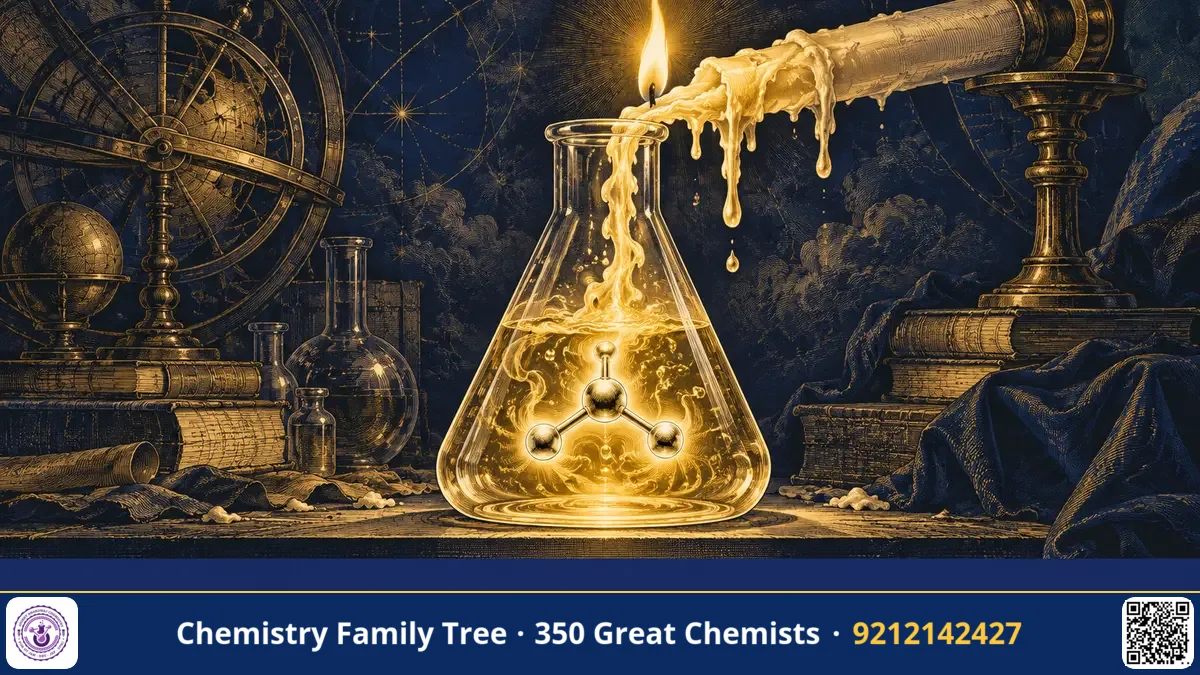
Open any organic chemistry book and you will meet carbocations: SN1 reactions, E1 eliminations, Friedel–Crafts alkylation, Markovnikov addition and rearrangements all pass through them. For decades, these positively charged carbon species were written in mechanisms but never directly seen, because they react in a fraction of a second. George A. Olah solved the problem by dissolving them in extremely strong acids, called superacids, in which nothing is left to react with them. Under these conditions carbocations become stable enough to be studied by NMR and other spectroscopy. For this work on carbocation chemistry, Olah received the 1994 Nobel Prize in Chemistry, unshared.
The Scientific Problem Before the Discovery
By the 1940s, physical organic chemists such as Christopher Ingold, Frank Whitmore and others had proposed that many reactions involve carbocation intermediates. For example, SN1 hydrolysis of tert-butyl chloride:
(CH₃)₃C–Cl → (CH₃)₃C⁺ + Cl⁻ (slow)
(CH₃)₃C⁺ + H₂O → (CH₃)₃C–OH₂⁺ → (CH₃)₃C–OH + H⁺ (fast)
Evidence was indirect: kinetics, stereochemistry and product studies. Nobody had isolated or observed such a cation. In ordinary solvents, the cation is attacked by any nucleophile, loses a proton to form an alkene, or rearranges within microseconds. There was also an ongoing debate about the structure of some cations, such as the 2-norbornyl cation: is it a pair of rapidly equilibrating classical cations, or a single "non-classical" species with a delocalised three-centre, two-electron bond? Direct observation was needed.
The Discovery: Taming Cations in Superacids
In the 1960s Olah, then working at Dow Chemical in Canada and later at Case Western Reserve University in the United States, realised that a medium with extremely low nucleophilicity and very high acidity could keep carbocations alive. His team used strong Lewis acids such as antimony pentafluoride (SbF₅) and solvents such as liquid sulfur dioxide or sulfuryl chloride fluoride at low temperatures. The key steps are as follows.
- Choose a precursor. For example, tert-butyl fluoride, (CH₃)₃C–F.
- Add a strong Lewis acid. SbF₅ removes fluoride, forming the very stable hexafluoroantimonate anion: (CH₃)₃C–F + SbF₅ → (CH₃)₃C⁺ SbF₆⁻.
- Use a non-nucleophilic medium. SbF₆⁻ is an extremely poor nucleophile, so the cation survives.
- Record spectra. ¹H NMR of the solution shows a single sharp signal at very low field (about δ 4.3), consistent with nine equivalent protons on a positively charged species. ¹³C NMR shows the central carbon far downfield (about δ 330).
The most famous superacid is magic acid, a mixture of fluorosulfonic acid and antimony pentafluoride (HSO₃F–SbF₅). The name came about in the 1960s when a co-worker of Olah's group placed a piece of a paraffin candle in the acid at a laboratory party. The candle dissolved and the NMR spectrum showed the tert-butyl cation, which meant the acid was strong enough to protonate and cleave an alkane. Superacids are defined as acids stronger than 100% sulfuric acid.
Olah's group went on to observe a large range of cations: secondary and tertiary alkyl cations, the allyl and benzyl cations, arenium ions (the intermediates in electrophilic aromatic substitution), and the 2-norbornyl cation. They also showed that even alkanes can be protonated in superacids to give carbonium ions (five-coordinate carbon) such as CH₅⁺:
CH₄ + H⁺ → CH₅⁺
The Chemistry Behind It
| Term | Meaning |
|---|---|
| Carbenium ion (classical carbocation) | Trivalent carbon with a positive charge, such as (CH₃)₃C⁺; sp² hybridised, planar, empty p orbital |
| Carbonium ion (non-classical) | Five-coordinate carbon with a three-centre two-electron bond, such as CH₅⁺ |
| Superacid | Acid stronger than 100% H₂SO₄ (Hammett acidity H₀ below −12) |
| Non-nucleophilic anion | Anions such as SbF₆⁻ that do not attack the cation |
The stability order of alkyl cations, tertiary > secondary > primary > methyl, is explained by hyperconjugation and the inductive effect of alkyl groups. Olah's NMR data gave direct physical evidence for this order, which until then was only a textbook rule.
Applications Today
- Petrochemicals: Superacid catalysis is related to isomerisation, cracking and alkylation reactions used to produce high-octane gasoline.
- Friedel–Crafts chemistry: Understanding of alkylation and acylation intermediates improved yields and selectivity.
- Polymer chemistry: Cationic polymerisation of alkenes and cyclic ethers.
- Methanol economy: Olah later promoted the idea of using methanol as a fuel and chemical feedstock, including methanol made from carbon dioxide and hydrogen.
- Teaching: The existence of carbocations as real species gives students confidence in the mechanisms they learn.
Exam Corner
- George Olah received the 1994 Nobel Prize in Chemistry for his contribution to carbocation chemistry.
- Magic acid = HSO₃F + SbF₅; a superacid that can protonate alkanes.
- tert-Butyl cation is planar (sp²) with an empty p orbital; ¹³C NMR shows C⁺ at about 330 ppm.
- Stability: 3° > 2° > 1° > CH₃⁺ due to hyperconjugation and +I effect.
- Carbonium ions (such as CH₅⁺) have five-coordinate carbon with a 3c–2e bond.
Common Misconceptions
- "Carbocations can never be seen." In superacid media they can be observed for hours or longer.
- "Carbonium and carbenium are the same." Carbenium is three-coordinate; carbonium is five-coordinate.
- "Superacids are just very concentrated acids." They are defined by acidity beyond that of pure sulfuric acid and by non-nucleophilic counter-anions.
Quick Revision Box
- Olah: 1994 Nobel Prize in Chemistry, alone, for carbocations.
- Method: (CH₃)₃C–F + SbF₅ → (CH₃)₃C⁺ SbF₆⁻ in SO₂ClF at low temperature.
- Magic acid: HSO₃F–SbF₅.
- Carbenium: R₃C⁺ (planar). Carbonium: CH₅⁺ type (5-coordinate).
- NMR provided direct proof of carbocation structure.
- Later: methanol economy.
FAQ
Why do superacids keep carbocations stable?
They are so acidic and their anions so weakly nucleophilic that nothing is available to react with the cation.
Who named magic acid?
The name came from Olah's laboratory after the candle episode in the 1960s.
Did Olah win alone?
Yes, the 1994 Nobel Prize in Chemistry was awarded to him alone.
Which exam topics does this support?
Reaction intermediates, carbocation stability, rearrangements and NMR chemical shifts in organic chemistry papers.
Published by ABC Chemistry — IIT-JAM | CSIR-NET | GATE Chemistry Coaching. Visit abcchemistry.com
About the chemist
George Olah
1927-2017 · United States · Nobel Chemistry 1994
Carbocation chemistry, superacids