Biography · Chemist no. 138 of 350
George Porter, Baron Porter of Luddenham (1920-2002): Flash Photolysis Pioneer and Great Science Communicator
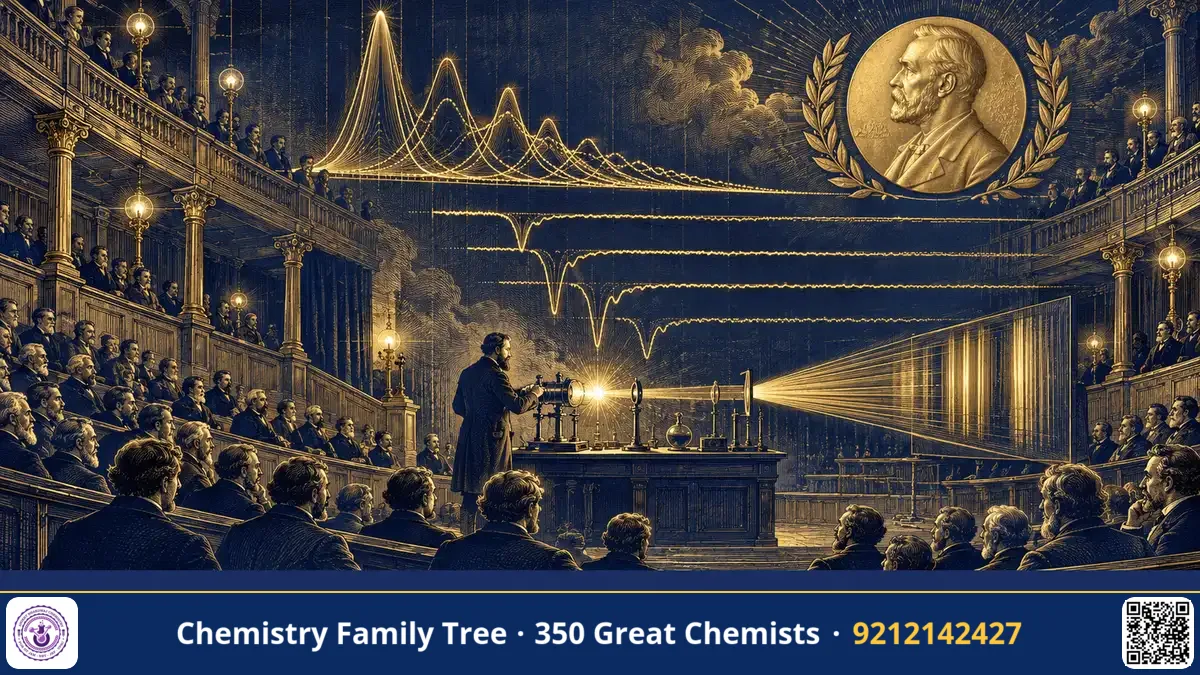
George Porter was a British physical chemist who, with Ronald Norrish, invented flash photolysis and so opened the study of the fastest events in chemistry. He shared the 1967 Nobel Prize in Chemistry with Norrish and Manfred Eigen. Porter then led the Royal Institution in London, served as President of the Royal Society, and became one of Britain's best-known communicators of science through lectures and television. His legacy in one line: he used light to reveal the short-lived molecules of chemistry, and he worked all his life to share science with the public.
Early Life and Family
Porter was born on 6 December 1920 in Stainforth, in the West Riding of Yorkshire, England. His family was of modest means and he was brought up in a Methodist home. He attended Thorne Grammar School, where his talent for chemistry showed early, and he won a scholarship to the University of Leeds.
Education and Mentors
Porter studied chemistry at the University of Leeds and graduated in 1941. The Second World War had begun, and he joined the Royal Naval Volunteer Reserve as a radar specialist, serving as a Lieutenant. Radar taught him electronics and the use of pulsed signals, skills that were essential for flash photolysis later. After the war, in 1946, he went to Cambridge as a research student under Ronald Norrish, and obtained his PhD in 1949. He remained at Cambridge as a demonstrator and lecturer until 1954. Norrish was his main mentor, and their collaboration produced the Nobel-winning technique.
Career Timeline
| Year | Event |
|---|---|
| 1920 | Born in Stainforth, Yorkshire |
| 1941 | Graduates from the University of Leeds; joins the Royal Navy Volunteer Reserve as a radar officer |
| 1946-1949 | Research student at Cambridge under Ronald Norrish; PhD in 1949 |
| 1949-1950 | Co-develops flash photolysis with Norrish |
| 1955 | Becomes Professor of Physical Chemistry (Firth Professor) at the University of Sheffield |
| 1960 | Elected Fellow of the Royal Society |
| 1966 | Director of the Royal Institution and Fullerian Professor of Chemistry |
| 1967 | Shares the Nobel Prize in Chemistry |
| 1972 | Knighted |
| 1985-1990 | President of the Royal Society |
| 1990 | Created a life peer, Baron Porter of Luddenham |
| 2002 | Dies in Canterbury, Kent |
Major Scientific Contributions
Flash photolysis. Porter and Norrish built the first apparatus where a bright flash produced transient species and a delayed flash recorded their absorption spectrum. They detected the ClO radical and many other intermediates.
Triplet states. Porter showed that triplet states of organic molecules could be seen in fluid solution at room temperature by their triplet-triplet absorption, and he measured their lifetimes and how oxygen and other quenchers shorten them. This helped to place the Jablonski scheme on firm experimental ground.
Time-resolution. Under Porter's leadership, the technique moved from microseconds to nanoseconds and picoseconds, using lasers instead of lamps.
Photosynthesis and solar energy. In his later years at the Royal Institution he worked on the primary processes of photosynthesis, chlorophyll photochemistry and models for artificial photosynthesis. He argued that humanity would eventually need to use solar energy directly.
The chemistry is explained in the companion discovery article.
Awards, Honours and Nobel Prize
Porter shared the 1967 Nobel Prize in Chemistry with Ronald Norrish, "for their studies of extremely fast chemical reactions, effected by disturbing the equilibrium by means of very short pulses of energy". The other half of the prize went to Manfred Eigen. He was elected Fellow of the Royal Society in 1960, knighted in 1972, appointed to the Order of Merit in 1989, and created a life peer in 1990. He received the Royal Society's Davy Medal and Rumford Medal, as well as many honorary degrees. He was Chancellor of the University of Leicester for many years.
Personality, Struggles and Lesser-Known Facts
- As a radar officer in the war, Porter learned the electronic techniques of pulses and timing that he later used in his Nobel Prize experiments.
- He was known as a brilliant lecturer and a master of demonstration, who gave Friday Evening Discourses and Christmas lectures at the Royal Institution, the tradition begun by Michael Faraday.
- He presented television programmes about science and was a strong advocate for explaining science to young people and to politicians.
- He led the Centre for Photomolecular Sciences at Imperial College London, where he continued research after his years at the Royal Institution.
- He believed that artificial photosynthesis would be one of the most important scientific tasks of the future.
Legacy and Influence on Modern Chemistry
Every laser spectroscopy laboratory that studies fast chemistry stands in the tradition of Porter and Norrish. Transient absorption spectroscopy is a routine tool in studies of solar cells, light-emitting materials, photobiology and reaction mechanisms. Porter's drive for communication also changed how scientists think about their duty to society: a Nobel laureate who explained chemistry in public lectures set a model for later scientists. For Indian students, the triplet state, Jablonski diagram, quenching, and Stern-Volmer equation appear in physical chemistry and spectroscopy questions in IIT-JAM, CSIR-NET and GATE.
Lessons for Students
- Skills from outside chemistry, such as radar electronics, can become the key to a discovery.
- Learn to explain your work simply; communication is part of science.
- Think about the big problems, such as clean energy, even while doing detailed lab work.
- Build on your mentor's ideas, then go further than the mentor did.
Quick Facts Box
- Born: 6 December 1920, Stainforth, Yorkshire, England
- Died: 31 August 2002, Canterbury, Kent, England
- Nationality: British
- Field: Physical chemistry, photochemistry
- Famous for: Flash photolysis; triplet states; science communication
- Nobel Prize: Chemistry, 1967 (shared with R. G. W. Norrish and M. Eigen)
FAQ
Who was Porter's teacher?
Ronald Norrish at Cambridge, with whom he later shared the Nobel Prize.
What was Porter's role at the Royal Institution?
He was Director from 1966 and Fullerian Professor of Chemistry, and carried forward the tradition of public lectures.
Was he President of the Royal Society?
Yes, from 1985 to 1990.
Why is he called Lord Porter?
He was created a life peer in 1990 with the title Baron Porter of Luddenham.
Published by ABC Chemistry — IIT-JAM | CSIR-NET | GATE Chemistry Coaching. Visit abcchemistry.com
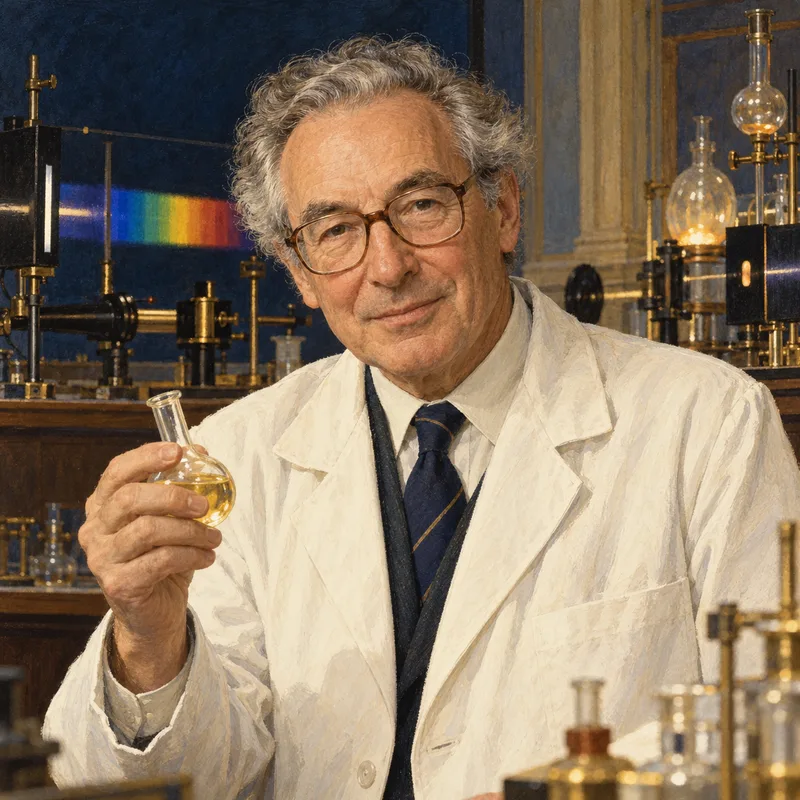
About the chemist
George Porter
1920-2002 · United Kingdom · Nobel Chemistry 1967
Flash photolysis