The discovery, explained · Chemist no. 138 of 350
George Porter and Flash Photolysis: Watching Triplet States and Radicals Appear and Vanish
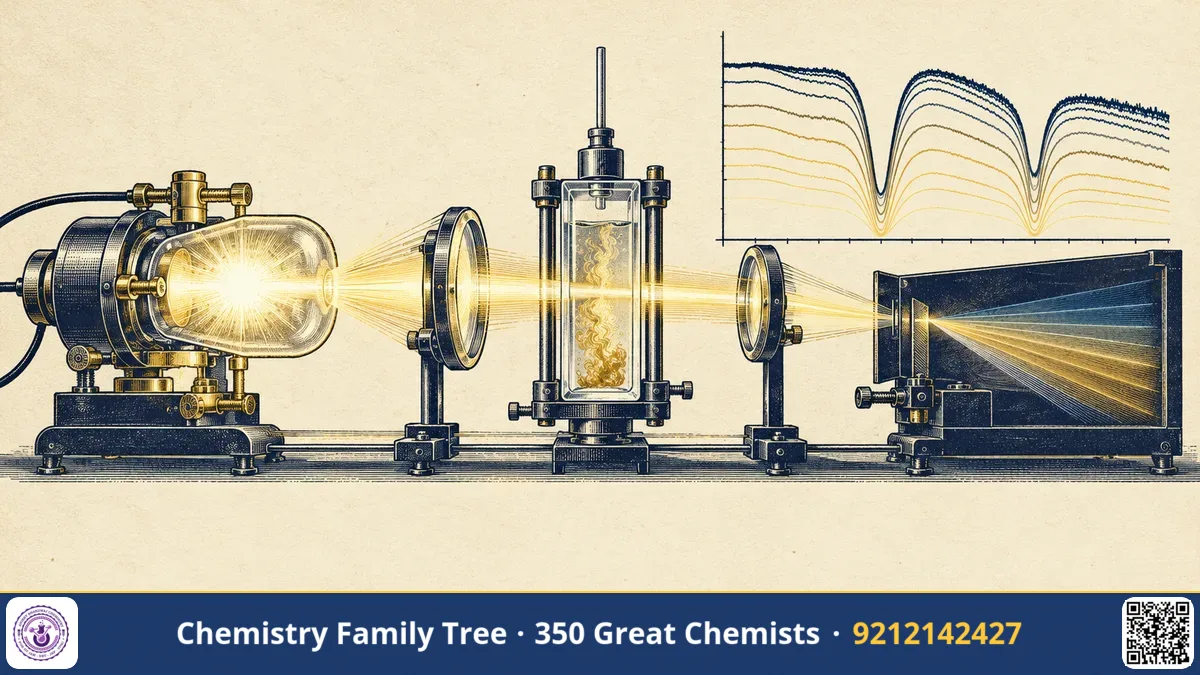
When light strikes a molecule, what actually happens in the next microsecond? Until about 1950 this was largely a guess. George Porter, as a young research student in Cambridge, helped to change that. Working with Ronald Norrish, he helped to develop flash photolysis, an experiment in which one very intense flash of light creates a burst of excited molecules and free radicals, and a second flash records their absorption spectra at chosen time delays. Porter carried the method forward in the following decades, using it to study triplet states, radicals and photosynthetic pigments, and to push time resolution from microseconds to nanoseconds and picoseconds. In 1967 he shared the Nobel Prize in Chemistry with Norrish (one half), while Manfred Eigen received the other half.
The Scientific Problem Before the Discovery
Photochemistry had developed the laws of light absorption and quantum yield, but reaction mechanisms involving short-lived species were inferred rather than seen. Gilbert Lewis and Michael Kasha had proposed in the 1940s that molecules could be excited into a long-lived triplet state, which explained phosphorescence, but direct evidence at room temperature in fluid solution was missing. Free radicals such as CH₃• and OH• were suspected as intermediates, but their concentrations in a steady-state experiment are far too low to detect. The challenge was to generate them faster than they disappear and then record spectra in a time shorter than their lifetime.
The Discovery: Step by Step
- Pump flash. A capacitor bank is discharged through a gas-filled quartz flash tube. The flash is so intense that a large fraction of the molecules in the sample absorb a photon at the same time.
- Transient formation. Within microseconds, excited singlet and triplet molecules, atoms and radicals appear at concentrations high enough to detect.
- Probe flash and spectrum. After a precisely adjustable delay, a weaker, broad-band flash passes through the sample and into a spectrograph, giving the absorption spectrum of everything present at that moment.
- Kinetics. Repeating the experiment with different delay times shows how each transient grows and decays, giving rate constants for reactions such as radical recombination and quenching.
- Applications. Early results included the spectra of the ClO radical, and in organic molecules and aromatic hydrocarbons, the detection of the triplet state by its characteristic absorption.
Porter later improved the method by using flash lamps of shorter duration, then lasers. His group at Sheffield and at the Royal Institution extended it to the nanosecond and picosecond range.
The Chemistry Behind It
Photochemical events are summarised in the Jablonski diagram:
- Absorption: S₀ + hν → S₁ (about 10⁻¹⁵ s).
- Vibrational relaxation and internal conversion: to the lowest vibrational level of S₁ (picoseconds).
- Fluorescence: S₁ → S₀ + hν (nanoseconds).
- Intersystem crossing: S₁ → T₁, a spin-forbidden change of multiplicity.
- Phosphorescence: T₁ → S₀ + hν, a spin-forbidden emission that can last milliseconds to seconds.
The triplet state is long-lived because the return to the singlet ground state is spin-forbidden. In flash photolysis, triplet molecules are detected by triplet-triplet absorption, T₁ → Tₙ, which is usually a strong absorption in a region where the ground state is transparent. The decay follows first-order or second-order kinetics:
First order:   [T] = [T]₀ e^(−kt)
Second order (e.g. 2R• → R–R):   1/[R] = 1/[R]₀ + 2kt
The quantity measured is absorbance A = εcl (Beer-Lambert law), so concentration changes become absorbance changes. A triplet quencher such as oxygen reduces the lifetime according to the Stern-Volmer relation:
1/τ = 1/τ₀ + k_q[Q]
Later, Porter used flash photolysis to explore energy transfer, electron transfer, chlorophyll photochemistry and the primary events of photosynthesis. He was among the first to argue for artificial photosynthesis as a long-term source of fuel from sunlight and water, developing model systems to split water or reduce protons using light.
Applications Today
- Photobiology. Transient absorption methods trace primary events in vision (rhodopsin) and photosynthesis, and the repair of DNA damaged by UV.
- Solar energy. Dye-sensitised solar cells, perovskite films and artificial photosynthesis are tested by transient absorption spectroscopy.
- Photodynamic therapy. In cancer treatment, drugs form triplet states that produce singlet oxygen to destroy tumour cells; flash photolysis is used to optimise them.
- Materials. OLED displays depend on singlet and triplet excitons whose lifetimes and decay channels are measured with these methods.
- Environmental chemistry. The lifetimes of radicals in air and water, and the photodegradation of pollutants and pesticides, are measured with laser flash photolysis.
Exam Corner
- Flash photolysis: pump (intense flash) and probe (delayed spectrum); Norrish and Porter, 1949-50.
- Triplet states have parallel electron spins, are longer lived, and are produced by intersystem crossing.
- Fluorescence is spin-allowed (ns); phosphorescence is spin-forbidden (ms to s).
- Stern-Volmer: I₀/I = 1 + K_SV[Q]; lifetime form 1/τ = 1/τ₀ + k_q[Q].
- 1967 Nobel Prize in Chemistry: Eigen (half), Norrish and Porter (half).
Common Misconceptions
- "Triplet states have no unpaired electrons." A triplet has two unpaired electrons with parallel spins (S = 1).
- "Phosphorescence and fluorescence are the same." They differ in the spin change and in lifetime.
- "Porter won the Nobel Prize in Physics." His prize was in Chemistry.
Quick Revision Box
- Flash photolysis creates transients with an intense flash and detects them by a delayed probe.
- Singlet S₁ may cross to triplet T₁ by intersystem crossing.
- Triplet-triplet absorption identifies the triplet state.
- Lifetime quenching: 1/τ = 1/τ₀ + k_q[Q].
- Porter extended the method to picoseconds and to photosynthesis.
- Nobel Prize in Chemistry 1967.
FAQ
What is the difference between a singlet and a triplet state?
In a singlet the two electrons have opposite spins (S = 0); in a triplet they have parallel spins (S = 1).
Why is flash photolysis needed to see radicals?
Radicals are so reactive that their steady-state concentration is tiny; a flash makes enough of them at once to record their spectra.
What was Porter's role compared with Norrish?
Porter was Norrish's research student who helped to build the first apparatus, and he later extended the method widely.
Did Porter work on artificial photosynthesis?
Yes, he promoted research on using light energy to split water and was a leading advocate of this field.
Published by ABC Chemistry — IIT-JAM | CSIR-NET | GATE Chemistry Coaching. Visit abcchemistry.com
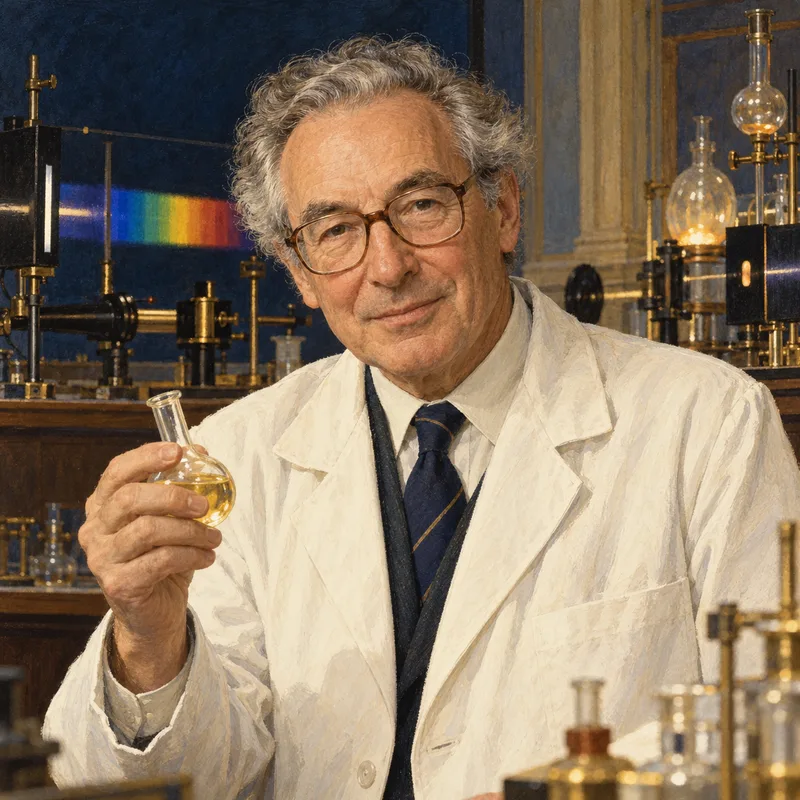
About the chemist
George Porter
1920-2002 · United Kingdom · Nobel Chemistry 1967
Flash photolysis