Biography · Chemist no. 187 of 350
Gerhard Ertl: The Physicist Who Became a Surface Chemist and Won a Nobel Prize
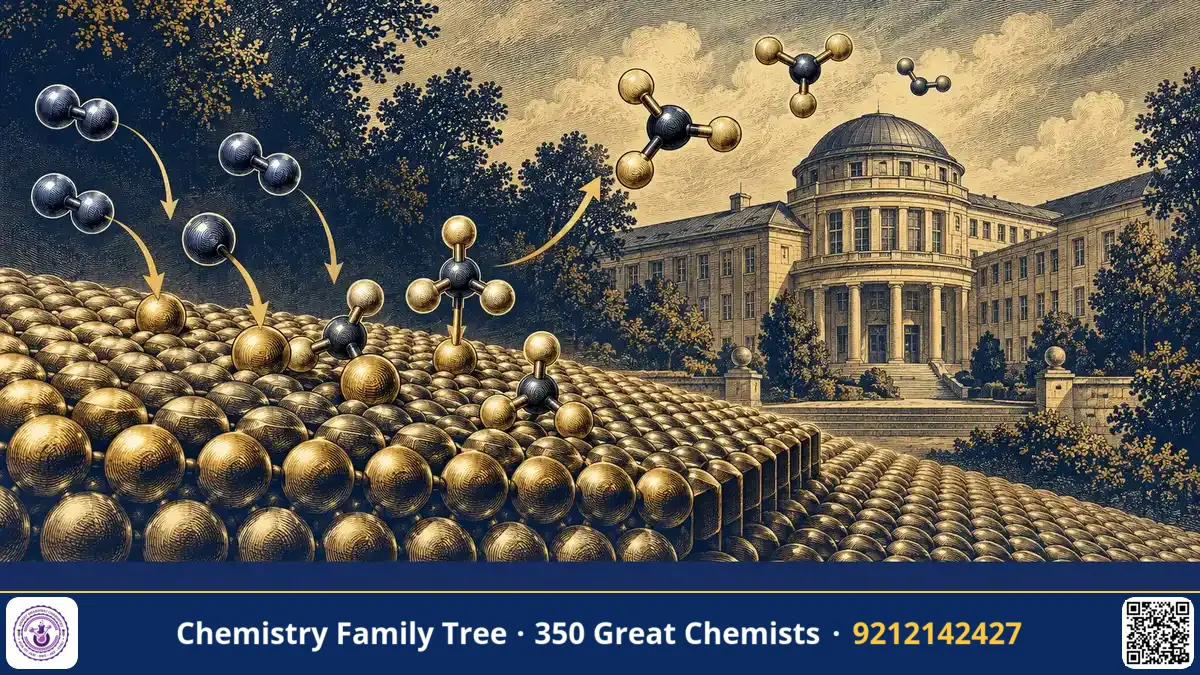
Gerhard Ertl (born 10 October 1936) is a German physical chemist who is a pioneer of modern surface science. By studying reactions on carefully prepared metal crystals in ultra-high vacuum, he explained at the atomic level how catalysts work, including the Haber-Bosch ammonia process. He received the 2007 Nobel Prize in Chemistry "for his studies of chemical processes on solid surfaces". His career is a good example of how physics and chemistry merge in modern science.
Early Life and Family
Ertl was born in Stuttgart, in the south-west of Germany, in 1936, in the Bad Cannstatt district. He was a child in the Second World War and grew up in the difficult years of reconstruction in Germany. Southern Germany had a strong tradition of engineering, with companies such as Bosch and Daimler, and the region valued technical training. He showed an early inclination towards science and mathematics. His life is also marked by a coincidence that he likes to recall: the Nobel Prize announcement of 2007 came on 10 October, his 71st birthday.
Education and Mentors
Ertl studied physics, not chemistry, at the University of Stuttgart, and at the Sorbonne in Paris and the Ludwig Maximilian University of Munich, and completed his diploma at the Technical University of Munich and received his doctorate in 1965 in physical chemistry there, under Heinz Gerischer, a well-known physical chemist who studied electrochemistry and semiconductor surfaces. Gerischer introduced him to the importance of interfaces. After the doctorate he spent time as a researcher abroad, where he became familiar with vacuum techniques, and he then combined them with his training in physics to study catalysis.
Career Timeline
| Year | Event |
|---|---|
| 1936 | Born in Stuttgart, Germany |
| 1965 | PhD in physical chemistry, Technical University of Munich, under Heinz Gerischer |
| 1968 | Professor at the Technical University of Hannover |
| 1973 | Professor of physical chemistry at the Ludwig Maximilian University of Munich |
| 1970s–1980s | Elucidated the mechanism of ammonia synthesis on iron and CO oxidation on platinum |
| 1986 | Became director of the Fritz Haber Institute of the Max Planck Society, Berlin (Department of Physical Chemistry) |
| 2004 | Retired as director; remained active as an emeritus scientist |
| 2007 | Nobel Prize in Chemistry |
Major Scientific Contributions
Ertl's major contribution is the step-by-step mechanism of ammonia synthesis over iron single crystals. He showed that hydrogen dissociates easily, nitrogen dissociation is the slow rate-determining step, and then adsorbed N and H atoms combine to form NH, NH₂ and NH₃ in sequence. His group measured the energy of each step and showed that the calculated reaction rate agrees with that of an industrial catalyst. The equations are given in our discovery article.
He also studied the oxidation of CO on platinum, the central reaction of the car exhaust catalytic converter, and found that, under some conditions, the reaction rate oscillates, with spirals and travelling waves on the surface. In addition, his group worked on hydrogen adsorption on metals, photoemission electron microscopy, fuel-cell electrode reactions and the reactions of ozone-depleting species on ice surfaces. His key achievement was to show that complex catalytic reactions can be understood by studying simple model systems.
Awards, Honours and Nobel Prize
- Nobel Prize in Chemistry 2007: awarded to Gerhard Ertl alone "for his studies of chemical processes on solid surfaces". It is a Chemistry prize.
- Wolf Prize in Chemistry (1998), shared with Gabor Somorjai, for surface science.
- Member of the German Academy of Sciences Leopoldina and foreign member of academies including the US National Academy of Sciences.
- Honorary doctorates and other national awards in Germany.
Personality, Struggles and Lesser-Known Facts
- Birthday Nobel: The announcement of his prize fell on his 71st birthday.
- A physicist in a chemistry prize: His training was strongly in physics, which is why he thought quantitatively about adsorption and kinetics.
- Waiting for tools: The vacuum techniques he needed were not available when catalysis started, so surface science had to be built almost from scratch.
- The pressure gap: Many chemists doubted that studies on single crystals in vacuum could say anything about real catalysts under high pressure (the "pressure gap" and "materials gap"). He addressed these gaps by showing that the same rate constants applied.
- Institute heritage: The Fritz Haber Institute carries the name of the inventor of ammonia synthesis, so the institute's director solved the mystery that Haber's process had left open.
Legacy and Influence on Modern Chemistry
Ertl turned catalysis from an art into a science. Today catalyst design uses computational chemistry together with surface experiments, and the concept of studying elementary steps on well-defined surfaces is standard. The work contributes to cleaner cars, more efficient fertiliser production, hydrogen energy, and understanding atmospheric chemistry. In India, which has a large fertiliser and refining industry and an active catalysis community (such as the National Chemical Laboratory in Pune and IITs), Ertl's concepts like chemisorption, Langmuir-Hinshelwood kinetics and promoters are taught in physical chemistry classes.
Lessons for Students
- Strong basics in physics and mathematics greatly help a chemist.
- Simplify a complex problem into a model system, then build back to reality.
- Invest in the right instruments and in clean experiments.
- Do not be discouraged if industry doubts your approach; show the link with data.
- Appreciate older science: Haber, Bosch and Langmuir laid the base for Ertl.
Quick Facts Box
- Born: 10 October 1936, Stuttgart, Germany
- Died: Living
- Nationality: German
- Field: Physical chemistry, surface science, catalysis
- Famous for: Mechanism of ammonia synthesis on iron; CO oxidation on Pt
- Nobel: Chemistry 2007 (sole recipient)
FAQ
Who shared the 2007 Nobel Prize in Chemistry?
No one. Gerhard Ertl received it alone.
Where did he work?
At Munich, and as director at the Fritz Haber Institute of the Max Planck Society in Berlin.
What is the rate-determining step in ammonia synthesis?
The dissociative adsorption of nitrogen on the iron surface.
Why is his work relevant to cars?
His studies of CO oxidation on platinum explain the working of catalytic converters in exhaust systems.
Published by ABC Chemistry — IIT-JAM | CSIR-NET | GATE Chemistry Coaching. Visit abcchemistry.com
About the chemist
Gerhard Ertl
1936- · Germany · Nobel Chemistry 2007
Chemical processes on solid surfaces