The discovery, explained · Chemist no. 187 of 350
Gerhard Ertl and the Chemistry of Surfaces: Watching Haber-Bosch Happen Atom by Atom
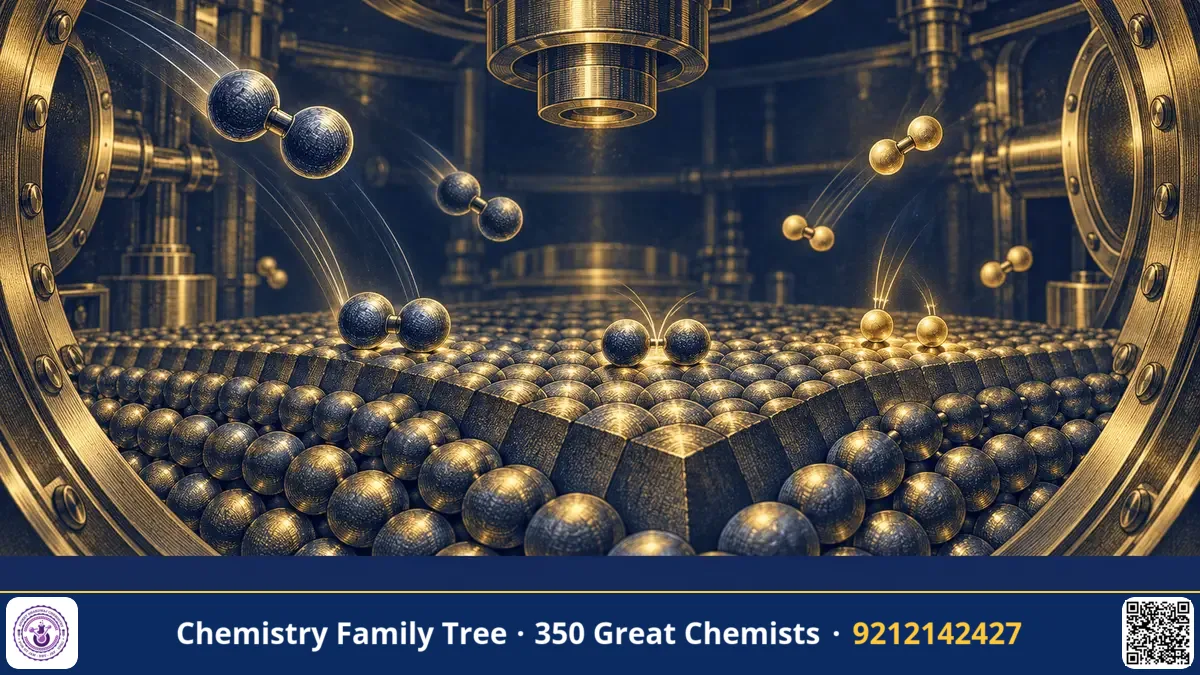
About half of the nitrogen in the proteins in your body once passed through a Haber-Bosch ammonia plant. The fertiliser industry, which feeds billions of people (including in India, one of the world's biggest consumers of urea), depends on the reaction N₂ + 3H₂ ⇌ 2NH₃ over an iron catalyst. For over fifty years the process was run successfully, but nobody knew exactly what happens on the iron surface. The German physical chemist Gerhard Ertl answered this question, using the new tools of ultra-high-vacuum surface science. In 2007 he received the Nobel Prize in Chemistry "for his studies of chemical processes on solid surfaces".
The Scientific Problem Before the Discovery
Heterogeneous catalysis, where the catalyst is a solid and the reactants are gases or liquids, is behind most industrial chemistry. Ammonia synthesis (Fritz Haber, Carl Bosch, Alwin Mittasch), catalytic converters, petroleum refining and fuel cells all use it. Yet in the 1950s and 1960s catalysts were studied mostly empirically. Real catalysts are messy powders, with surfaces that are not uniform and are changed by contaminants. One could measure the overall rate, but not the individual steps.
Irving Langmuir had proposed adsorption models in 1916, and the Langmuir–Hinshelwood mechanism (both reactants adsorbed on the surface) was known as a concept, but there was no direct proof. Scientists needed:
- Clean, well-defined single-crystal surfaces.
- Ultra-high vacuum (about 10⁻¹⁰ mbar) so that the surface stays clean for hours.
- Methods to identify what is adsorbed and how the atoms are arranged.
The Discovery: Step by Step
Ertl's strategy was to take a reaction, strip it down to a single crystal in vacuum, and measure each elementary step separately. In the 1970s and 1980s at Munich and the Fritz Haber Institute in Berlin he used:
- Low-energy electron diffraction (LEED): to determine the arrangement of atoms on the surface.
- Photoelectron spectroscopy (UPS, XPS): to identify adsorbed species and their binding energy.
- Thermal desorption spectroscopy: to measure how strongly molecules stick.
- Work function measurements and later scanning tunnelling microscopy and photoemission electron microscopy to see the spatial patterns.
With these tools he studied ammonia synthesis on iron single crystals, especially Fe(111), Fe(100) and Fe(110), and obtained a complete energy profile. The mechanism he established:
H₂(g) → 2 H(ads)                   (fast, dissociative adsorption)
N₂(g) → N₂(ads) → 2 N(ads)         (slow, rate-determining)
N(ads) + H(ads) → NH(ads) → NH₂(ads) → NH₃(ads) → NH₃(g)
The crucial finding: the dissociation of the very strong N≡N bond is the slowest step. The adsorbed nitrogen atoms are then hydrogenated stepwise. He also showed that the surface structure matters; Fe(111) is far more active than Fe(110), and promoters such as potassium raise the sticking probability of N₂.
The Chemistry Behind It
The overall reaction is exothermic (ΔH° ≈ −92 kJ per mole of N₂ reacted) and involves a decrease in the number of gas molecules (4 → 2), so Le Chatelier's principle favours high pressure and low temperature. But the N≡N bond energy is about 945 kJ/mol, so at low temperature the reaction is too slow. A catalyst lowers the activation energy by splitting N₂ into adsorbed atoms. The industrial compromise is 400–500 °C and 150–300 atm over iron promoted with K₂O and Al₂O₃.
Ertl's work gave a quantitative picture: the energy diagram of the reaction, with the adsorption energy of each species and the activation barrier of each elementary step. Using his data, scientists could calculate the overall rate from the elementary steps, and the numbers matched the industrial catalyst, a clear victory for molecular-level modelling. The rate of the rate-determining step depends on the sticking coefficient s of N₂ and the surface coverage θ:
rate ∝ s(N₂) · p(N₂) · (1 − θ)²
Ertl also studied the oxidation of carbon monoxide on platinum, 2CO + O₂ → 2CO₂, the key reaction of automobile catalytic converters. It proceeds by the Langmuir–Hinshelwood mechanism:
CO(g) → CO(ads); O₂(g) → 2 O(ads); CO(ads) + O(ads) → CO₂(g)
On Pt(110) he found that the reaction can oscillate in time and form travelling waves and spirals on the surface, a case of self-organisation far from equilibrium. The cause is that the surface switches reversibly between two structural forms of platinum, depending on CO coverage. This connected surface chemistry with non-linear dynamics.
Applications Today
- Fertilisers: Optimising ammonia catalysts saves large amounts of energy (about 1–2% of the world's energy is used for ammonia).
- Catalytic converters: Pt, Pd and Rh catalysts convert CO, NOₓ and hydrocarbons into CO₂, N₂ and H₂O in vehicles.
- Fuel cells and hydrogen: Understanding electrode surfaces helps the development of clean energy.
- Environment: Reactions on surfaces of ice and aerosol particles take part in ozone depletion.
- Semiconductors and corrosion: Surface reactions control chip fabrication and rusting.
Exam Corner
- Ertl won the Nobel Prize in Chemistry 2007 for studies of chemical processes on solid surfaces; he worked at the Fritz Haber Institute, Berlin.
- In Haber-Bosch synthesis the rate-determining step is dissociative chemisorption of N₂ on iron.
- Industrial conditions: 400–500 °C, 150–300 atm, Fe catalyst with K₂O and Al₂O₃ promoters.
- Langmuir–Hinshelwood mechanism: both reactants adsorb, then react on the surface; Eley–Rideal: one reacts from the gas phase.
- Tools: LEED, XPS, UPS, TDS, STM, ultra-high vacuum.
Common Misconceptions
- "A catalyst changes the equilibrium." It does not; it only speeds up approach to equilibrium.
- "Haber invented the catalyst alone." Haber found the principle, Bosch scaled up the process and Mittasch discovered the effective iron catalyst; Ertl explained the mechanism decades later.
- "Hydrogenation of N is the slow step." The slow step is N₂ dissociation.
Quick Revision Box
- Gerhard Ertl: German; Nobel Prize in Chemistry 2007 (sole recipient).
- Single crystals plus ultra-high vacuum gave molecular-level kinetics.
- Haber-Bosch: N₂ dissociation on Fe is rate-determining; H₂ dissociates easily.
- Promoters (K) raise N₂ sticking probability.
- CO oxidation on Pt(110) shows oscillations and wave patterns.
- Langmuir-Hinshelwood mechanism is the model for surface reactions.
FAQ
Why is ultra-high vacuum necessary?
At normal pressure a clean surface is covered by a monolayer of gas in a fraction of a second. At 10⁻¹⁰ mbar it stays clean for hours, so measurements are reliable.
Is surface chemistry part of the JAM/GATE syllabus?
Yes. Adsorption isotherms, chemisorption versus physisorption and catalysis are standard physical chemistry topics.
What did Ertl prove about the iron catalyst?
That its activity depends on the crystal face and that N₂ dissociation limits the rate, with potassium as an electronic promoter.
Why does CO oxidation oscillate?
Because CO adsorption changes the platinum surface structure, which changes the sticking of oxygen, giving a feedback loop and periodic changes.
Published by ABC Chemistry — IIT-JAM | CSIR-NET | GATE Chemistry Coaching. Visit abcchemistry.com
About the chemist
Gerhard Ertl
1936- · Germany · Nobel Chemistry 2007
Chemical processes on solid surfaces