Biography · Chemist no. 140 of 350
Gerhard Herzberg: The Life of a Spectroscopy Pioneer
Introduction
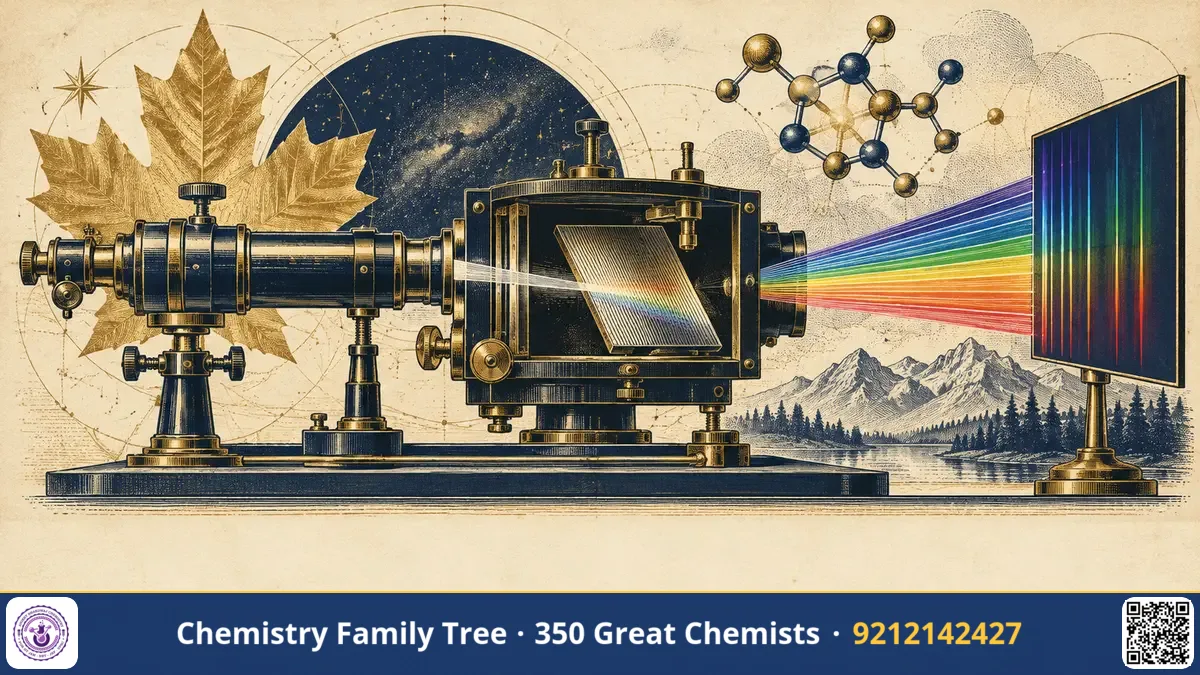
Gerhard Herzberg (1904-1999) was a German-born Canadian scientist who showed that the light absorbed and emitted by molecules can reveal their exact shape, bond lengths and electronic structure. He received the Nobel Prize in Chemistry in 1971, even though most of his career was spent in physics departments. His life took him from Hamburg to Darmstadt, then to Saskatchewan and Ottawa, and his books became the standard texts on molecular spectra. In one line: Herzberg taught chemists how to read molecules through light.
Early Life and Family
Gerhard Herzberg was born on 25 December 1904 in Hamburg, Germany. His father died when he was young, and the family lived modestly. Hamburg was a busy port city, and the young Herzberg developed an early interest in astronomy and physics. As a boy he was fascinated by the stars, and this interest later returned in his work on molecules in planetary atmospheres and space. He did not come from a wealthy background, and his education depended on his own diligence.
Education and Mentors
He studied at the Technische Hochschule Darmstadt, where he worked with Hans Rau and received his doctorate in 1928. He then spent time as a postdoctoral researcher at the University of Göttingen, where he met leading figures of quantum theory such as Max Born and James Franck, and at the University of Bristol, where he worked with John Lennard-Jones. These visits introduced him to the new quantum mechanics at the exact moment when it was being applied to molecules. He also learned German experimental precision and English theoretical thinking, a combination that shaped his style.
Career Timeline
| Year | Event |
|---|---|
| 1904 | Born in Hamburg on 25 December |
| 1928 | Doctorate at Technische Hochschule Darmstadt |
| 1929 | Marries Luise Oettinger |
| 1930s | Becomes Privatdozent and professor at Darmstadt; publishes work on atomic and molecular spectra |
| 1935 | Leaves Germany for the University of Saskatchewan, Canada |
| 1945-1948 | Professor of spectroscopy at Yerkes Observatory, University of Chicago |
| 1949 | Joins the National Research Council of Canada in Ottawa; later heads the Division of Pure Physics |
| 1959 | His group records the spectrum of the methylene radical, CH2 |
| 1971 | Awarded the Nobel Prize in Chemistry |
| 1975 | The Herzberg Institute of Astrophysics is established at the NRC |
| 1999 | Dies in Ottawa on 3 March |
Major Scientific Contributions
Herzberg's first major contribution was in atomic and molecular spectra: he wrote Atomic Spectra and Atomic Structure (1937) and the three-volume series Molecular Spectra and Molecular Structure, which covered diatomic molecules, infrared and Raman spectra of polyatomic molecules, and electronic spectra of polyatomic molecules. These are widely nicknamed "the Herzberg volumes" by spectroscopists.
He determined accurate bond lengths and dissociation energies for many diatomic molecules using the rigid rotor and anharmonic oscillator models, expressed as EJ = BJ(J+1) and E(v) = (v+½)ωe - (v+½)²ωexe. He extended the same logic to polyatomic molecules. His group also found the spectra of free radicals such as CH2 and CH3, and established that CH2 in its ground state is bent and a triplet. He identified the weak electric quadrupole spectrum of molecular hydrogen, which helped astronomers detect H2 on the outer planets. For the underlying science, read the companion post on his molecular spectroscopy work.
Awards, Honours and Nobel Prize
- Nobel Prize in Chemistry, 1971, awarded for his contributions to the knowledge of the electronic structure and geometry of molecules, particularly free radicals. It was a sole award.
- Fellow of the Royal Society of London and Fellow of the Royal Society of Canada.
- Companion of the Order of Canada, one of the country's highest civilian honours.
- The Herzberg Institute of Astrophysics in Ottawa was named in his honour, and Canada's top science award from NSERC carries his name: the Gerhard Herzberg Canada Gold Medal for Science and Engineering.
- Numerous honorary degrees from universities around the world.
Personality, Struggles and Lesser-Known Facts
- Forced to leave Germany. His wife Luise was of Jewish descent, and under the Nazi regime Herzberg's position in Darmstadt became untenable. In 1935 he left for Canada, where he was offered a place at the University of Saskatchewan. It was a major disruption, but it began his Canadian career.
- A difficult start in Canada. Research funds were limited at Saskatoon, and during the Second World War, as a German-born scientist, he was not able to join secret war projects. He stayed focused on teaching and spectroscopy.
- Love of astronomy. His time at Yerkes Observatory allowed him to connect laboratory spectra with the heavens, and he remained interested in the identification of molecules in space throughout his life.
- Collaborative family life. Luise, a physicist, worked on spectroscopy with him and co-authored papers. After her death in 1971, the year he won the Nobel Prize, he later married Monika Tenthoff.
- Quiet teacher. Colleagues remembered him as a patient and modest person who helped students patiently in the laboratory.
Legacy and Influence on Modern Chemistry
Whenever an infrared spectrum is interpreted, or a microwave spectrum gives a bond length, Herzberg's frameworks are being used. His data tables on diatomic molecules are used by astronomers, atmospheric scientists and combustion researchers. The study of reactive intermediates, radicals and carbenes, grew from the possibility of measuring them directly. Laser spectroscopy, femtochemistry and modern astrochemistry all stand on this foundation. Canada's scientific community regards him as one of the founders of its modern research culture.
Lessons for Students
- Master the fundamentals. Rotational and vibrational energy formulas look simple but unlock huge amounts of information.
- Precision matters. Herzberg's reputation came from careful measurement and honest error estimates.
- Cross subject boundaries. He moved among physics, chemistry and astronomy, and each helped the others.
- Stay productive in difficult times. Displacement and war did not stop him from doing world-class work.
- Write things down well. His books educated several generations.
Quick Facts Box
- Born: 25 December 1904, Hamburg, Germany
- Died: 3 March 1999, Ottawa, Canada
- Nationality: German-born, later Canadian
- Field: Molecular spectroscopy, physical chemistry, astrophysics
- Famous for: Spectra and structure of diatomic and polyatomic molecules; free radicals
- Nobel: Chemistry, 1971
FAQ
Why did Herzberg move to Canada?
Under Nazi laws his wife's Jewish ancestry made his position in Germany impossible. He accepted an offer from the University of Saskatchewan in 1935.
Did Herzberg win the Nobel Prize in Physics?
No. Although he worked in physics departments, his Nobel Prize in 1971 was in Chemistry.
What are the Herzberg books?
They are the volumes of Molecular Spectra and Molecular Structure, along with Atomic Spectra and Atomic Structure, which became standard references for spectroscopists.
What can Indian students learn from him?
That rigorous basics, patience and curiosity across subjects can lead to world-class contributions, even when conditions are far from ideal.
Published by ABC Chemistry — IIT-JAM | CSIR-NET | GATE Chemistry Coaching. Visit abcchemistry.com
About the chemist
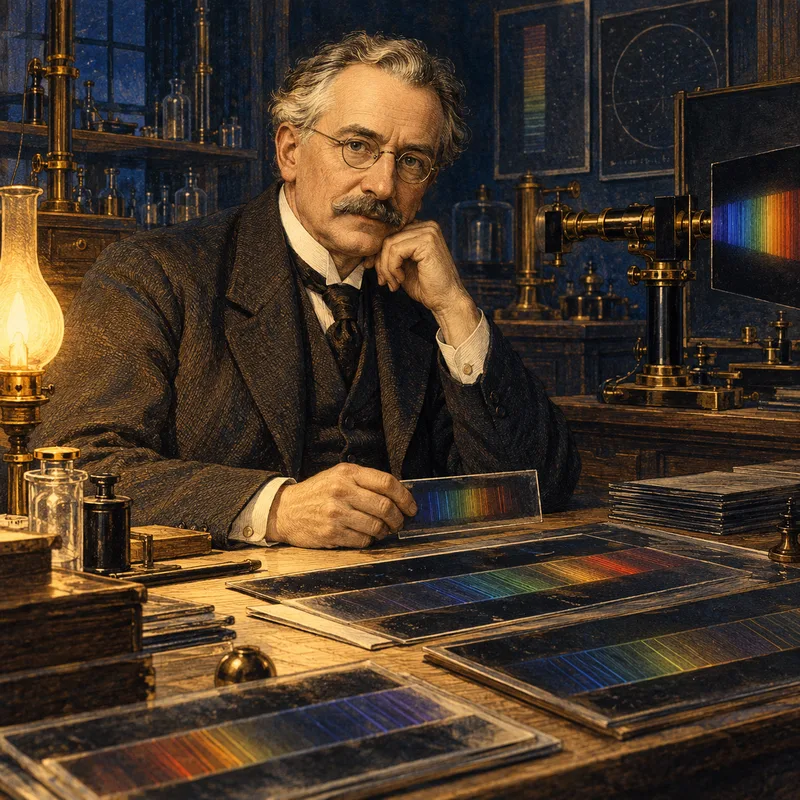
Gerhard Herzberg
1904-1999 · Canada · Nobel Chemistry 1971
Molecular spectroscopy and free radicals