The discovery, explained · Chemist no. 140 of 350
Gerhard Herzberg: Reading Molecules Through Their Spectra
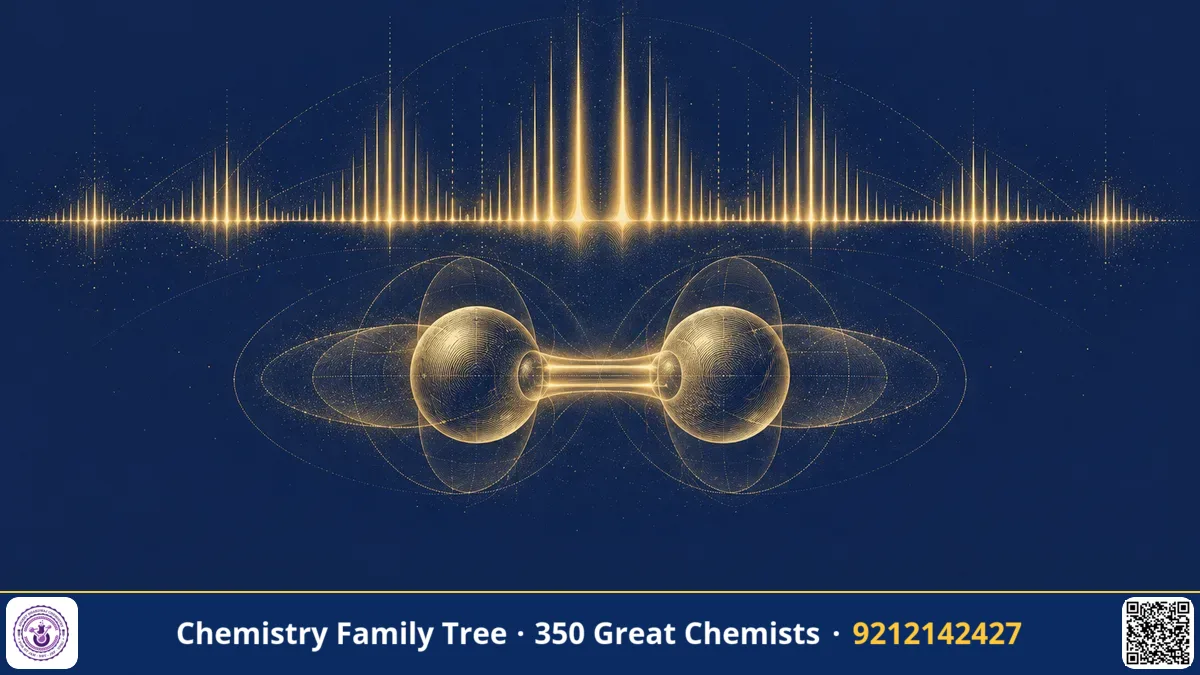
Every molecule carries a hidden fingerprint. When light interacts with a molecule, only certain colours are absorbed or emitted, and the pattern of those lines tells us the bond length, bond strength, shape and even the electronic structure. Gerhard Herzberg (1904-1999) turned this idea into a precise science. He measured the spectra of simple molecules with extraordinary accuracy, interpreted them with quantum mechanics, and even caught short-lived free radicals such as CH2 and CH3 in the act. For this work he received the Nobel Prize in Chemistry in 1971. His books on molecular spectra are still the standard reference on the subject. If you have studied rigid rotor, anharmonic oscillator or selection rules for JAM, NET or GATE, you have studied Herzberg's chemistry.
The Scientific Problem Before the Discovery
By the late 1920s quantum mechanics had arrived, but chemists still had no direct, quantitative picture of the molecule. Bond lengths of diatomic molecules were known only roughly. The structure of polyatomic species was inferred from chemical behaviour. Free radicals were suspected as intermediates in flames and in the upper atmosphere, but nobody had measured their geometry. Was methylene, CH2, linear or bent? Was the methyl radical flat or pyramidal? These questions could not be answered by ordinary chemical tests because such radicals live for only a tiny fraction of a second.
Spectroscopy offered a way forward, but the theory of rotational and vibrational energy levels had to be combined with high-resolution experiments. The Born-Oppenheimer approximation, which separates electronic, vibrational and rotational motions, supplied the theoretical frame. What was missing was careful experimental work and a systematic interpretation. Herzberg supplied both.
The Discovery and Experiments
Herzberg trained in Darmstadt and worked in Germany until 1935, when he moved to Canada. Over the following decades, at the University of Saskatchewan and later at the National Research Council in Ottawa, he built large spectrographs and long absorption paths to study gas-phase spectra.
- Diatomic molecules. He analysed the band spectra of molecules such as H2, N2, O2, CO and C2, extracting rotational constants, vibrational frequencies and dissociation energies. His work gave reliable bond lengths for dozens of species.
- Polyatomic molecules. He extended the method to triatomic and larger molecules, deducing geometries from the pattern of rotational lines.
- Free radicals. Using flash photolysis and absorption spectroscopy, his group recorded the spectra of transient species. In 1959 his team showed that methylene (CH2) in its ground state is a bent triplet molecule, and the methyl radical CH3 was found to be planar.
- Astrophysical links. He identified the quadrupole spectrum of hydrogen, a very weak absorption, which allowed molecular hydrogen to be detected in the atmospheres of outer planets. Laboratory spectra also helped astronomers recognise molecules in comets and interstellar space.
The Chemistry Behind It
Total molecular energy is approximated as a sum: E = Eelectronic + Evibrational + Erotational. The energies fall in different regions: electronic transitions in the UV-visible, vibrational in the infrared, and rotational in the microwave and far infrared.
Rotational energy (rigid rotor)
EJ = B J(J+1)      J = 0, 1, 2, ...
B = h / (8π² c I)         I = μ r²
μ = m₁m₂ / (m₁ + m₂)
The line spacing in a pure rotational spectrum is 2B. Measuring B gives the moment of inertia I and therefore the bond length r. The selection rule is ΔJ = ±1, and the molecule must have a permanent dipole moment. That is why HCl shows a pure rotational spectrum but N2 does not.
Vibrational energy (anharmonic oscillator)
E(v) = (v + ½) ωe - (v + ½)² ωexe
The harmonic model gives equally spaced levels, with selection rule Δv = ±1. Real bonds are anharmonic, so levels crowd together at higher v, overtones (Δv = ±2) appear weakly, and the bond finally dissociates. Extrapolating the level spacing to zero gives the dissociation energy, a method of the Birge-Sponer type that Herzberg used widely.
Vibration-rotation and electronic spectra
In an infrared vibration-rotation band, rotational lines accompany the vibrational jump, forming a P branch (ΔJ = -1) and an R branch (ΔJ = +1), with a gap at the band centre because ΔJ = 0 is forbidden for a diatomic. In electronic spectra, the Franck-Condon principle controls the intensity of vibrational progressions. Herzberg's analysis of such bands for molecules like O2 also revealed weak forbidden transitions, one of which is still called the Herzberg bands of oxygen.
Why radical geometry matters
Whether CH2 is linear or bent depends on its electronic configuration. The ground state is a triplet (two unpaired electrons) with a bent shape of about 134 degrees, while the lowest singlet state is more strongly bent. This was important for understanding carbene reactivity: singlet carbenes add stereospecifically to alkenes, while triplet carbenes react in a stepwise, non-stereospecific way.
Applications Today
- Everyday analysis. IR spectrometers in pharma and food labs use the vibrational frequencies that Herzberg's tables explained. Microwave spectroscopy is used for precise structure determination of small molecules.
- Atmospheric and climate science. Spectra of CO2, CH4, H2O and O3 are the basis of remote sensing and greenhouse-gas measurement from satellites.
- Astrochemistry. Radio telescopes in India and elsewhere identify interstellar molecules using laboratory rotational constants of the Herzberg type.
- Combustion and plasma chemistry. Detection of radicals such as OH, CH and C2 in flames follows his methods.
- Education. The rigid rotor and anharmonic oscillator, which you meet in physical chemistry, are the basis of his analysis.
Exam Corner
- Pure rotational spectra need a permanent dipole; selection rule ΔJ = ±1; line spacing 2B, with B = h/(8π²cI).
- Vibrational selection rule Δv = ±1 for the harmonic oscillator; the infrared-active mode must change the dipole moment.
- Anharmonic energy: E(v) = (v+½)ωe - (v+½)²ωexe; overtones become allowed.
- Isotopic substitution (for example H to D) changes the reduced mass, so B and the vibrational frequency shift. Frequency varies as 1/√μ.
- Ground-state CH2 is a bent triplet carbene; CH3 is planar. Herzberg received the 1971 Nobel Prize in Chemistry.
Common Misconceptions
- "Herzberg was a physicist, so his Nobel was in Physics." He worked in physics departments, but the 1971 prize was in Chemistry, for the electronic structure and geometry of molecules, especially free radicals.
- "All molecules show IR absorption." Only vibrations that change the dipole moment are IR active. Homonuclear diatomics such as N2 and O2 are IR inactive, though they show Raman scattering.
- "Rotational spectra give bond energies." They give moments of inertia and hence geometry. Bond energies come from vibrational and electronic data.
Quick Revision Box
- Nobel Prize in Chemistry, 1971: electronic structure and geometry of molecules, especially free radicals.
- Rigid rotor: EJ = BJ(J+1); spacing between lines = 2B.
- Anharmonic oscillator: levels converge toward the dissociation limit.
- Born-Oppenheimer approximation separates electronic, vibrational and rotational energy.
- CH2 ground state is a bent triplet; CH3 is planar.
- Standard text: Molecular Spectra and Molecular Structure (several volumes).
FAQ
What did Herzberg win the Nobel Prize for?
He won the 1971 Nobel Prize in Chemistry for his contributions to the knowledge of the electronic structure and geometry of molecules, particularly free radicals.
How can spectra give bond length?
The rotational constant B depends on the moment of inertia I = μr². Once B is measured from line spacing, r follows directly because the reduced mass μ is known.
Why are free radicals hard to study?
They are highly reactive and exist only briefly at low concentration. Fast techniques such as flash photolysis, followed by absorption spectroscopy, allow their spectra to be recorded before they react.
Is Herzberg important for GATE and CSIR-NET?
Yes. The topics of rotational, vibrational and electronic spectroscopy, selection rules, isotopic effects and anharmonicity form a regular part of physical chemistry papers, and they all rest on his analysis.
Published by ABC Chemistry — IIT-JAM | CSIR-NET | GATE Chemistry Coaching. Visit abcchemistry.com
About the chemist
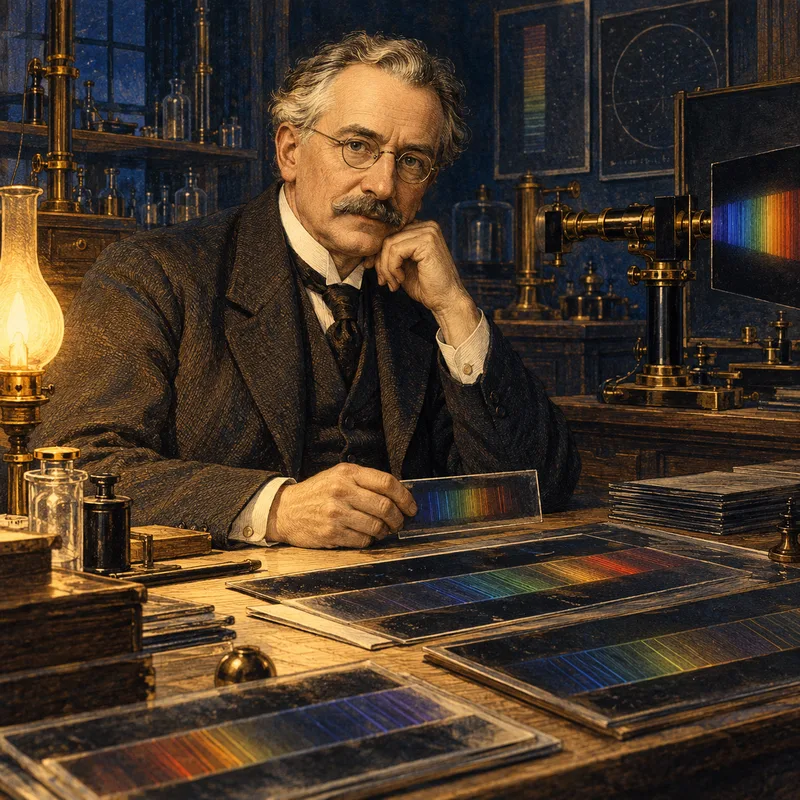
Gerhard Herzberg
1904-1999 · Canada · Nobel Chemistry 1971
Molecular spectroscopy and free radicals