The discovery, explained · Chemist no. 345 of 350
Gertrude Elion and the Rational Design of Medicines
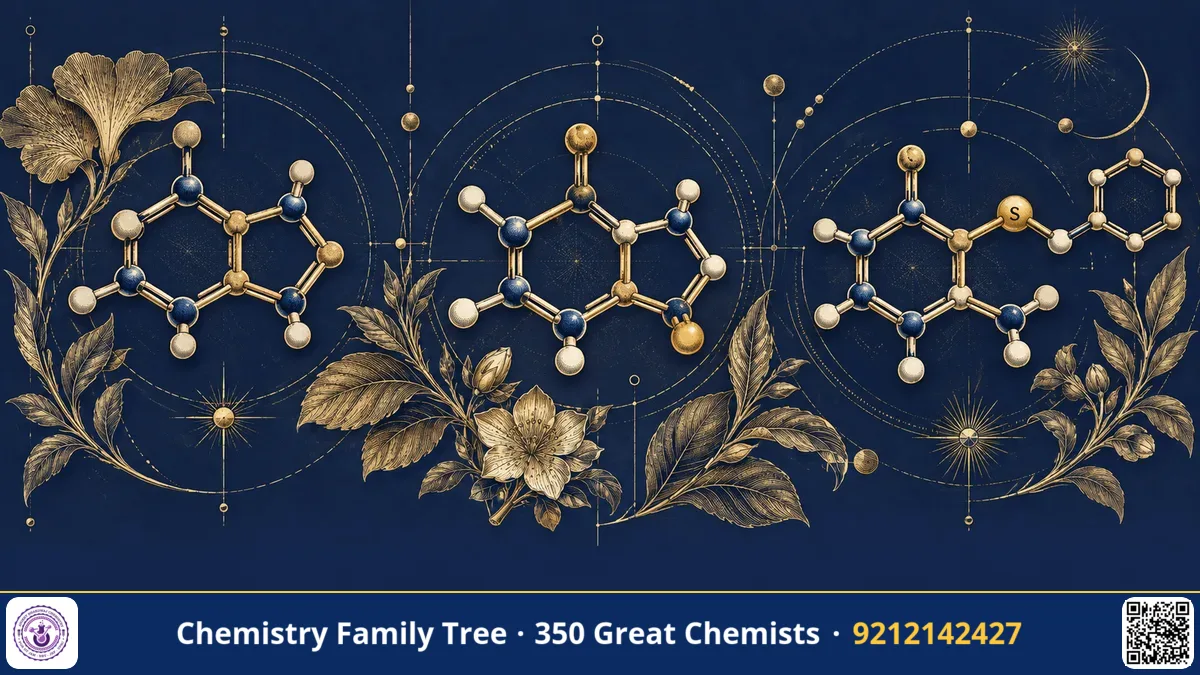
Before the middle of the twentieth century, most drugs were found by trial and error: scientists screened plant extracts and thousands of compounds and hoped to find one that worked. Gertrude Belle Elion, working with George Hitchings at the Burroughs Wellcome laboratories, changed this approach. Instead of random screening, they studied how normal cells and disease-causing cells, such as cancer cells, bacteria and viruses, build their nucleic acids, and then designed molecules that interfere with those differences. This method, called rational drug design, led to medicines for leukaemia, gout, malaria, bacterial infections, organ transplants and herpes. In 1988 Elion shared the Nobel Prize in Physiology or Medicine (not Chemistry) with Hitchings and Sir James Black. This article explains her chemistry in a way that is useful for medicinal chemistry questions in JAM, NET and GATE.
The Scientific Problem Before the Discovery
Cells need DNA and RNA to grow and divide. DNA and RNA are built from nucleotides containing bases: the purines adenine (A) and guanine (G), and the pyrimidines cytosine (C), thymine (T) and uracil (U). Rapidly dividing cells, such as cancer cells, bacteria and virus-infected cells, need large amounts of these building blocks.
Hitchings had an idea: if a cell is given a false building block, a molecule that looks like a natural base but is slightly modified, it may take it in and then be unable to continue making nucleic acids. Such a false building block is called an antimetabolite. The problem was to find which structural changes would block the abnormal cells and not damage healthy ones. This needed a good understanding of biochemical pathways and a lot of careful organic synthesis.
The Discovery: Step by Step
- Studying the pathways. Elion and Hitchings used bacteria and later cancer cells to see which natural purines and pyrimidines were needed for growth, and how enzymes handled them.
- Making analogues. Elion synthesised many modified purines, replacing an oxygen by sulphur, or adding groups to the ring, to create near-copies of natural bases.
- 6-Mercaptopurine (6-MP). By replacing the C6 carbonyl oxygen of hypoxanthine by an –SH group, she made a compound that blocked purine synthesis in leukaemia cells. It was introduced for childhood leukaemia in the early 1950s and greatly improved remission rates when combined with other drugs.
- Azathioprine. A derivative of 6-MP, it suppresses the immune system and became a vital drug for preventing rejection of transplanted kidneys.
- Allopurinol. A purine isomer designed to block the enzyme xanthine oxidase, it reduces the formation of uric acid and treats gout.
- Other drugs. Her group also produced pyrimethamine for malaria and trimethoprim for bacterial infections, and in the 1970s, acyclovir for herpes viruses.
The Chemistry Behind It
The purine skeleton
A purine is a fused bicyclic ring: a six-membered pyrimidine ring joined to a five-membered imidazole ring. Hypoxanthine has a C=O at position 6; replacing O by S gives 6-mercaptopurine, which is a thione/thiol tautomeric compound.
Hypoxanthine (6-oxopurine)  →  6-Mercaptopurine (6-thiopurine)
        C=O at C6                      C=S (–SH) at C6
The drug is converted inside the cell, by the enzyme HGPRT, to a nucleotide analogue (thioinosinic acid) which inhibits several steps of purine biosynthesis. As a result, the cell cannot make the A and G nucleotides required for DNA and RNA.
Allopurinol and uric acid
Purines are broken down in the body in the following sequence, in which xanthine oxidase catalyses the last two steps:
Hypoxanthine  →  Xanthine  →  Uric acid
         (xanthine oxidase)
Uric acid is poorly soluble; its crystals deposit in joints and cause gout. Allopurinol (a pyrazolo[3,4-d]pyrimidine) is a substrate and then an inhibitor of xanthine oxidase, so uric acid production falls and soluble precursors are excreted instead.
Acyclovir: a chain terminator
Acyclovir is an analogue of the nucleoside deoxyguanosine in which the sugar ring is replaced by an open-chain side group, –CH₂OCH₂CH₂OH, which has no 3'-hydroxyl group. The drug works in three steps:
- A viral enzyme, thymidine kinase, phosphorylates acyclovir to its monophosphate. Healthy human cells do this very poorly, which gives selectivity.
- Cellular enzymes convert it to the triphosphate form.
- Viral DNA polymerase inserts it into the growing DNA chain, and since there is no 3'-OH, no further nucleotide can be added. The chain is terminated.
Trimethoprim and folate
Trimethoprim blocks dihydrofolate reductase (DHFR) in bacteria much more strongly than the human enzyme: dihydrofolate + NADPH + H⁺ → tetrahydrofolate + NADP⁺. Without tetrahydrofolate, the cell cannot make thymidine and purines.
| Drug | Target | Use |
|---|---|---|
| 6-Mercaptopurine | Purine biosynthesis | Leukaemia |
| Azathioprine | Purine metabolism in lymphocytes | Transplant rejection |
| Allopurinol | Xanthine oxidase | Gout |
| Trimethoprim | Bacterial DHFR | Bacterial infections |
| Pyrimethamine | Parasite DHFR | Malaria |
| Acyclovir | Viral DNA polymerase | Herpes |
Applications Today
- Cancer therapy: 6-mercaptopurine and thioguanine remain part of treatment for acute lymphoblastic leukaemia.
- Transplant medicine: azathioprine and its relatives suppress immune rejection.
- Gout treatment: allopurinol is one of the most widely prescribed gout drugs, including in India.
- Antiviral care: acyclovir and its derivatives are used for cold sores, genital herpes, chickenpox and shingles.
- Drug discovery: the principle of exploiting differences between host and invader pathways is the foundation of modern targeted therapy.
Exam Corner
- Purines: adenine and guanine (fused six- and five-membered rings); pyrimidines: cytosine, thymine, uracil.
- Antimetabolites are structural analogues of natural metabolites that block enzyme pathways (e.g., 6-MP, methotrexate).
- Allopurinol inhibits xanthine oxidase; uric acid is the end product of purine catabolism in humans.
- Acyclovir lacks a 3'-OH; it is a chain terminator activated by viral thymidine kinase.
- Trimethoprim inhibits DHFR; sulphonamides inhibit dihydropteroate synthase; the two together block folate synthesis in sequence.
Common Misconceptions
- "Elion won the Nobel Prize in Chemistry." Her 1988 Nobel was in Physiology or Medicine.
- "Rational design means no experiments." It uses biochemical knowledge to guide the experiments, which are still needed.
- "Antiviral drugs kill viruses." Acyclovir stops viral DNA replication; it does not eliminate the virus from the body.
Quick Revision Box
- Elion and Hitchings used differences in nucleic acid metabolism to design drugs.
- 6-MP: sulphur replaces oxygen at C6 of hypoxanthine.
- Allopurinol blocks xanthine oxidase and lowers uric acid.
- Acyclovir: no 3'-OH, so it terminates viral DNA chains.
- Nobel Prize in Physiology or Medicine, 1988.
- Antimetabolites mimic natural substrates.
FAQ
What is an antimetabolite?
It is a molecule structurally similar to a natural metabolite that competes with it or replaces it and so disrupts a metabolic pathway.
Why is acyclovir selective for virus-infected cells?
It is first activated by a viral enzyme, thymidine kinase, so it becomes active mostly in infected cells.
What is the end product of purine breakdown in humans?
Uric acid, formed from hypoxanthine and xanthine by xanthine oxidase.
Why is she important for medicinal chemistry?
Her work set a model for designing drugs from knowledge of biochemistry rather than random screening.
Published by ABC Chemistry — IIT-JAM | CSIR-NET | GATE Chemistry Coaching. Visit abcchemistry.com
About the chemist
Gertrude Elion
1918-1999 · United States · Nobel Physiology/Medicine 1988
Rational drug design; azathioprine, acyclovir