Biography · Chemist no. 316 of 350
Gerty Cori: Complete Life and Legacy of a Pioneer Biochemist
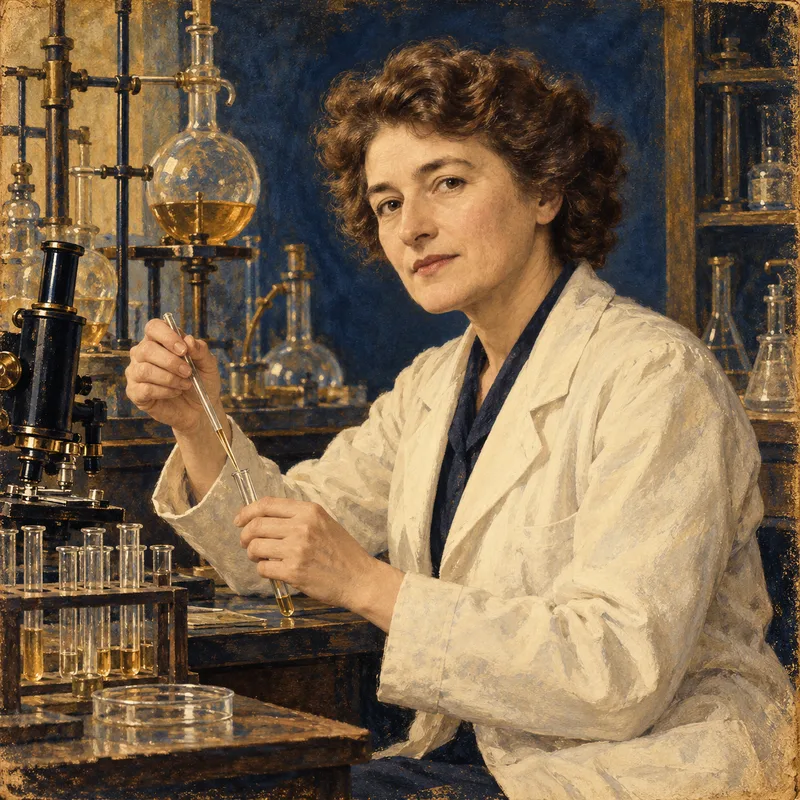
Gerty Theresa Cori (née Radnitz, 1896-1957) was a Czech-born American biochemist who became the first woman to win a Nobel Prize in Physiology or Medicine (1947) and the first American woman to win a Nobel Prize in science. With her husband Carl she worked out how the body stores and releases glucose. Her legacy: a lifetime proof that determination and careful experiments can overcome discrimination, war and illness.
Early Life and Family
Gerty was born on 15 August 1896 in Prague, then part of the Austro-Hungarian Empire. Her father, Otto Radnitz, was a chemist and manager of sugar refineries, and he became a successful industrial chemist who developed methods for refining sugar. Her mother, Martha, was a friend of the famous writer Franz Kafka. The family was Jewish by origin. Gerty was educated at home by tutors until the age of ten, then went to a girls' school (a Lyceum) in Prague, and she graduated at 16. Her uncle, a professor of paediatrics, inspired her interest in medicine, and she decided to study it.
Education and Mentors
Women had restricted access to university in her country, and the Lyceum did not prepare girls for the entrance examination. Gerty therefore studied intensively and in one year completed Latin, physics, chemistry, mathematics and more to pass the entrance examination for the medical school of the German University of Prague, which she entered in 1914. There she met a fellow student, Carl Ferdinand Cori, in an anatomy class. They shared a love of research and mountain climbing. She graduated as a doctor of medicine in 1920, and the couple married in the same year in Vienna. Gerty worked at a children's hospital in Vienna, where she researched blood disorders and studied a rare condition of low blood platelets. She also experienced antisemitism and food shortages in post-war Europe, and she developed xerophthalmia, an eye disease due to vitamin A deficiency, which made them determined to leave.
Career Timeline
| Year | Event |
|---|---|
| 1896 | Born in Prague |
| 1920 | MD degree, Prague; marriage to Carl Cori |
| 1922 | Emigrated to the United States; Carl took a job at the New York State Institute for the Study of Malignant Diseases in Buffalo, and Gerty joined as a research assistant |
| 1920s | Studied effects of insulin and adrenaline on glucose and glycogen; developed the idea of the Cori cycle |
| 1931 | Moved to Washington University School of Medicine, St Louis, where Carl became head of pharmacology |
| 1936-1939 | Discovered glucose-1-phosphate and glycogen phosphorylase |
| 1943 | Promoted to research associate professor |
| 1947 | Nobel Prize in Physiology or Medicine, shared; she became a full professor in the same year |
| 1952 | Showed that a form of glycogen storage disease is caused by an enzyme defect |
| 1957 | Died on 26 October in St Louis, Missouri |
Major Scientific Contributions
- The Cori cycle: The movement of lactate from muscle to liver and glucose back to muscle.
- Glucose-1-phosphate and phosphorylase: Discovery of the phosphate ester and the enzyme which makes it, leading to the first test-tube synthesis of glycogen.
- Hormone action: Studies of insulin, adrenaline and pituitary hormones in glucose metabolism.
- Inherited metabolic disease: Her work established the idea of glycogen storage diseases as inborn errors of enzymes, an important early step toward molecular medicine.
These ideas are explained in detail in our discovery post on the Cori cycle.
Awards, Honours and Nobel Prize
The 1947 Nobel Prize in Physiology or Medicine was shared: one half jointly to Carl and Gerty Cori "for their discovery of the course of the catalytic conversion of glycogen", and the other half to Bernardo Houssay of Argentina for his work on the pituitary hormones in sugar metabolism. Gerty also received the Garvan Medal of the American Chemical Society in 1948 (an award for women chemists), and the Squibb Award in endocrinology. In 1950 President Truman appointed her to the board of the National Science Foundation. She was elected to the National Academy of Sciences. A crater on the Moon and a US postage stamp have honoured her, and she has been recognised as a National Historic Chemical Landmark site together with her husband at Washington University.
Personality, Struggles and Lesser-Known Facts
- Unequal position: For many years she was paid far less than her husband and held a low-ranking position, research associate, although she was an equal partner in the work. When a dean in Buffalo told Carl that it was not good for him to work with his wife and he might lose his job, he refused to separate.
- A very late professorship: She became a full professor at Washington University only in 1947, the same year she won the Nobel Prize.
- Illness: In 1947 she was diagnosed with myelosclerosis, a bone-marrow disease. She continued to work for ten more years, often receiving blood transfusions, and she kept researching until almost the end of her life.
- Mentor of future laureates: Several people who worked in her laboratory later won Nobel Prizes, including Arthur Kornberg, Severo Ochoa, Earl Sutherland and Luis Leloir who visited, and many visitors came to learn their methods. Her kitchen-table discussions with Carl were famous.
- Hobbies: She loved mountain walking, travelling and collecting minerals, art and good furniture. She also helped refugee scientists from Europe and supported younger colleagues.
- Her son: Their son Tom was born in 1936 and later became a chemist.
Legacy and Influence on Modern Chemistry
The Coris founded a school of enzymology in St Louis. Their discovery of phosphorylase, and its regulation, set the model for how we study enzymes today: purify, measure kinetics, identify cofactors and examine control by hormones. The Cori cycle is taught in every biochemistry course. Her study of glycogen storage disease opened the area of inherited metabolic disorders, now diagnosed by newborn screening. Washington University's medical school and several awards bear their names, and Gerty is an icon for women in science. Indian students of biochemistry meet the Cori cycle, Cori ester and Cori disease in almost every syllabus.
Lessons for Students
- Prepare hard for the gate you want to enter. She finished years of school work in one year to enter medical school.
- Choose the right partner. A shared goal and mutual respect with Carl gave both of them far more than either could have done alone.
- Do not let unfair treatment stop the work. She kept her position low for years and still produced Nobel-level science.
- Keep working with purpose. Even with a serious illness she continued research.
Quick Facts Box
- Born: 15 August 1896, Prague
- Died: 26 October 1957, St Louis, Missouri, USA
- Nationality: Czech-born, naturalised American
- Field: Biochemistry, enzymology
- Famous for: Cori cycle, glucose-1-phosphate, glycogen phosphorylase
- Nobel: 1947, Physiology or Medicine (shared with Carl Cori and Bernardo Houssay)
FAQ
Was Gerty Cori awarded the Nobel Prize in Chemistry?
No. The prize was in Physiology or Medicine, 1947, although the work is biochemistry.
Who was the first woman to win a Nobel Prize in Physiology or Medicine?
Gerty Cori. She was also the third woman to receive any Nobel Prize in science, after Marie Curie and Irène Joliot-Curie.
How did Gerty and Carl Cori work together?
They shared a laboratory, wrote their papers together and discussed experiments daily. Gerty especially contributed in enzyme chemistry and the study of glycogen.
What disease did Gerty Cori suffer from?
She suffered from myelosclerosis, a disease of the bone marrow, from 1947. She died of it in 1957.
Published by ABC Chemistry — IIT-JAM | CSIR-NET | GATE Chemistry Coaching. Visit abcchemistry.com
About the chemist
Gerty Cori
1896-1957 · United States · Nobel Physiology/Medicine 1947
Cori cycle; glycogen metabolism