The discovery, explained · Chemist no. 316 of 350
Gerty Cori and the Cori Cycle: How the Body Recycles Glucose
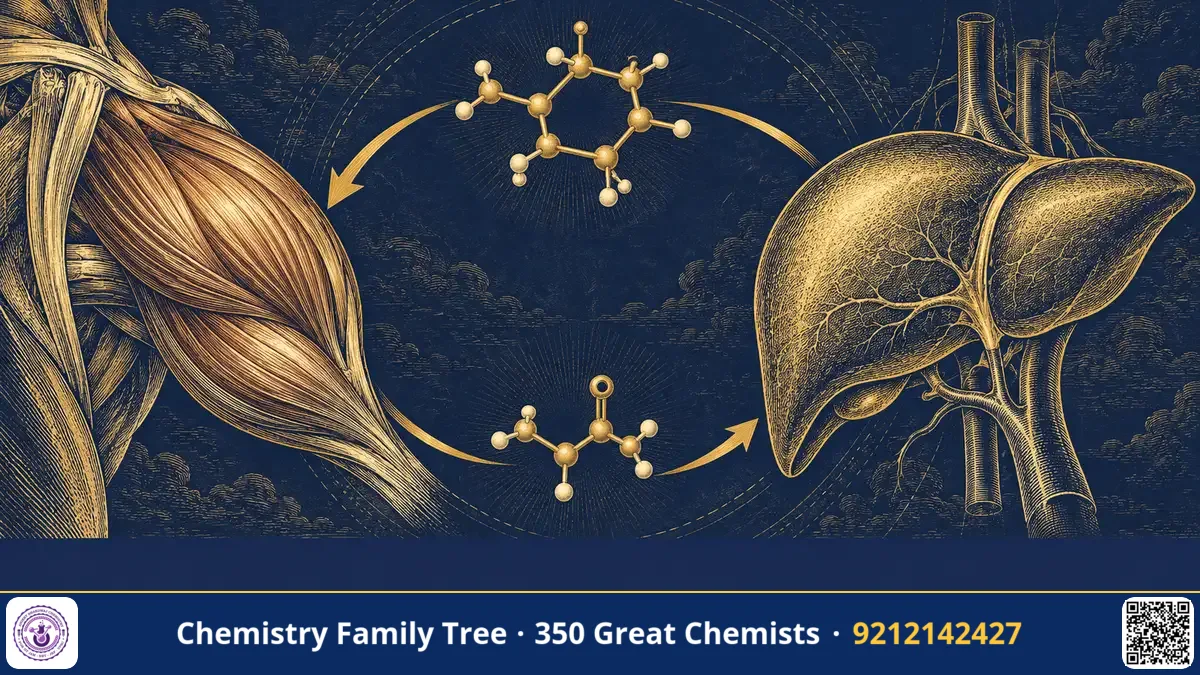
When you sprint for a bus, your leg muscles work so hard that they run short of oxygen. They keep going by turning glucose into lactate. Where does that lactate go? Your liver takes it, rebuilds it into glucose and sends the glucose back to the muscles. This beautiful loop is called the Cori cycle, after Gerty Theresa Cori (1896-1957) and her husband Carl Ferdinand Cori. Together they also worked out how glycogen is broken down and rebuilt in the body, discovering the compound glucose-1-phosphate (the "Cori ester") and the enzyme glycogen phosphorylase. For this, the Coris shared the 1947 Nobel Prize in Physiology or Medicine with Bernardo Houssay. Gerty Cori was the first woman to win a Nobel Prize in that field.
The Scientific Problem Before the Discovery
In the early twentieth century scientists knew that the body stores glucose as glycogen, mainly in liver and muscle, and that blood glucose must be held steady. They also knew that muscles produce lactic acid when they work hard. But the details were unclear. How exactly does glycogen turn into lactate? Is the lactate lost, or reused? What controls blood sugar? Insulin had just been discovered in 1921, and its effect on blood glucose was dramatic, yet nobody knew how it worked at the level of the cell.
At that time many believed that enzymes could only break things down. Making a large polymer such as glycogen from small units seemed to need cellular "life force" rather than ordinary enzymes. The Coris set out to show that purified enzymes in a test tube could do both.
The Discovery / Experiment
Step 1: Follow the sugar in the whole animal
In the 1920s the Coris studied how injected adrenaline (epinephrine) and insulin change blood sugar and glycogen in rats and rabbits. They measured glycogen, glucose and lactate in tissues very carefully. They found that adrenaline raises blood glucose and lactate, and that lactate formed in muscle is later turned into liver glycogen. This was the first evidence of the cycle.
Step 2: The cycle
The pathway can be written in two halves.
In muscle:  glycogen (or glucose) → 2 pyruvate → 2 lactate   (glycolysis, net 2 ATP)
In blood:   lactate travels to the liver
In liver:   2 lactate → 2 pyruvate → glucose   (gluconeogenesis, costs 6 ATP equivalents)
In blood:   glucose returns to muscle
Notice that the liver spends more energy (about 4 ATP + 2 GTP, in all 6 high-energy phosphate bonds) than the muscle gains (2 ATP). The liver pays an energy cost so that the muscle can keep working without oxygen. The shared lactate is not wasted, and the acid load is carried away from muscle.
Step 3: The Cori ester
In the late 1930s, working with minced frog muscle extracts, the Coris found that glycogen breaks down in the presence of inorganic phosphate to give a new ester, glucose-1-phosphate, not free glucose. The reaction is:
(glucose)n + Pi ⇌ (glucose)n-1 + glucose-1-phosphate
This is phosphorolysis, a cleavage by phosphate rather than water (hydrolysis). The enzyme is glycogen phosphorylase. Glucose-1-phosphate is then converted by phosphoglucomutase to glucose-6-phosphate, which enters glycolysis.
Step 4: Making glycogen in a test tube
The most exciting step was the reverse. By adding glucose-1-phosphate to the enzyme with a small primer of glycogen, the Coris built new glycogen outside a living cell. This was the first time that a biological polymer had been synthesised in vitro by a purified enzyme. It showed that metabolism can be understood as ordinary chemistry. Inside the body, however, glycogen is made mainly by a different route using UDP-glucose and glycogen synthase (found later by Luis Leloir), because the cell concentration of inorganic phosphate keeps phosphorylase working mostly in the breakdown direction.
Step 5: Hormone control and enzyme forms
The Coris found two forms of phosphorylase: phosphorylase a (active) and b (needs AMP). This work with Arda Green led to the idea that hormones regulate enzymes by chemically changing them, which later was explained as phosphorylation by Edwin Krebs and Edmond Fischer.
The Chemistry Behind It
Key concepts for students:
- Glycogen: a branched polymer of glucose with α-1,4 links in chains and α-1,6 links at branch points, about every 8 to 12 residues.
- Phosphorolysis vs hydrolysis: phosphorolysis saves ATP because the product is already phosphorylated (glucose-1-phosphate to glucose-6-phosphate with no ATP needed).
- Cofactor: glycogen phosphorylase needs pyridoxal phosphate (derived from vitamin B6) at its active site.
- Debranching: phosphorylase stops four residues from a branch point; a debranching enzyme (transferase + α-1,6 glucosidase) then removes the branch.
- Cori cycle energetics: overall net cost of 4 ATP per cycle for the body, paid by oxidation of fats or other fuel in the liver.
Applications Today
- Glycogen storage diseases: Gerty Cori later showed that a human disease, now known as Cori disease (type III), is due to a defect in the debranching enzyme, so that abnormal glycogen with short outer branches builds up. This was the first demonstration of an inherited enzyme deficiency linked to a metabolic disease.
- Diabetes and lactic acidosis: The Cori cycle helps explain why metformin can cause lactic acidosis in rare cases, by blocking liver gluconeogenesis from lactate.
- Sports science: Lactate clearance after intense exercise follows the Cori cycle.
- Cancer metabolism: Tumours produce lactate, and the Cori cycle can burden the host by wasting energy.
- Medical teaching: The cycle is a standard part of biochemistry courses in Indian medical and B.Sc. programmes.
Exam Corner
- Cori cycle: muscle lactate goes to liver, becomes glucose, returns to muscle. Net cost: 6 ATP-equivalents spent in liver, 2 ATP gained in muscle.
- Glycogen phosphorylase releases glucose-1-phosphate using inorganic phosphate (phosphorolysis) and needs pyridoxal phosphate.
- Glucose-1-phosphate is converted to glucose-6-phosphate by phosphoglucomutase.
- Liver has glucose-6-phosphatase and releases free glucose; muscle lacks it and uses G-6-P itself.
- Gerty and Carl Cori shared the 1947 Nobel Prize in Physiology or Medicine with Bernardo Houssay.
Common Misconceptions
- "The Cori cycle is the same as the Krebs (citric acid) cycle." No. The Cori cycle is an inter-organ loop of glucose and lactate; the Krebs cycle is a pathway inside mitochondria.
- "Glycogen is broken to free glucose by hydrolysis only." Mostly it is phosphorolysis; free glucose comes only from debranching points and from liver G-6-Pase.
- "Cori cycle gives energy." It actually costs net energy; its value is the recycling of lactate and keeping muscle working.
Quick Revision Box
- Cori cycle = muscle glycolysis → lactate → liver gluconeogenesis → glucose → muscle.
- Cori ester = glucose-1-phosphate.
- Glycogen phosphorylase: phosphorolysis, PLP cofactor, regulated by phosphorylation.
- First in vitro enzymatic synthesis of a polysaccharide (glycogen).
- Cori disease = type III glycogen storage disease (debranching enzyme defect).
- Nobel Prize 1947 in Physiology or Medicine, shared.
FAQ
What is the Cori cycle in simple words?
It is the recycling of lactate: muscle makes lactate during hard work, the liver turns it back to glucose, and the blood carries the glucose back to the muscle.
Why does the liver spend more ATP than the muscle gains?
Gluconeogenesis is the energy-expensive reverse of glycolysis, costing 6 high-energy bonds per glucose, but it lets muscles keep working anaerobically and shifts the energy cost to the liver, which has plenty of oxygen.
What is the Cori ester?
Glucose-1-phosphate, the first product of glycogen phosphorolysis, discovered by the Coris.
Is the Cori cycle important for competitive exams?
Yes. Questions on energy balance, organs involved, enzymes of gluconeogenesis and glycogen metabolism are common in NET life science, GATE biotechnology and medical entrance tests.
Published by ABC Chemistry — IIT-JAM | CSIR-NET | GATE Chemistry Coaching. Visit abcchemistry.com
About the chemist
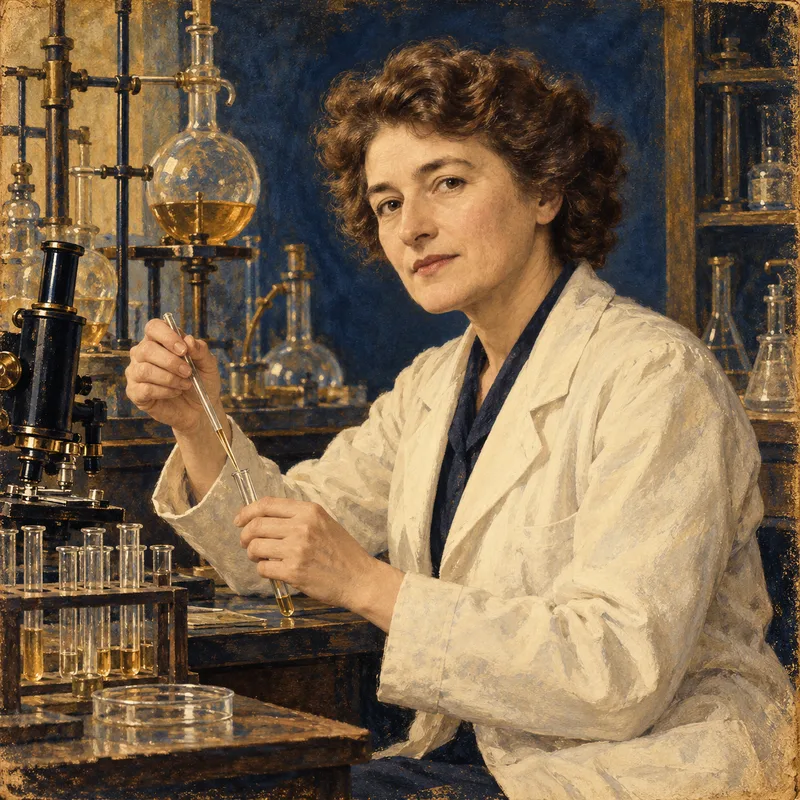
Gerty Cori
1896-1957 · United States · Nobel Physiology/Medicine 1947
Cori cycle; glycogen metabolism