Biography · Chemist no. 18 of 350
Gilbert N. Lewis: The Chemist Who Shaped the Language of Bonding
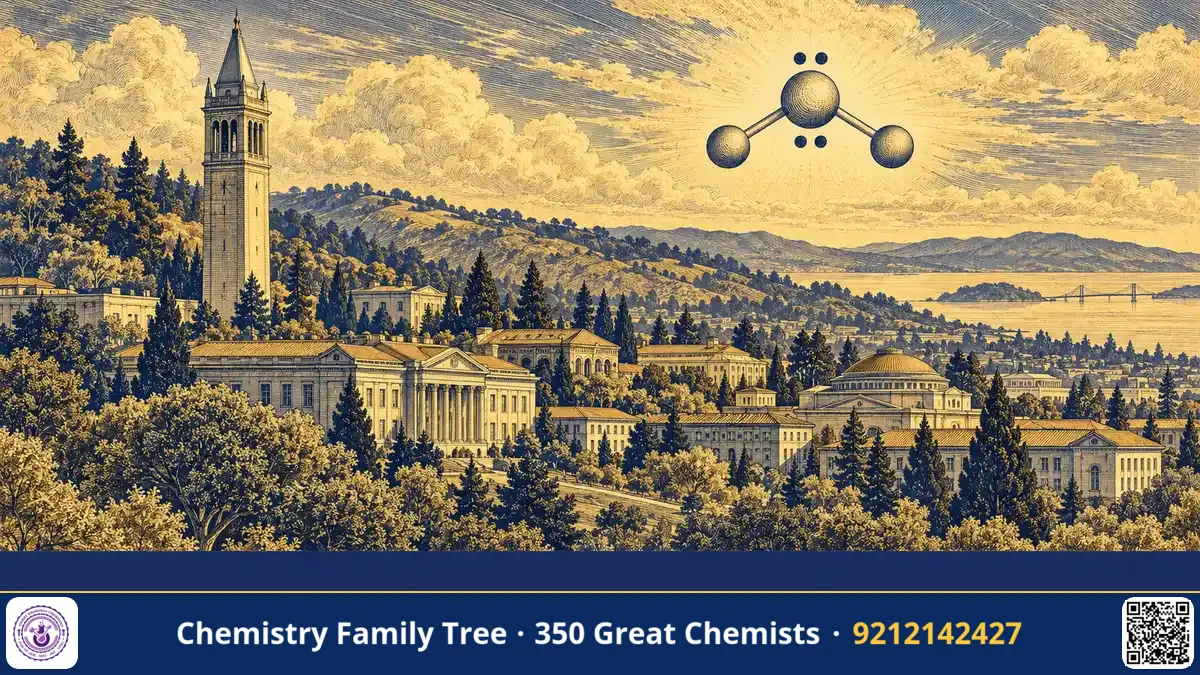
Gilbert Newton Lewis (1875–1946) was an American physical chemist and one of the most influential chemists of the twentieth century. He gave us the electron-pair covalent bond, the octet rule, Lewis dot structures and the Lewis definition of acids and bases. He also made major contributions to thermodynamics, and built the chemistry department of the University of California, Berkeley into a world leader. His legacy: every student who draws dots around an atom uses his idea.
Early Life and Family
G. N. Lewis was born on 23 October 1875 in Weymouth, Massachusetts. His father, Frank Wesley Lewis, was a lawyer and later a broker, and his mother was Mary Burr White Lewis. The family moved to Lincoln, Nebraska, when Gilbert was a child. He did not attend school until he was about nine, and he was taught at home by his parents. He read widely and showed an early talent for mathematics and science.
In 1912 Lewis married Mary Hinckley Sheldon, daughter of a Harvard professor of Romance languages. They had three children. Two of his sons, Richard and Edward, became chemists.
Education and Mentors
Lewis studied at the University of Nebraska for two years, then moved to Harvard, where he received his bachelor's degree in 1896 and his doctorate in 1899 under the physical chemist Theodore W. Richards, who won the Nobel Prize in Chemistry in 1914 for atomic weight determinations. After a short teaching time at Harvard he spent 1900–1901 in Germany, where he worked with Walther Nernst at Göttingen and Wilhelm Ostwald at Leipzig. Thermodynamics, the subject he learned from Richards and Nernst, remained a lifelong interest.
Career Timeline
| Year | Event |
|---|---|
| 1875 | Born in Weymouth, Massachusetts, 23 October |
| 1899 | PhD at Harvard under T. W. Richards |
| 1900–1901 | Studies in Germany with Nernst and Ostwald |
| 1904–1905 | Superintendent of Weights and Measures in Manila, Philippines |
| 1905 | Joins the Massachusetts Institute of Technology |
| 1912 | Becomes professor and Dean of Chemistry at the University of California, Berkeley |
| 1916 | Publishes "The Atom and the Molecule" with the shared-pair bond |
| 1923 | Publishes Valence and the acid–base definition; Thermodynamics with Merle Randall |
| 1926 | Proposes the name "photon" |
| 1933 | Prepares nearly pure heavy water |
| 1946 | Dies in Berkeley, 23 March |
Major Scientific Contributions
- The covalent bond. A shared pair of electrons, and the octet rule. Details are in our discovery post on Lewis's electron-pair bond.
- Acid–base theory. Acids accept electron pairs; bases donate them (1923).
- Chemical thermodynamics. He introduced the concepts of fugacity and activity, and ionic strength. His 1923 textbook with Merle Randall, Thermodynamics and the Free Energy of Chemical Substances, taught a generation to use free energy.
- Heavy water. In 1933 he isolated nearly pure D₂O in quantity, and used deuterons (deuterium nuclei) as projectiles in nuclear reactions in cooperation with Ernest Lawrence.
- The word "photon". He suggested the term in 1926 for the atom of light, although his theory differed from the one that was later accepted.
- Photochemistry. In the 1930s and 1940s he studied the phosphorescence of organic molecules in rigid solvents, helping to explain the triplet state.
Awards, Honours and Nobel Prize
Lewis was nominated for the Nobel Prize in Chemistry many times, but never received it. This is often discussed as one of the notable omissions in Nobel history, and several of his students and colleagues did win the prize. He was awarded the Davy Medal of the Royal Society (1929) and the Willard Gibbs Medal (1924). He was elected to the US National Academy of Sciences, though he resigned from it in 1934, and was a Foreign Member of the Royal Society.
Personality, Struggles and Lesser-Known Facts
- A teacher who built a school. At Berkeley he recruited bright young researchers, started a famous weekly research conference and put emphasis on discussion. His students and colleagues included William Giauque, Harold Urey, Glenn Seaborg and Melvin Calvin. Giauque, Urey, Seaborg and Calvin all won Nobel Prizes.
- A dispute over priority. Lewis and Irving Langmuir debated the credit for the electron-pair theory of bonding for years. Both made valuable contributions, and many textbooks speak of the Lewis–Langmuir theory.
- Late start at school. He was taught at home until about the age of nine, mostly by reading, which may explain his independent way of thinking.
- A quiet but sharp critic. He did not hesitate to criticise ideas he thought wrong, and he kept a high standard for the department.
- His death. He was found dead in his Berkeley laboratory in March 1946. He was working on fluorescence with liquid hydrogen cyanide, and the cause of death was reported as cyanide poisoning, though some accounts suggest a heart attack. The exact circumstances remain uncertain.
Legacy and Influence on Modern Chemistry
Lewis's ideas form the basic language of bonding in introductory and advanced chemistry. Quantum mechanics later explained why electron pairs bond, through the valence bond theory of Heitler, London and Pauling, and the molecular orbital theory of Hund and Mulliken, but the Lewis picture remained an indispensable working tool. His acid–base concept supports coordination chemistry, catalysis and organic mechanisms. The Berkeley College of Chemistry, which he led from 1912 to 1941, produced Nobel Prize winners for decades. The Lewis Hall at Berkeley is named in his honour.
Lessons for Students
- Simple models can be extremely powerful, even if they have limits. Know both.
- Build a team: Lewis succeeded as a teacher and as a research leader.
- Do not be discouraged by awards. His influence exceeded that of many who received prizes.
- Read widely, across thermodynamics, spectroscopy and structure.
Quick Facts Box
- Born: 23 October 1875, Weymouth, Massachusetts, USA
- Died: 23 March 1946, Berkeley, California, USA
- Nationality: American
- Field: Physical chemistry, chemical bonding, thermodynamics
- Famous for: Covalent bond as shared electron pair, Lewis structures, Lewis acids and bases
- Nobel: None, despite many nominations
FAQ
Did G. N. Lewis win a Nobel Prize?
No. He was nominated many times, but never won.
Who coined the word photon?
Lewis proposed the name in 1926. Einstein had earlier introduced the idea of light quanta.
What is the Lewis–Randall book known for?
It presented chemical thermodynamics, including free energy, activity and fugacity, in a form that chemists could use for practical calculations.
Which famous scientists studied or worked with Lewis?
William Giauque, Harold Urey, Glenn Seaborg and Melvin Calvin, among others, were connected with his Berkeley group.
Published by ABC Chemistry — IIT-JAM | CSIR-NET | GATE Chemistry Coaching. Visit abcchemistry.com
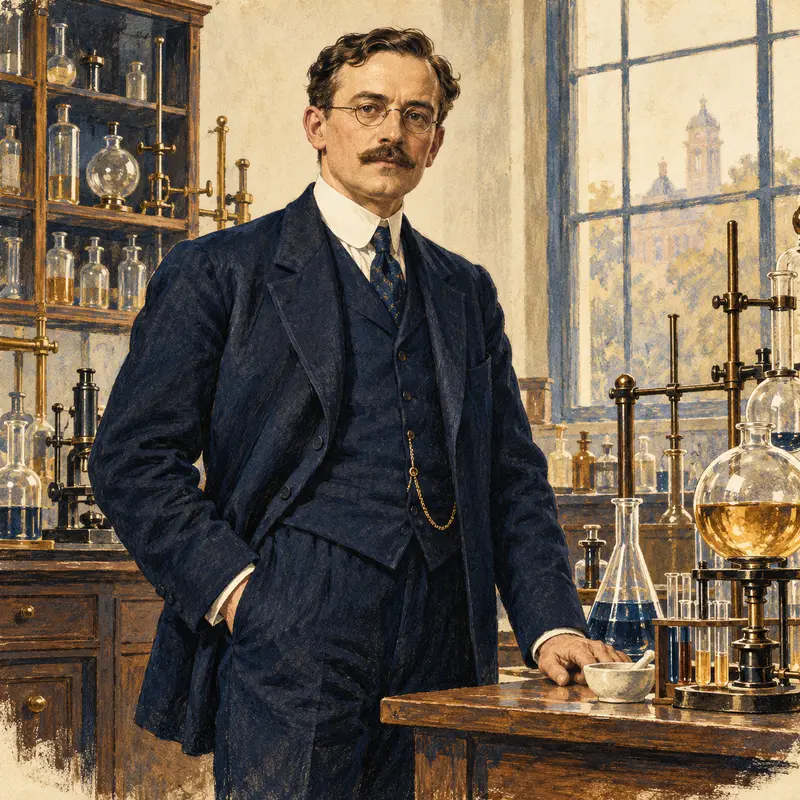
About the chemist
Gilbert N. Lewis
1875-1946 · United States
Covalent bond; Lewis acids and bases