The discovery, explained · Chemist no. 18 of 350
G. N. Lewis and the Shared Electron Pair: How Atoms Really Bond
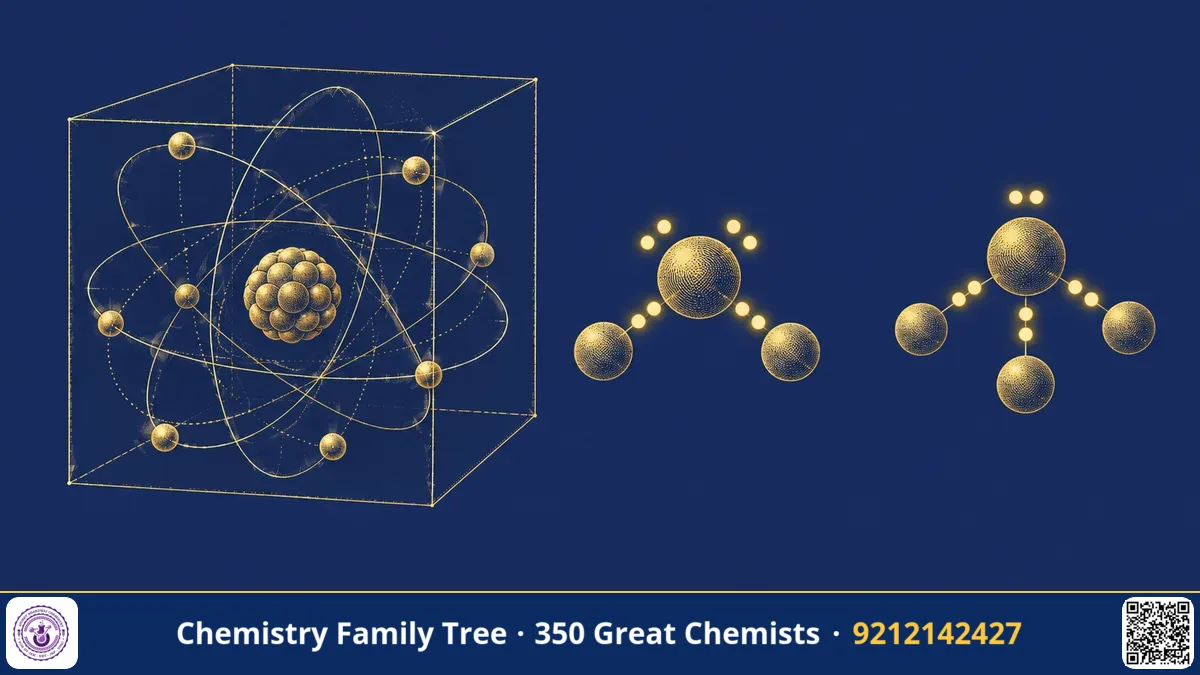
Whenever you draw a Lewis dot structure of water, ammonia or carbon dioxide, you are using an idea published by the American chemist Gilbert Newton Lewis in 1916. Lewis proposed that atoms bond by sharing pairs of electrons so that each reaches a stable group of eight electrons, the octet. In 1923 he added a second revolutionary idea: an acid is a substance that accepts an electron pair, and a base is one that donates it. These two concepts explain a huge part of inorganic and organic chemistry, from the bonding in H₂ to the working of AlCl₃ as a catalyst. Few chemists have shaped the language of the subject as strongly as Lewis.
The Scientific Problem Before the Discovery
By 1900 chemists knew thousands of compounds, but there was no clear theory of why atoms combine in fixed ratios. The discovery of the electron in 1897 and Rutherford's nuclear atom in 1911 suggested that electrons must be responsible for bonding. Sodium chloride, a salt, could be understood by electron transfer: Na loses an electron and Cl gains one. The ionic picture was developed by Walther Kossel in 1916.
But electron transfer could not explain molecules such as H₂, Cl₂, CH₄ or organic compounds. These do not conduct as ions and have no obvious charge. Chemists also knew the periodic table's stable noble gases, which have eight outer electrons (two for helium), but nobody had a general rule linking this to bonding. The problem was to find a single theory for both ionic and non-ionic compounds.
The Discovery: Step by Step
Lewis had been thinking about this since about 1902. He first drew a cubical atom, with up to eight electrons at the corners of a cube, to explain the periodic table. In a 1916 paper in the Journal of the American Chemical Society, titled "The Atom and the Molecule", he set out his full theory:
- The outer (valence) electrons are responsible for chemical bonding.
- A covalent bond is formed when two atoms share a pair of electrons.
- Atoms tend to attain eight electrons in the outermost shell (the rule of eight, now called the octet rule); hydrogen attains two (the duet).
- A single bond is one shared pair, a double bond two pairs, a triple bond three pairs.
The notation using dots for electrons became known as Lewis dot structures:
 H:H     :Cl:Cl:     H:Ö:H     H:N:H (with lone pair)
                     (H2O)         H  (NH3)
In his 1923 book Valence and the Structure of Atoms and Molecules he extended the model and proposed a new acid–base theory: an acid accepts an electron pair, and a base donates an electron pair, forming a coordinate (dative) covalent bond.
The Chemistry Behind It
Counting electrons. For N₂, total valence electrons = 10. The structure :N≡N: has a triple bond and one lone pair on each N, giving each atom an octet. For CO₂, each oxygen shares two pairs with carbon: O=C=O.
Exceptions to the octet rule. Lewis's theory has limits, which are favourite exam topics:
| Type | Examples | Explanation |
|---|---|---|
| Incomplete octet | BF₃, BeCl₂, AlCl₃ | Central atom has 6 or 4 electrons |
| Expanded octet | PCl₅, SF₆, ClF₃ | Central atom from period 3 or beyond with more than 8 electrons |
| Odd-electron molecules | NO, NO₂ | An odd number of valence electrons |
Lewis acids and bases. This definition is broader than Arrhenius or Brønsted–Lowry, since it includes substances that have no protons:
BF₃ + :NH₃ → F₃B←NH₃
Here BF₃ has an empty p orbital and accepts the lone pair of NH₃. Other Lewis acids include H⁺, AlCl₃, FeBr₃ and metal cations such as Cu²⁺. Lewis bases include NH₃, H₂O, OH⁻, Cl⁻ and CN⁻. Formation of complex ions, such as Cu²⁺ + 4NH₃ → [Cu(NH₃)₄]²⁺, is a Lewis acid–base reaction. This idea later became the basis of coordination chemistry, as well as the nucleophile (Lewis base) and electrophile (Lewis acid) language in organic mechanisms.
Irving Langmuir, who popularised and extended Lewis's ideas in 1919, gave us the term "covalent bond"; the combined picture is sometimes called the Lewis–Langmuir theory.
Applications Today
- Organic chemistry: arrows in mechanisms show movement of electron pairs, which is a direct extension of Lewis's model. Friedel–Crafts alkylation uses AlCl₃ as a Lewis acid catalyst:
R–Cl + AlCl₃ → R⁺ + AlCl₄⁻. - Industry: Lewis acids such as BF₃ and TiCl₄ are used as catalysts in polymerisation, including Ziegler–Natta systems for polyethylene and polypropylene made in Indian petrochemical plants.
- Drug and materials design: the lone-pair donor ability of nitrogen and oxygen explains metal binding in enzymes and in medicines such as cisplatin.
- Teaching and computation: Lewis structures are the first step toward VSEPR theory, which predicts molecular shapes, and toward valence bond and molecular orbital theory.
- Everyday chemistry: water treatment, metal extraction and cleaning chemistry all involve donor–acceptor interactions.
Exam Corner
- Lewis acid = electron pair acceptor; Lewis base = electron pair donor. Example: BF₃ (acid), NH₃ (base).
- Octet rule exceptions: BF₃ (incomplete), PCl₅ and SF₆ (expanded), NO (odd electron).
- All Brønsted bases are Lewis bases, but not all Lewis acids are Brønsted acids (BF₃ has no H⁺ to donate).
- A coordinate bond is a shared pair in which both electrons come from one atom, for example NH₄⁺ and H₃O⁺.
- Formal charge = valence electrons − non-bonding electrons − ½ bonding electrons, used to choose the best Lewis structure.
Common Misconceptions
- "The octet rule is a law that is always true." It is only a useful guide. Many compounds break it.
- "Lewis acid means a proton donor." That is the Brønsted definition. A Lewis acid is an electron pair acceptor.
- "A coordinate bond is different from a covalent bond once formed." After formation, the N–H bonds in NH₄⁺ are identical. The name only indicates the origin of the electrons.
Quick Revision Box
- Covalent bond = shared electron pair (Lewis, 1916).
- Octet rule: atoms tend to have eight valence electrons; H has two.
- Lewis acid accepts an electron pair; Lewis base donates one (1923).
- Coordinate bond: both electrons of the shared pair come from one atom.
- Exceptions: BF₃, PCl₅, SF₆, NO.
- Lewis also coined the word "photon" (1926).
FAQ
What is a Lewis dot structure?
It is a diagram showing valence electrons as dots around the atomic symbol. Shared pairs are drawn between atoms and lone pairs on individual atoms.
Why is BF₃ a Lewis acid?
Boron has only six electrons and an empty 2p orbital, so it can accept a lone pair from a donor such as NH₃.
Did Lewis explain the shapes of molecules?
No. Lewis structures show connectivity and electron pairs but not the geometry. VSEPR theory, developed later by Sidgwick, Powell and Gillespie, uses them to predict shapes.
How is Lewis's theory different from Kossel's?
Kossel explained ionic bonding by electron transfer. Lewis explained covalent bonding by electron sharing.
Published by ABC Chemistry — IIT-JAM | CSIR-NET | GATE Chemistry Coaching. Visit abcchemistry.com
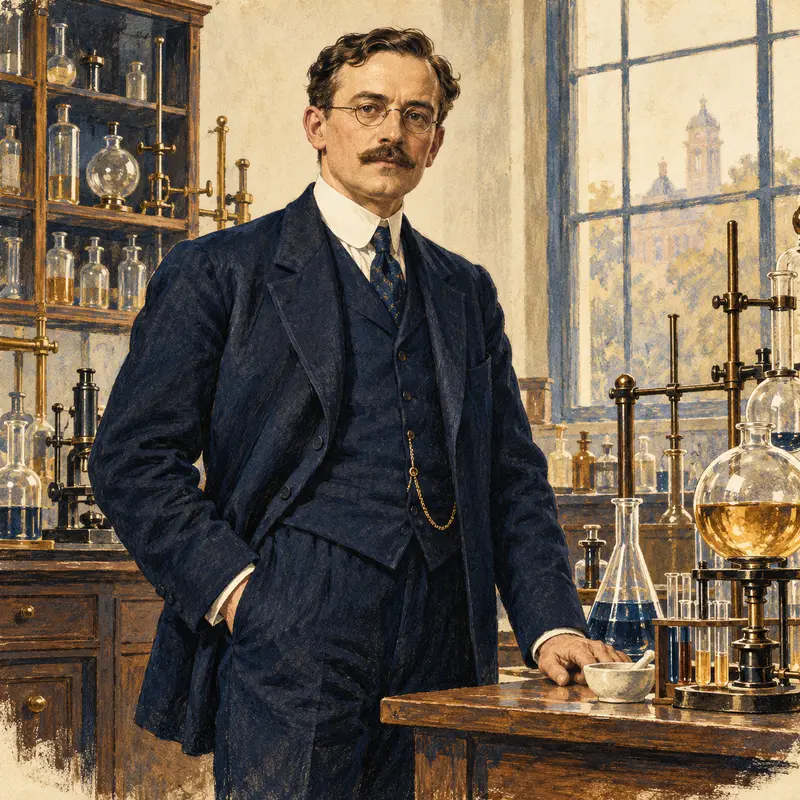
About the chemist
Gilbert N. Lewis
1875-1946 · United States
Covalent bond; Lewis acids and bases