Biography · Chemist no. 75 of 350
Giulio Natta: The Italian Engineer Who Gave Plastics a Shape
Giulio Natta (1903-1979) was an Italian chemical engineer and professor at the Politecnico di Milano who discovered how to make stereoregular polymers. Using catalysts based on Karl Ziegler's work, he produced isotactic polypropylene in 1954 and developed the language of tacticity. He shared the 1963 Nobel Prize in Chemistry with Ziegler. His legacy in one line: he showed that the three-dimensional arrangement of atoms in a polymer chain decides what kind of material it becomes.
Early Life and Family
Giulio Natta was born on 26 February 1903 in Imperia, a coastal town in Liguria, in northwest Italy. His father was a judge, and his family encouraged learning. As a student Natta did well in mathematics and science, and his school years in Genoa prepared him for university. He was drawn to the practical power of chemistry and chose to study chemical engineering instead of pure mathematics, which was his first inclination. His early life unfolded in the years after the First World War, a time when Italy was building its industries and technical universities.
Education and Mentors
Natta studied chemical engineering at the Politecnico di Milano and graduated in 1924 with a degree in chemical engineering. He then became an assistant to Giuseppe Bruni, a physical chemist who was interested in solid-state chemistry and X-ray methods. Under this influence, he developed expertise in X-ray and electron diffraction, which he used to study the structures of catalysts and crystalline solids. These skills in diffraction later came together with polymer science in his great discovery.
Career Timeline
| Year | Event |
|---|---|
| 1903 | Born in Imperia, Italy |
| 1924 | Graduates in chemical engineering, Politecnico di Milano |
| 1933 | Becomes professor at Pavia University |
| 1935 | Moves to the Politecnico di Torino (Turin) as professor |
| 1938 | Becomes professor and director of the Institute of Industrial Chemistry at the Politecnico di Milano |
| 1930s-40s | Works on methanol, higher alcohols and synthetic rubber with Montecatini |
| 1954 | Produces isotactic polypropylene |
| 1957 | Commercial production of polypropylene (Moplen) begins |
| 1963 | Nobel Prize in Chemistry (with Ziegler) |
| 1979 | Dies in Bergamo, Italy |
Major Scientific Contributions
Natta's work can be grouped into three areas. Early on, he applied X-ray and electron diffraction to catalysts and studied industrial reactions such as methanol synthesis and the oxo process. Second, in the 1950s he studied the polymerisation of olefins with Ziegler-type catalysts, discovered isotactic polypropylene and explained stereoregular polymerisation. Third, he developed new synthetic rubbers by controlled polymerisation of dienes. He defined the terms isotactic, syndiotactic and atactic, and he established the helical structure of crystalline polypropylene with the help of his group. You can read the mechanism and structures in our discovery post.
Awards, Honours and Nobel Prize
- Nobel Prize in Chemistry, 1963, shared with Karl Ziegler, "for their discoveries in the field of the chemistry and technology of high polymers".
- Honorary doctorates from several universities and membership in many scientific academies.
Personality, Struggles and Lesser-Known Facts
- Illness: In his later years, Natta suffered from Parkinson's disease, which caused tremor and difficulty with movement. Although his health worsened, he continued to direct his research group, with his collaborators helping to write and carry out experiments.
- A strong team: His group included Paolo Corradini, Giorgio Mazzanti, Giuseppe Allegra and others who made major contributions to polymer science.
- University and industry together: His collaboration with the company Montecatini showed how a university laboratory and an industrial partner could develop a discovery into a product in just a few years.
- Dispute with Ziegler: The commercial use of the catalyst and priority claims over polypropylene led to patent disputes involving both sides and their sponsoring companies.
- Dedicated teacher: He insisted that students learn both the theory and the engineering of chemical processes.
- Family: He married Rosita Beati in 1935, and they had two children.
Legacy and Influence on Modern Chemistry
Almost every chemistry student first meets Natta's name together with Ziegler's in the term "Ziegler-Natta catalyst". Polypropylene is now one of the most widely used plastics in the world, found in packaging, textiles, cars and medical devices. The idea of controlling stereochemistry during polymerisation spread to metallocene catalysts, which give polymers with more precise structure. His work also supports the whole concept of tacticity, an essential concept in polymer chemistry courses. In India, the study of polymer stereochemistry features in M.Sc. syllabi, and polypropylene plants across the country run on principles first shown in Natta's laboratory.
Natta's story also shows the value of structural thinking in chemistry. When he examined the crystalline fraction of polypropylene, he did not stop at saying that it was a new plastic. He asked how the atoms were arranged in space, and he used diffraction to find the helical conformation of the chain. This habit of linking structure with properties is exactly what examination questions on polymers test: tacticity, crystallinity, melting point and mechanical strength are all different views of the same three-dimensional structure. Students who practise drawing isotactic, syndiotactic and atactic chains carefully find these questions much easier.
Lessons for Students
- Knowing both physical methods (X-ray diffraction) and synthetic chemistry gives a strong edge.
- Structure controls properties; always ask how the atoms are arranged.
- Build bridges between university research and industry.
- Continue your work with courage even when health challenges arise.
Quick Facts Box
- Born: 26 February 1903, Imperia, Italy
- Died: 2 May 1979, Bergamo, Italy
- Nationality: Italian
- Field: Industrial chemistry, polymer chemistry
- Famous for: Isotactic polypropylene; stereoregular polymers
- Nobel: Chemistry, 1963 (with Karl Ziegler)
FAQ
What is Natta famous for?
For discovering isotactic polypropylene and the concept of stereoregular polymers.
Which company supported his research?
Montecatini, an Italian chemical company, which commercialised polypropylene.
Why is he linked with Ziegler?
Because Natta used a catalyst based on Ziegler's discovery for propylene, and both shared the 1963 Nobel Prize.
Which disease affected Natta in later life?
Parkinson's disease, but he continued to lead his team for years.
Published by ABC Chemistry — IIT-JAM | CSIR-NET | GATE Chemistry Coaching. Visit abcchemistry.com
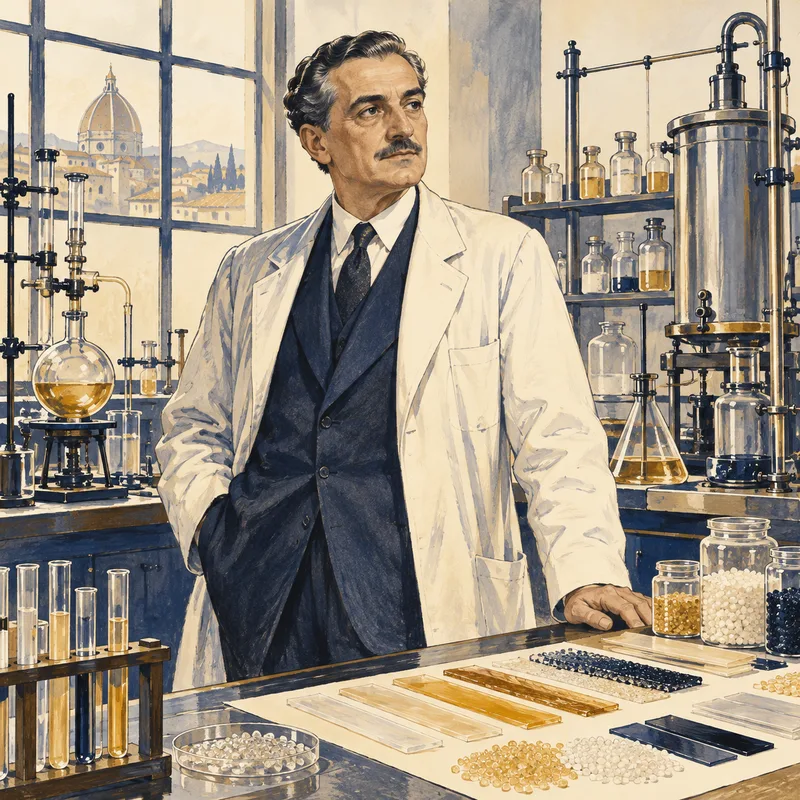
About the chemist
Giulio Natta
1903-1979 · Italy · Nobel Chemistry 1963
Stereoregular polypropylene; Ziegler-Natta catalysts