The discovery, explained · Chemist no. 75 of 350
Giulio Natta and Isotactic Polypropylene: Controlling the Shape of Polymers
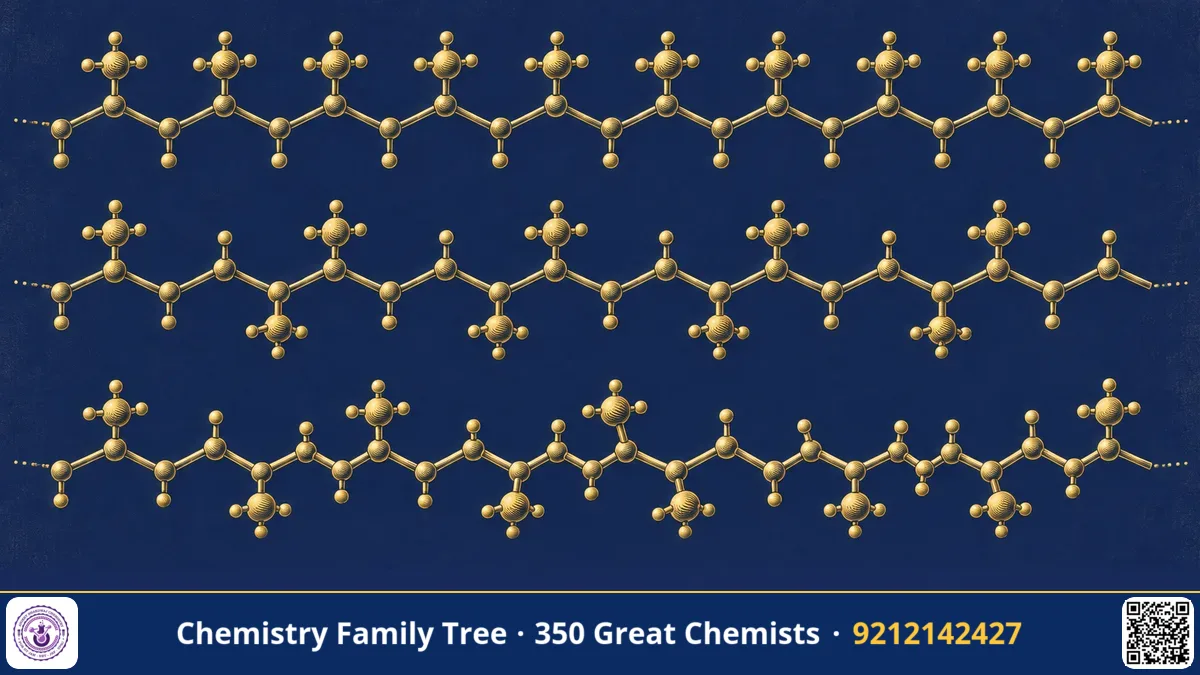
In March 1954, in a laboratory at the Politecnico di Milano, the Italian chemist Giulio Natta and his group polymerised propylene using a catalyst of the Ziegler type and obtained a solid, crystalline plastic. Until then propylene had given only sticky oils or low-grade polymers. The new material was isotactic polypropylene, a polymer in which all the methyl groups lie on the same side of the chain. Natta realised that the catalyst did not just join monomers; it controlled the three-dimensional arrangement of every unit. He called such polymers stereoregular, and defined the terms isotactic, syndiotactic and atactic. For this work he shared the 1963 Nobel Prize in Chemistry with Karl Ziegler.
The Scientific Problem Before the Discovery
Ethylene (CH2=CH2) is symmetrical, so the polymer chain has no stereochemical choice at each step. Propylene (CH2=CH–CH3) is different. Every time a monomer is added, one carbon atom of the chain becomes a stereocentre, carrying a methyl group on one side or the other. If the choice is random, as in free-radical polymerisation, the result is an irregular chain called atactic polymer. Atactic polypropylene cannot crystallise, and is soft, rubbery or oily, so it has little use as a plastic.
Chemists therefore asked whether there was a way to force each monomer to add in the same orientation. If so, the chain would have a regular structure and could pack in a crystal lattice. After Ziegler's discovery of a low-pressure catalyst for ethylene in 1953, the question was whether such catalysts could also control propylene polymerisation.
The Discovery: Step-by-Step
- Applying the catalyst to propylene. Natta, who worked as a consultant with the company Montecatini, obtained a sample of Ziegler's catalyst system and applied it to propylene. On 11 March 1954 his group obtained a polymer.
- Fractionation. The crude polymer was extracted with boiling solvents such as diethyl ether and n-heptane. The ether-soluble part was amorphous (atactic) polymer. The residue insoluble in boiling heptane was highly crystalline.
- X-ray diffraction. Natta was an expert in X-ray diffraction and electron diffraction and had trained in that field. Diffraction of the crystalline fraction showed a regular repeating pattern with a helical conformation of three monomer units per turn.
- Naming the structures. With his colleagues Paolo Corradini and others, he proposed that the crystalline polymer was isotactic. They also described syndiotactic polymers, in which the methyl groups alternate regularly from one side to the other.
- Industrial development. Montecatini started commercial production of isotactic polypropylene in 1957 under the trade name Moplen.
The Chemistry Behind It
When the polymer chain is drawn as a zigzag in the plane of the paper, three arrangements are possible for the substituents (R = CH3):
Isotactic     : all CH3 groups on the same side of the chain
Syndiotactic  : CH3 groups alternate regularly (up, down, up, down)
Atactic       : CH3 groups placed randomly
This property is called tacticity. Isotactic and syndiotactic polymers are stereoregular and can crystallise. Isotactic polypropylene (iPP) has a melting point near 165 °C, compared with about 130 °C for HDPE, and it is stiff and strong. Atactic polypropylene is amorphous and soft.
The stereocontrol arises because the active centre of the heterogeneous catalyst (TiCl3 crystal surface with an alkylaluminium co-catalyst) is chiral and has a fixed geometry. Each propylene molecule coordinates to the titanium site with a preferred face and inserts into the growing Ti–C bond (the Cossee-Arlman mechanism). The same face is chosen each time, producing the same configuration at each stereocentre. In an isotactic chain the helical form arises because the methyl groups avoid steric hindrance; the chain adopts a 3₁ helix (three units per turn).
Natta also produced stereoregular polymers from other monomers such as 1-butene and styrene, and found catalysts that give cis-1,4-polyisoprene, which is like natural rubber, and cis-1,4-polybutadiene. He developed a convention, called the Natta projection, for drawing polymer chain structures with stereochemical detail.
Applications Today
- Packaging: Polypropylene films and containers for food, medicines and consumer goods.
- Textiles and household goods: Carpets, ropes, chairs, buckets and non-woven fabrics, including surgical masks.
- Automobiles: Bumpers, battery cases and interior panels are made of polypropylene compounds.
- Medical: Syringes and reusable laboratory ware, since PP withstands autoclave sterilisation.
- Synthetic rubber: Stereospecific polymerisation of dienes gives tyre rubbers.
- India: Indian plants produce polypropylene on a large scale for packaging and woven sacks used in agriculture.
Exam Corner
- Isotactic: substituents on the same side; syndiotactic: alternate; atactic: random.
- Ziegler-Natta catalyst gives stereoregular polypropylene; free-radical polymerisation gives atactic polypropylene.
- Isotactic PP is crystalline, with a melting point of about 165 °C.
- Coordination polymerisation proceeds by monomer coordination and migratory insertion.
- The 1963 Nobel Prize in Chemistry was shared by Ziegler and Natta.
Common Misconceptions
- "Natta invented the catalyst." The catalyst was developed from Ziegler's work. Natta's contribution was stereoregular polymerisation of propylene and the concept of tacticity.
- "Tacticity is the same as cis-trans isomerism." Tacticity concerns configuration at stereocentres along the chain; cis-trans refers to double bond geometry, as in polyisoprene.
- "All polypropylene is the same." Properties depend strongly on tacticity, molecular weight and crystallinity.
Quick Revision Box
- First isotactic polypropylene: 11 March 1954, Milan.
- Tacticity types: isotactic, syndiotactic, atactic.
- iPP melts near 165 °C and forms a 3₁ helix.
- Stereocontrol from chiral surface sites of the catalyst.
- Commercial production by Montecatini from 1957 (Moplen).
- Nobel Prize in Chemistry 1963 (with Ziegler).
FAQ
Why does atactic polypropylene not crystallise?
Its irregular arrangement of methyl groups prevents the chains from packing in a regular lattice.
What does "stereoregular" mean?
It means that the configuration of stereocentres along the chain follows a regular pattern, such as always the same (isotactic) or alternating (syndiotactic).
What made Natta's X-ray work important?
It proved the regular crystalline structure and the helical shape of the polymer, which supported the concept of stereoregular polymerisation.
Is polypropylene a thermoplastic?
Yes. It softens on heating and can be moulded, then hardens on cooling.
Published by ABC Chemistry — IIT-JAM | CSIR-NET | GATE Chemistry Coaching. Visit abcchemistry.com
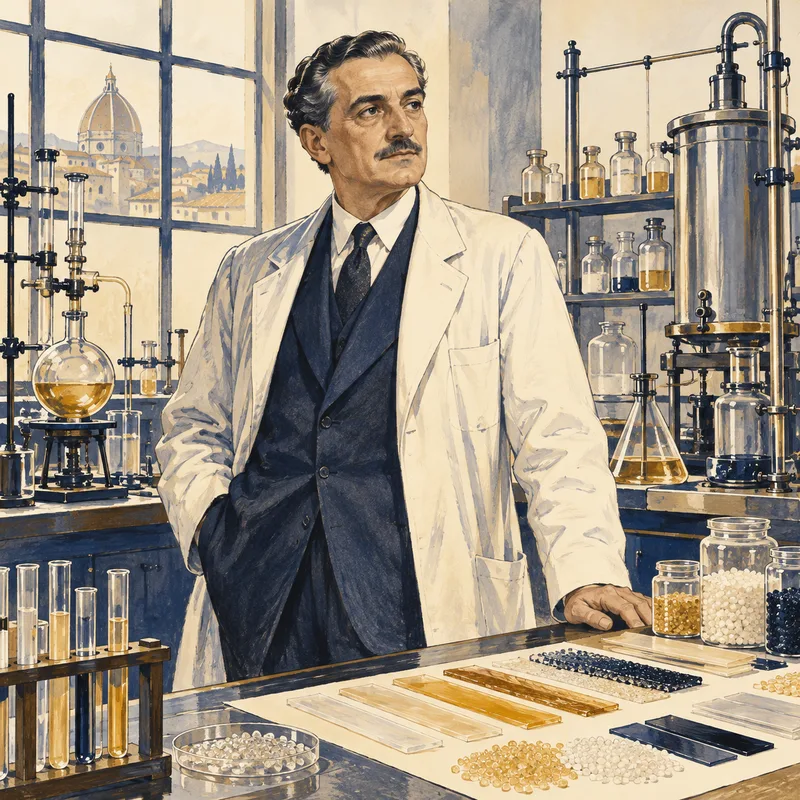
About the chemist
Giulio Natta
1903-1979 · Italy · Nobel Chemistry 1963
Stereoregular polypropylene; Ziegler-Natta catalysts