The discovery, explained · Chemist no. 37 of 350
Glenn Seaborg and the Actinide Concept
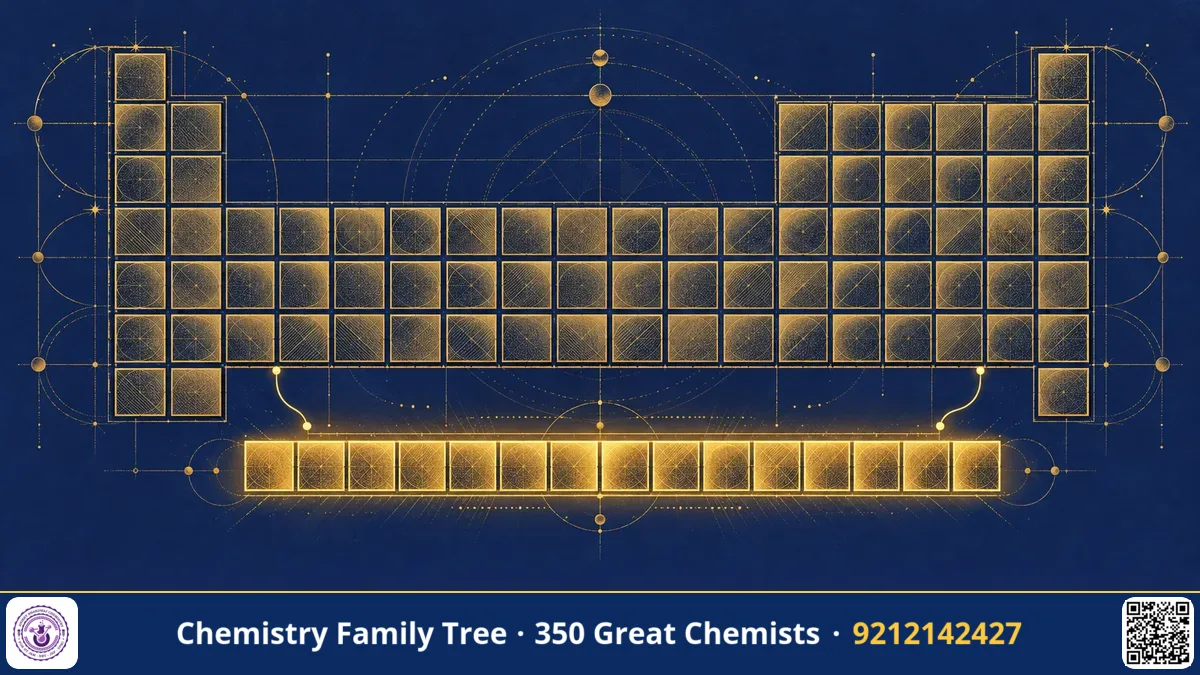
Look at the bottom of the periodic table. Two rows of elements are placed below the main body: the lanthanides and the actinides. The second row, from actinium to lawrencium, is there because of Glenn Theodore Seaborg. In 1944-45 he proposed the actinide concept: the heavy elements from actinium onwards form a new series in which the 5f subshell is filled, just as the 4f subshell is filled in the lanthanides. He and his co-workers at the University of California, Berkeley, also discovered or co-discovered plutonium and nine more transuranium elements. Seaborg shared the 1951 Nobel Prize in Chemistry with Edwin McMillan for their discoveries in the chemistry of the transuranium elements. This post explains how he did it and why it matters.
The Scientific Problem Before the Discovery
Mendeleev's table of 1869 ended with uranium (atomic number 92). By the late 1930s, with Chadwick's discovery of the neutron and the invention of the cyclotron by Ernest Lawrence at Berkeley, scientists could try to make elements heavier than uranium. In 1940 Edwin McMillan and Philip Abelson produced element 93, neptunium, by bombarding uranium with neutrons.
The chemistry of these new elements was a puzzle. Chemists placed thorium, protactinium and uranium under hafnium, tantalum and tungsten in the periodic table, as members of groups 4, 5 and 6. If this was correct, element 93 should resemble rhenium, and element 94 should resemble osmium. But in experiments, the new elements did not behave like that. They were hard to separate, since they behaved more like uranium and the rare earths. Where should they be placed in the table? The problem was practical as well as conceptual, because scientists had to know the chemistry to isolate and identify each new element in tiny amounts.
The Discovery: Step by Step
Step 1: Discovery of plutonium (1940-41)
Seaborg was a young chemist at Berkeley. In December 1940 he, Edwin McMillan, Joseph Kennedy and Arthur Wahl bombarded uranium with deuterons (nuclei of heavy hydrogen) in the 60-inch cyclotron. They made neptunium-238, which decays by beta emission to element 94:
²³⁸₉₂U + ²₁H → ²³⁸₉₃Np + 2 ¹₀n
²³⁸₉₃Np →(β⁻)→ ²³⁸₉₄Pu
Using chemistry, they showed that the new substance could be oxidised to a higher oxidation state and was not a simple analogue of osmium. They named it plutonium, after the planet Pluto, which comes after Neptune. In 1941 they showed that the isotope plutonium-239 is fissile with slow neutrons, like uranium-235. Pu-239 can be produced in reactors from uranium-238:
²³⁸₉₂U + ¹₀n → ²³⁹₉₂U →(β⁻)→ ²³⁹₉₃Np →(β⁻)→ ²³⁹₉₄Pu
Step 2: Working with invisible amounts
During the Second World War, Seaborg worked at the Metallurgical Laboratory of the University of Chicago on the Manhattan Project, developing chemical methods to extract plutonium from irradiated uranium. At first the quantities were so small that they were weighed with microbalances: in 1942, the first visible sample of a plutonium compound was only a few micrograms. Seaborg's team developed oxidation-reduction and precipitation methods, such as the bismuth phosphate process, to separate plutonium from uranium and from the intensely radioactive fission products.
Step 3: The actinide concept (1944-45)
Working on the chemistry of americium (95) and curium (96), Seaborg noticed that they did not behave like elements of groups 7 and 8. They behaved much like the rare earth elements, with a stable +3 oxidation state. He proposed that the elements from actinium (89) onwards form a series in which the 5f orbitals are filled, analogous to the lanthanide series, where the 4f orbitals are filled:
Lanthanides:  La (57) → Lu (71)    filling 4f
Actinides:    Ac (89) → Lr (103)   filling 5f
This predicted the chemical properties of undiscovered elements, and it guided the discovery of americium and curium and many that followed. It was a bold move, because he moved thorium, protactinium and uranium out of groups 4, 5 and 6 conceptually, and some colleagues advised him that it would harm his reputation. The idea proved correct.
Step 4: More elements
Seaborg and his team discovered or co-discovered plutonium (94), americium (95), curium (96), berkelium (97), californium (98), einsteinium (99), fermium (100), mendelevium (101) and nobelium (102), although credit for nobelium was disputed with other laboratories. Later, seaborgium (106) was discovered at Berkeley by a team including Albert Ghiorso, and in 1997 it was named for him while he was still alive. Seaborg also helped to discover many isotopes, among them iodine-131 and technetium-99m (with Emilio Segrè), which are widely used in medicine.
The Chemistry Behind It
Electronic configuration
The actinides are f-block elements. Their general configuration is [Rn] 5f¹⁻¹⁴ 6d⁰⁻² 7s². The 5f orbitals are more extended than the 4f orbitals of the lanthanides, so they take part more in bonding. This leads to a wider range of oxidation states.
Oxidation states
| Element | Common oxidation states |
|---|---|
| Thorium (Th) | +4 |
| Uranium (U) | +3, +4, +5, +6 (+6 as UO₂²⁺) |
| Plutonium (Pu) | +3, +4, +5, +6 (up to four states can coexist in solution) |
| Americium (Am) onwards | +3 is the most stable |
Actinide contraction
Ionic radii decrease across the actinides because poor shielding by 5f electrons increases effective nuclear charge, similar to the lanthanide contraction.
Radioactivity
All actinides are radioactive. Their handling requires gloveboxes and special chemical methods based on ion exchange, solvent extraction and precipitation.
Making heavy elements
Heavier elements are made by neutron capture in reactors and by bombardment with accelerated light ions in cyclotrons. For example, einsteinium and fermium were first identified in debris from the 1952 thermonuclear test, and mendelevium was made in 1955 by bombarding einsteinium-253 with alpha particles.
Applications Today
- Nuclear power: uranium-235 and plutonium-239 are fuels in reactors; mixed-oxide (MOX) fuel contains plutonium.
- Smoke detectors: americium-241 emits alpha particles that ionise air in household detectors.
- Space exploration: plutonium-238 powers radioisotope thermoelectric generators on deep-space probes.
- Medicine: technetium-99m is used for diagnostic imaging, and iodine-131 for thyroid treatment, both of which Seaborg's group helped to discover.
- Research: californium-252 is a strong neutron source for industry and research.
- India context: India's thorium-based nuclear programme, designed by Homi Bhabha, uses actinide chemistry, and BARC has developed reprocessing methods based on solvent extraction.
Exam Corner
- Actinides (Z = 89 to 103) fill the 5f subshell. Lanthanides (Z = 57 to 71) fill 4f.
- Most actinides show +3; uranium and plutonium show several oxidation states. Actinides show a wider range of oxidation states than lanthanides.
- All actinides are radioactive. Transuranium elements are those with Z greater than 92.
- Plutonium was named after Pluto, neptunium after Neptune, and uranium after Uranus.
- Seaborg shared the 1951 Nobel Prize in Chemistry with McMillan. Element 106 (seaborgium) was named for him in his lifetime.
Common Misconceptions
- "Actinides are only man-made." Thorium and uranium are found in nature, and traces of plutonium occur in uranium ores.
- "The actinide series has the same properties as the lanthanides." The first half of the series shows more variable oxidation states because 5f electrons are less buried.
- "Seaborg invented the atomic bomb." He worked on plutonium chemistry but was also active later in arms control.
Quick Revision Box
- 1940-41: Plutonium discovered by Seaborg, McMillan, Kennedy and Wahl.
- 1944-45: Seaborg proposes the actinide concept (5f filling).
- Elements co-discovered by his teams: Pu, Am, Cm, Bk, Cf, Es, Fm, Md, No (and later Sg).
- Seaborgium (Z = 106) named in his honour while he lived.
- Actinides: +3 stable for heavier members; U and Pu have multiple states.
- Nobel Prize in Chemistry 1951 (shared with McMillan).
FAQ
Why are the actinides placed separately in the periodic table?
To keep the table compact. They belong between groups 2 and 3 (actinium to lawrencium), but showing them there would make the table too wide.
How many elements did Seaborg discover?
He is credited as a co-discoverer of ten elements: plutonium to nobelium, plus seaborgium. Credit for some of them was shared with other teams.
Why is plutonium important?
Plutonium-239 is fissile and can be produced from uranium-238, so it is used as nuclear fuel and in weapons.
What is the difference between lanthanides and actinides?
Lanthanides fill 4f orbitals and are mostly stable and non-radioactive (except promethium), while actinides fill 5f orbitals and are all radioactive.
Published by ABC Chemistry — IIT-JAM | CSIR-NET | GATE Chemistry Coaching. Visit abcchemistry.com

About the chemist
Glenn T. Seaborg
1912-1999 · United States · Nobel Chemistry 1951
Transuranium elements; actinide concept