Biography · Chemist no. 37 of 350
Glenn T. Seaborg: The Element Hunter of Berkeley
Introduction
Glenn Theodore Seaborg (1912-1999) was an American nuclear chemist who changed the periodic table more than any other person after Mendeleev. He co-discovered plutonium and nine other elements, proposed the actinide concept, won the 1951 Nobel Prize in Chemistry, served as chancellor of the University of California, Berkeley, and chaired the United States Atomic Energy Commission for a decade. His legacy in one line: he extended the periodic table beyond uranium and reorganised its bottom rows.
Early Life and Family
Seaborg was born on 19 April 1912 in Ishpeming, a mining town in Michigan's Upper Peninsula. His parents were of Swedish descent, and Swedish was spoken at home. When he was about ten years old, the family moved to the Los Angeles area in California, where he grew up in a working-class neighbourhood in South Gate. His mother, Selma, who had only a limited education herself, strongly encouraged him to study. He attended David Starr Jordan High School in Watts, Los Angeles. He first showed interest in literature and was not strongly drawn to science until a high school chemistry and physics teacher, Dwight Logan Reid, inspired him.
Education and Mentors
Seaborg worked in a laboratory in the summer to earn his fees and then entered the University of California, Los Angeles (UCLA), graduating in chemistry in 1934. He then joined the University of California, Berkeley, for graduate study, working with nuclear chemistry and receiving his PhD in 1937 with a thesis on neutron scattering. At Berkeley he was part of the circle of Gilbert N. Lewis, who was dean of the chemistry department, and he worked closely with Ernest Lawrence, inventor of the cyclotron, and Edwin McMillan. Lewis remained a role model for him. Seaborg later said that his Berkeley years placed him at the right place at the right time.
Career Timeline
| Year | Event |
|---|---|
| 1912 | Born in Ishpeming, Michigan (19 April) |
| 1934 | Graduates from UCLA |
| 1937 | PhD in chemistry at Berkeley |
| 1937-38 | With Segrè, co-discovers technetium-99m; with Livingood, iodine-131 |
| 1940-41 | Co-discovers plutonium |
| 1942-46 | Leads plutonium chemistry research at the Metallurgical Laboratory, University of Chicago (Manhattan Project) |
| 1944-45 | Proposes the actinide concept; helps discover americium and curium |
| 1946 | Returns to Berkeley as professor of chemistry |
| 1949-55 | Co-discovers berkelium, californium, einsteinium, fermium and mendelevium |
| 1951 | Wins the Nobel Prize in Chemistry (with Edwin McMillan) |
| 1958-61 | Chancellor of the University of California, Berkeley |
| 1961-71 | Chairman of the US Atomic Energy Commission |
| 1974 | Team at Berkeley discovers element 106 |
| 1997 | Element 106 named seaborgium during his lifetime |
| 1999 | Dies in Lafayette, California (25 February) |
Major Scientific Contributions
- Co-discovery of ten elements: plutonium (94), americium (95), curium (96), berkelium (97), californium (98), einsteinium (99), fermium (100), mendelevium (101), nobelium (102) and seaborgium (106).
- The actinide concept: the heavy elements actinium to lawrencium form a 5f series, similar to the lanthanides.
- Medical isotopes: iodine-131 and technetium-99m, widely used in diagnosis and treatment.
- Plutonium chemistry: methods for separating plutonium in tiny amounts, including the bismuth phosphate process.
- Science policy: support for the Partial Test Ban Treaty of 1963 and the Non-Proliferation Treaty of 1968 during his time at the Atomic Energy Commission.
For details of plutonium and the actinide series, read the companion post on the actinide concept.
Awards, Honours and Nobel Prize
- Nobel Prize in Chemistry, 1951, shared with Edwin McMillan, for discoveries in the chemistry of the transuranium elements.
- Enrico Fermi Award, 1959, from the United States government.
- National Medal of Science, 1991, and many other awards from scientific societies, along with dozens of honorary degrees.
- Seaborgium (Sg, Z = 106) was named in his honour, making him the first person to have an element named after him during his lifetime.
Personality, Struggles and Lesser-Known Facts
- A late arrival to science. He did not plan to study chemistry as a child. A good teacher changed his direction.
- Respect for the public. At the Atomic Energy Commission he promoted peaceful uses of the atom and arms control, and served under Presidents Kennedy, Johnson and Nixon.
- Concern about bombs. In 1945 he was a member of the Chicago committee that wrote the Franck Report, which urged that the atomic bomb should first be demonstrated rather than used on a city without warning.
- Family. He married Helen Griggs in 1942, and they had several children.
- Last years. He suffered a stroke in 1998 and died in 1999.
Legacy and Influence on Modern Chemistry
The modern periodic table, with the actinide series in its own row, is his legacy. Every chemistry student who learns about f-block elements, the +3 state of heavy elements or the production of artificial elements is learning Seaborg's ideas. His work on isotopes like iodine-131 and technetium-99m has helped millions of patients. Because plutonium and americium are used in energy, space missions and household smoke detectors, his work touches daily life. After he, scientists in the United States, Russia, Germany and Japan have extended the table to element 118.
Lessons for Students
- A good teacher can change your life. Be open to inspiration.
- Be bold with ideas. The actinide concept looked risky but was right.
- Work with others. Discoveries at Berkeley were team efforts.
- Use science for society. Seaborg worked for arms control and education.
- Keep a notebook. He kept detailed journals throughout his life.
Quick Facts Box
- Born: 19 April 1912, Ishpeming, Michigan, USA
- Died: 25 February 1999, Lafayette, California, USA
- Nationality: American
- Field: Nuclear chemistry
- Famous for: Plutonium and other transuranium elements, actinide concept
- Nobel Prize: Chemistry, 1951 (shared with Edwin McMillan)
FAQ
Which elements did Seaborg discover?
He co-discovered plutonium, americium, curium, berkelium, californium, einsteinium, fermium, mendelevium, nobelium and seaborgium.
What is the actinide concept?
It is the idea that elements from actinium onward form a series in which the 5f subshell is filled.
Where did Seaborg work?
Mainly at the University of California, Berkeley, with wartime service in Chicago and a decade in Washington as head of the Atomic Energy Commission.
Which element is named after him?
Seaborgium, atomic number 106.
Published by ABC Chemistry — IIT-JAM | CSIR-NET | GATE Chemistry Coaching. Visit abcchemistry.com
About the chemist
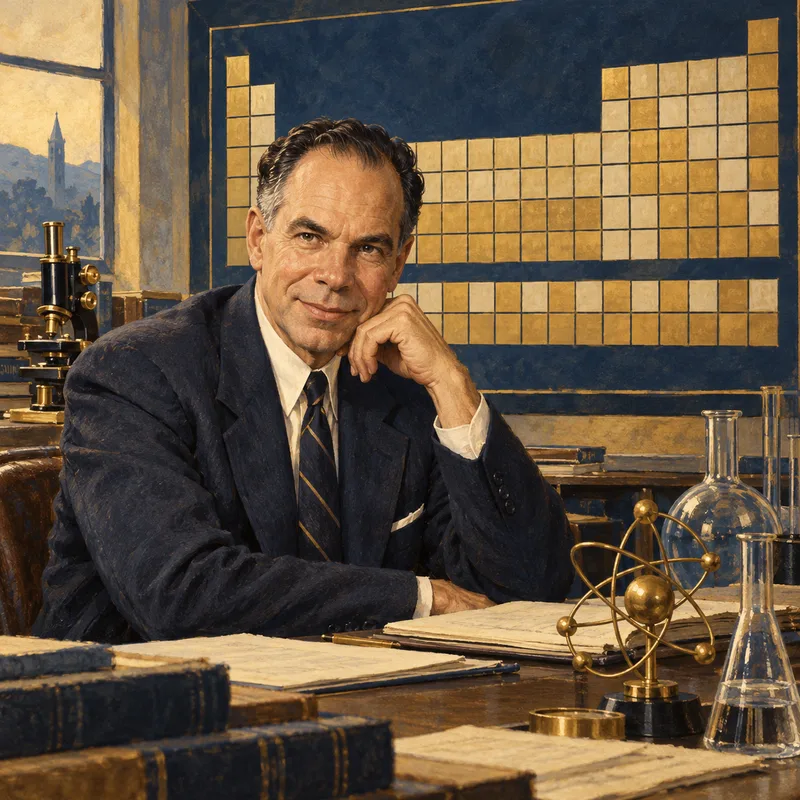
Glenn T. Seaborg
1912-1999 · United States · Nobel Chemistry 1951
Transuranium elements; actinide concept