The discovery, explained · Chemist no. 262 of 350
Graham's Law: Why Light Gases Escape Faster
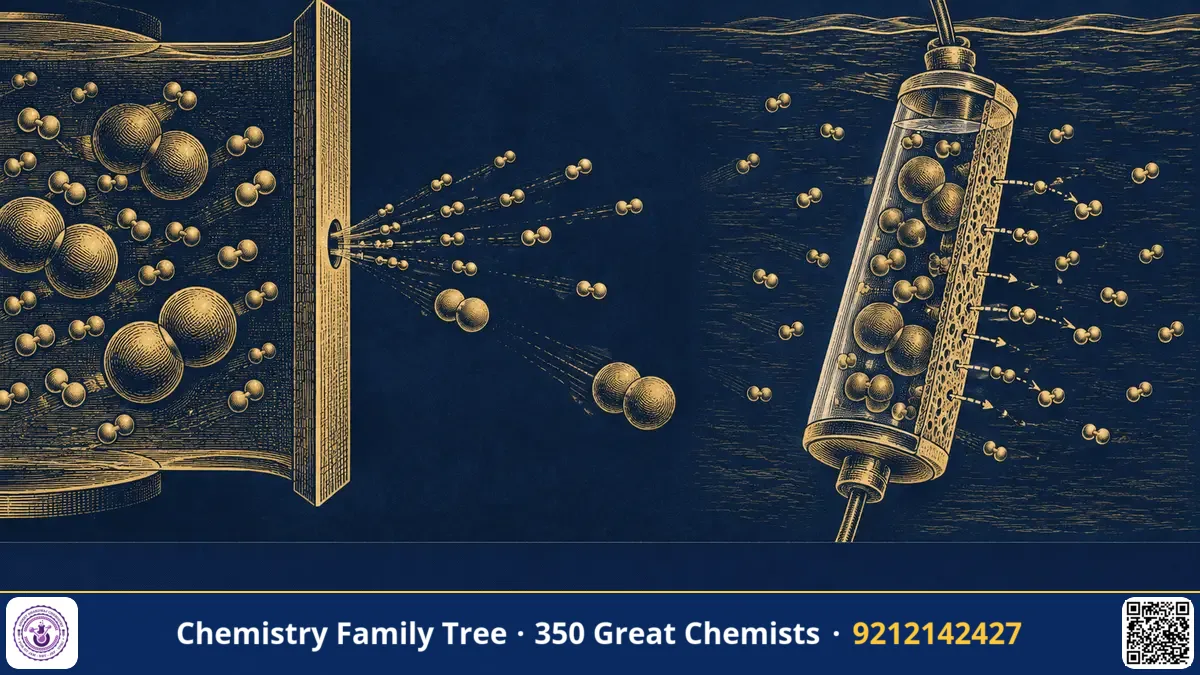
Open a bottle of perfume at one end of a room and the smell reaches the other end within minutes. Fill a balloon with hydrogen, and it shrinks faster than one filled with air. These common experiences are explained by Graham's law, discovered by the Scottish chemist Thomas Graham in 1829-1833. It states that the rate of diffusion or effusion of a gas is inversely proportional to the square root of its molar mass. Graham also created the word "colloid" and the technique of dialysis, which is the base of the artificial kidney. This blog explains both discoveries in simple language.
The Scientific Problem Before the Discovery
In the early 19th century, chemists knew that gases mix on their own, even if the heavier gas is below the lighter one. This is diffusion. John Dalton had observed that gases mix even against gravity. But nobody knew the quantitative rule connecting the speed of mixing to a property of the gas. The kinetic theory of gases was still being developed, and Avogadro's hypothesis had not yet been widely accepted.
Separately, chemists had trouble in understanding substances like glue, starch, gelatin and gum that did not crystallise and that did not pass through animal membranes. Their nature was not clear.
The Discovery: Graham's Experiments
Diffusion and effusion of gases. Graham used a tube with a porous plaster-of-Paris plug at one end. He filled it with a gas and measured how long it took for the gas to escape through the plug in comparison with air entering. He used different gases: hydrogen, nitrogen, oxygen, carbon dioxide and others. In 1831 he reported that the rate of diffusion varies inversely with the square root of the gas density. Later, he studied effusion through a very small hole (1846 onward) with similar results.
Rate1 / Rate2 = √(M2 / M1) = √(d2 / d1)    (at same T and P)
Also:  r1/r2 = t2/t1 = √(M2/M1)
Example: Compare hydrogen (M = 2) and oxygen (M = 32).
r(H2) / r(O2) = √(32/2) = √16 = 4
Hydrogen diffuses four times as fast as oxygen.
Colloids and dialysis (1861). Graham compared the diffusion of many substances in water through a parchment membrane. Substances such as salt, sugar and urea passed through easily; he called them crystalloids. Others like gelatin, starch, albumin and gum arabic hardly passed through; he called them colloids (from the Greek kolla, glue). He used the separation technique called dialysis, in which a mixture is put in a bag of parchment or similar membrane in a flow of pure water, so that small molecules and ions pass out while the colloidal particles stay inside.
The Chemistry Behind It
The kinetic theory explains Graham's law. At the same temperature, all gases have the same average kinetic energy:
½ m1 v1² = ½ m2 v2² → v1 / v2 = √(m2 / m1)
Lighter molecules move faster on average. The rate of effusion is proportional to the average speed, so lighter gases effuse faster.
- Diffusion is the spreading of a gas through another gas by random motion; effusion is the escape of gas through a tiny hole into vacuum. Graham's law is exact for effusion and approximate for diffusion, because collisions between molecules matter.
- Time form: For equal volumes, t₁/t₂ = √(M₁/M₂).
- Dependence on pressure and temperature: At the same pressure, rate ∝ 1/√M; at the same temperature, rate ∝ P/√M if pressures differ.
- Colloids: Colloidal particles are 1-1000 nm in size and are too large to pass through semipermeable membranes, which allow small molecules to pass. This is why dialysis works. Graham's early idea that colloids were a different kind of matter was replaced later by the idea that they are a state of dispersion (a gelatin particle can be a colloid, but common salt can also be made into a colloid in benzene).
Example problem: A gas X takes 2.5 times longer than oxygen to effuse through a small hole. Find its molar mass.
t(X)/t(O2) = √(M(X)/32) = 2.5 → M(X) = 32 × 6.25 = 200 g/mol
Applications Today
- Uranium enrichment: Natural uranium contains 0.7 percent U-235. By converting it to UF₆ gas, the lighter ²³⁵UF₆ effuses slightly faster than ²³⁸UF₆ (ratio √(352/349) ≈ 1.0043). Repeating this thousands of times in the gaseous diffusion process enriches uranium for reactors. Modern plants use centrifuges, based on similar mass differences.
- Hemodialysis: Artificial kidney machines remove urea and excess ions from the blood of patients with kidney failure using the principle of dialysis. Thousands of Indian patients depend on dialysis centres.
- Leak detection: Helium and hydrogen leaks are detected using their fast effusion.
- Purification of colloids: Dialysis removes electrolytes from sols such as Fe(OH)₃ sol, which is a standard Class 12 experiment.
- Gas analysis: Effusion rates have been used to find molar masses of unknown gases.
Exam Corner
- Graham's law: r ∝ 1/√M (at constant P and T); r₁/r₂ = √(M₂/M₁).
- H₂ effuses 4 times faster than O₂; He is √(32/4) = 2.83 times faster than O₂.
- Graham coined the terms colloid and crystalloid, and invented dialysis.
- Uranium enrichment uses UF₆: ratio of effusion rates is about 1.0043.
- Graham's law of effusion applies to gas escaping through an orifice smaller than the mean free path.
Common Misconceptions
- "Heavier gases diffuse faster." Lighter gases diffuse faster.
- "Diffusion and effusion are the same." Effusion needs a tiny hole into vacuum; diffusion is mixing of gases.
- "Colloids are always glue-like." The word means glue-like, but colloids are defined by particle size.
Quick Revision Box
- Graham's law: rate ∝ 1/√(molar mass).
- r₁/r₂ = √(M₂/M₁) = t₂/t₁.
- Explained by equal average kinetic energy at same T.
- Colloid and dialysis introduced by Graham (1861).
- Used in U-235 enrichment (UF₆) and dialysis.
- Colloid size: 1-1000 nm.
FAQ
What does Graham's law say?
The rate of diffusion or effusion of a gas is inversely proportional to the square root of its molar mass or density.
Who invented dialysis?
Thomas Graham, who described it in 1861 while studying colloids.
Why is UF₆ used for uranium enrichment?
Because it is a gas at moderate temperatures, and fluorine has only one natural isotope, so the mass difference comes only from uranium isotopes.
How much faster does hydrogen escape compared with oxygen?
Four times faster, since √(32/2) = 4.
Published by ABC Chemistry — IIT-JAM | CSIR-NET | GATE Chemistry Coaching. Visit abcchemistry.com
About the chemist
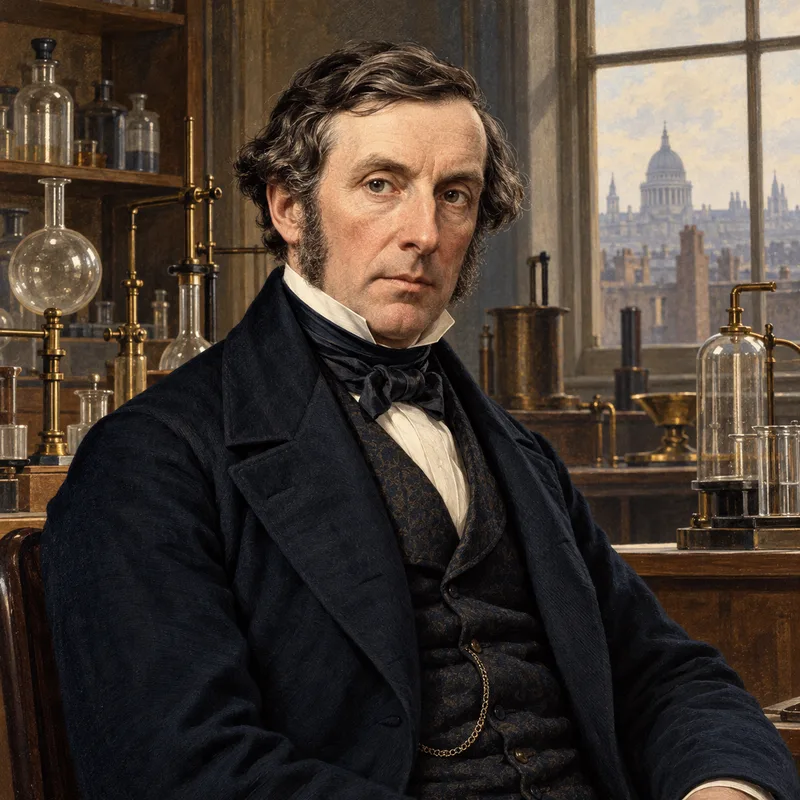
Thomas Graham
1805-1869 · United Kingdom
Graham's law; dialysis; colloid chemistry