Biography · Chemist no. 262 of 350
Thomas Graham (1805-1869): Father of Colloid Chemistry and Master of the Mint
Introduction
Thomas Graham was a Scottish chemist who formulated the law of diffusion and effusion of gases, invented dialysis and founded colloid chemistry. He later rose to become Master of the Royal Mint in London. His legacy in one line: he measured how molecules move, and showed that matter can exist in a colloidal state that is separate from true solutions.
Early Life and Family
Graham was born on 21 December 1805 in Glasgow, Scotland. His father, James Graham, was a prosperous textile manufacturer. Thomas was the son of a middle-class family with a Scottish Presbyterian background. His father wanted him to become a minister of the Church of Scotland, but Thomas developed a strong interest in chemistry and mathematics at school and at the university. After a time of tension between father and son, his father finally allowed him to follow chemistry, but cut his allowance, and Graham lived in modest conditions for some years.
Education and Mentors
He attended the University of Glasgow from 1819, taking an MA in 1824. There he studied under Thomas Thomson, professor of chemistry, who encouraged his scientific interest. He then went to Edinburgh to study further, where he attended lectures in chemistry and medicine, though he never finished a medical degree. Returning to Glasgow, he earned a living by teaching mathematics and chemistry privately and writing articles. In 1830 he became professor of chemistry at Anderson's University in Glasgow (today the University of Strathclyde).
Career Timeline
| Year | Event |
|---|---|
| 1805 | Born in Glasgow, 21 December |
| 1824 | MA, University of Glasgow |
| 1829-33 | Experiments leading to Graham's law of diffusion |
| 1830 | Professor of chemistry, Anderson's University, Glasgow |
| 1836 | Professor of chemistry at University College London; elected Fellow of the Royal Society |
| 1837 | Published Elements of Chemistry |
| 1841 | First president of the Chemical Society of London |
| 1846 | Further studies of effusion |
| 1855 | Became Master of the Mint |
| 1861 | Published papers on liquid diffusion, colloids and dialysis |
| 1869 | Died in London, 16 September |
Major Scientific Contributions
- Graham's law of diffusion: Rate of diffusion of a gas is inversely proportional to the square root of its density. See our discovery blog for the full explanation.
- Colloids and dialysis (1861): He separated substances into crystalloids and colloids, and developed dialysis.
- Phosphoric acids: In 1833 he showed that phosphoric acid exists in three forms: ortho-, pyro- and meta-phosphoric acids, with one, two and three equivalents of base. This was a key step in the concept of polybasic acids. In modern terms, H₃PO₄ is tribasic.
- Hydrogen occlusion by palladium: In 1866 he found that palladium absorbs large amounts of hydrogen (hundreds of times its own volume). He called the hydrogen-loaded metal "hydrogenium". This is the start of hydrogen storage in metals.
- Liquid diffusion: He measured the diffusion of salts in water, showing that different salts diffuse at different rates.
- Textbook: His Elements of Chemistry was widely used in Britain.
Awards, Honours and Nobel Prize
- Fellow of the Royal Society (1836); Copley Medal (1862) and Royal Medal (1850) of the Royal Society.
- First president of the Chemical Society of London (1841).
- Master of the Mint (1855-1869), a government post of high rank.
- No Nobel Prize, since he died decades before the prizes were created in 1901.
Personality, Struggles and Lesser-Known Facts
- He was a quiet and reserved man who lived simply, and his private life is little known.
- When his father cut off support for his choice of chemistry, Graham managed by teaching privately and by his own writing.
- As Master of the Mint, he supervised coinage and the quality of British coins, a post that used his chemical expertise but cost him research time.
- Alexander Williamson, famous for the Williamson ether synthesis, succeeded him as professor of chemistry at University College London.
- His colloid work went in an unexpected direction: he thought it was a basic difference in matter, but later scientists understood colloids as a state defined by particle size.
Legacy and Influence on Modern Chemistry
Graham's law is a standard result linking kinetic theory with experiment. Dialysis led to the artificial kidney, first used for patients in the 20th century, and today saves many lives, including in India. Colloid science, which Graham named, is important in paints, foods, medicines, cosmetics, nanotechnology and in the study of biological membranes. His work on phosphoric acids strengthened the concept of polybasic acidity taught in all courses on inorganic chemistry. His palladium-hydrogen work is relevant to modern hydrogen storage and fuel cells.
Lessons for Students
- Follow your calling. Graham chose chemistry against his father's wish.
- Measure carefully. His laws came from patient measurement of rates.
- Name new ideas. His terms colloid and dialysis are still in use.
- Science and public service can meet. He served the state at the Mint.
- Be ready to revise ideas. His view of colloids changed as science progressed.
Quick Facts Box
- Born: 21 December 1805, Glasgow
- Died: 16 September 1869, London
- Nationality: Scottish (British)
- Field: Physical and inorganic chemistry
- Famous for: Graham's law; colloids; dialysis
- Nobel Prize: None (died before 1901)
FAQ
Where was Thomas Graham born?
In Glasgow, Scotland, in 1805.
What did Graham do at the Mint?
He was Master of the Mint from 1855 until his death and supervised the coinage.
What is Graham's contribution to phosphoric acid chemistry?
He distinguished ortho-, pyro- and meta-phosphoric acids and showed their different basicities.
Who succeeded Graham at University College London?
Alexander Williamson, known for the Williamson ether synthesis.
Published by ABC Chemistry — IIT-JAM | CSIR-NET | GATE Chemistry Coaching. Visit abcchemistry.com
About the chemist
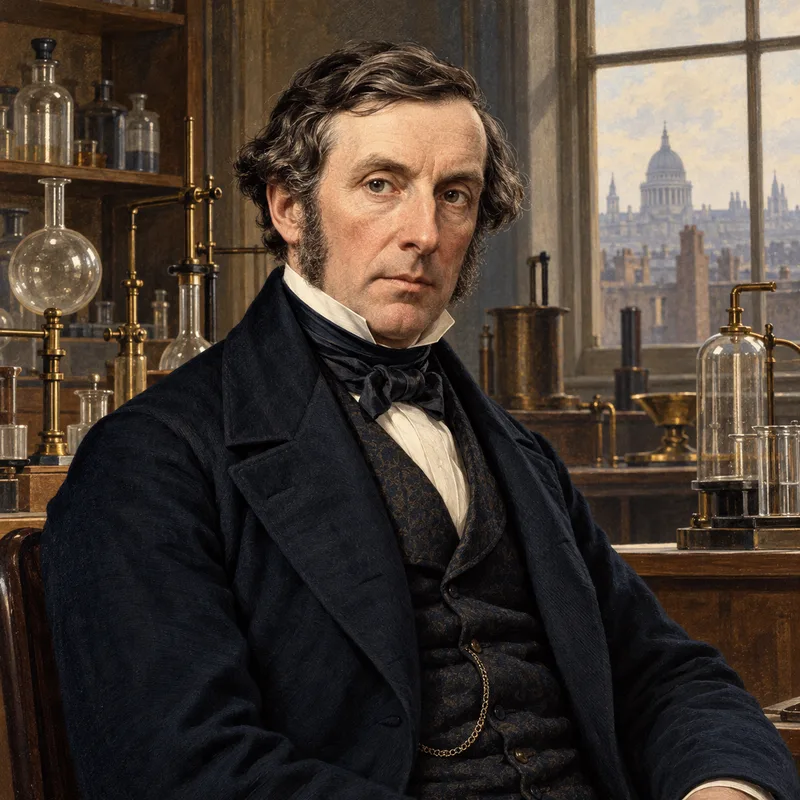
Thomas Graham
1805-1869 · United Kingdom
Graham's law; dialysis; colloid chemistry