Biography · Chemist no. 254 of 350
Gustav Robert Kirchhoff (1824-1887): The Physicist Who Read the Chemistry of the Stars
Introduction
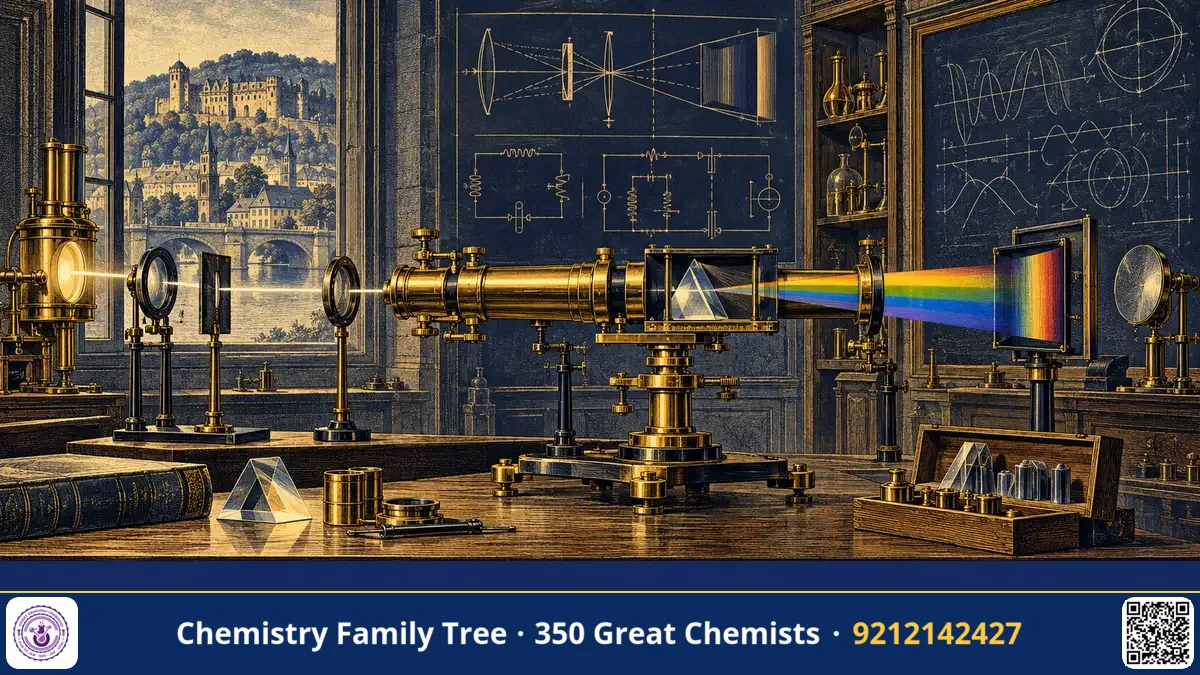
Gustav Robert Kirchhoff was a German physicist whose name appears in electrical circuits, in spectroscopy, in the theory of heat radiation and in thermochemistry. With Robert Bunsen he founded spectral analysis, discovered caesium and rubidium and explained the dark lines in the solar spectrum. His legacy in one line: he showed that light carries the chemical identity of its source, even from the Sun.
Early Life and Family
Kirchhoff was born on 12 March 1824 in Konigsberg, then in Prussia (now Kaliningrad, Russia). His father was a lawyer. He grew up in the educated middle-class life of Konigsberg, a city of Immanuel Kant and a major university. He was a bright pupil, with a special ability in mathematics, and entered the University of Konigsberg in 1842.
Education and Mentors
At Konigsberg Kirchhoff studied mathematics and physics under Franz Neumann, one of the leading German physicists, and Carl Gustav Jacobi, the mathematician. He attended Neumann's seminar in mathematical physics, which trained many future leaders of the field. While still a student in 1845, he published his laws on the flow of electric currents in networks, which he developed as a seminar exercise. These became the Kirchhoff circuit laws. He took his doctorate in 1847.
Career Timeline
| Year | Event |
|---|---|
| 1824 | Born in Konigsberg, Prussia |
| 1845 | Formulates the circuit laws as a student |
| 1847 | Doctorate at Konigsberg; moves to Berlin |
| 1850 | Extraordinary professor at Breslau, where he first meets Bunsen |
| 1854 | Professor of physics at Heidelberg, with Bunsen's support |
| 1858 | Kirchhoff's equation in thermochemistry |
| 1859 | Explains the Fraunhofer lines; law of thermal radiation |
| 1860-1861 | Discovery of caesium and rubidium with Bunsen |
| 1861-1862 | Map of the solar spectrum |
| 1862 | Receives the Rumford Medal with Bunsen |
| 1875 | Moves to the University of Berlin as professor of theoretical physics |
| 1887 | Dies in Berlin on 17 October |
Major Scientific Contributions
- Circuit laws (1845): The current law (the sum of currents at a junction is zero) and the voltage law (the sum of potential differences around a closed loop is zero). They apply to every electric network.
- Spectroscopy (1859): Three laws of spectra and the explanation of Fraunhofer lines, giving the basis for spectrochemical analysis.
- Thermal radiation: Kirchhoff's law of radiation and the black body, which led to Planck's quantum theory.
- Thermochemistry: The equation for the change in reaction enthalpy with temperature.
- Elements: Caesium and rubidium, found with Bunsen.
- Mechanics and optics: A mathematical formulation of the Huygens principle for diffraction, and a theory of vibrating plates.
Kirchhoff current law:  sum of I at a node = 0
Kirchhoff voltage law:  sum of V around a loop = 0
d(deltaH)/dT = deltaCp
Awards, Honours and Nobel Prize
Kirchhoff shared the Rumford Medal of the Royal Society with Bunsen in 1862, and the Davy Medal in 1877. He was a member of the Berlin Academy of Sciences and other academies. He died in 1887 and did not live to see the Nobel Prizes, which started in 1901.
Personality, Struggles and Lesser-Known Facts
- He was known as a very exact and careful thinker, who wrote in a clear mathematical style. His "Lectures on Mathematical Physics" were widely used.
- After an accident in the 1860s he needed crutches and later a wheelchair for the rest of his life. Despite this he continued to lecture in Berlin.
- He married Clara Richelot, the daughter of his mathematics teacher at Konigsberg, in 1857, and she died in 1869. He remarried in 1872 to Luise Brommel.
- His friendship with Bunsen began in Breslau, and Bunsen helped to bring him to Heidelberg. They worked together, walking daily in Heidelberg and discussing science. The collaboration lasted only a few years, but changed science.
- In Heidelberg, he was a part of a group that included Helmholtz, who arrived in 1858. This made Heidelberg one of the scientific centres of Germany at that time.
Legacy and Influence on Modern Chemistry
Spectral analysis became a major tool of chemistry and astronomy. Elements such as thallium, indium, gallium and helium were found by their spectra. Atomic absorption and emission instruments in every analytical laboratory follow the pattern of Kirchhoff's work. The black body problem was the starting point of quantum theory, and later of the Bohr model and quantum mechanics, the foundation of modern chemistry. The Kirchhoff equation is a standard formula of physical chemistry, and his circuit laws are taught to every student of electronics and electrochemistry.
Lessons for Students
- A simple question can lead to a major discovery: why are there dark lines in sunlight?
- Choose collaborators with different skills. Kirchhoff was a physicist and Bunsen an experimental chemist.
- Mathematics is a tool for chemistry. His clear equations made his results general.
- Keep working despite hardship. He taught with crutches and a wheelchair.
Quick Facts Box
- Born: 12 March 1824, Konigsberg, Prussia
- Died: 17 October 1887, Berlin
- Nationality: German
- Field: Physics, spectroscopy, thermochemistry
- Famous for: Circuit laws; spectroscopy laws; law of thermal radiation; Cs and Rb
- Nobel Prize: None (died before the prizes began)
FAQ
Was Kirchhoff a chemist or a physicist?
He was a physicist, but his work with Bunsen founded spectrochemical analysis, and his thermochemical equation is part of physical chemistry.
What are the Fraunhofer lines?
They are dark lines in the solar spectrum, produced by absorption of light by elements in the cooler outer atmosphere of the Sun.
How are Kirchhoff and Bunsen connected?
They worked together at Heidelberg from 1854 and developed the spectroscope, with which they discovered caesium and rubidium.
Did Kirchhoff win a Nobel Prize?
No. He died in 1887, before the prizes began. He was awarded the Rumford and Davy Medals with Bunsen.
Published by ABC Chemistry — IIT-JAM | CSIR-NET | GATE Chemistry Coaching. Visit abcchemistry.com
About the chemist
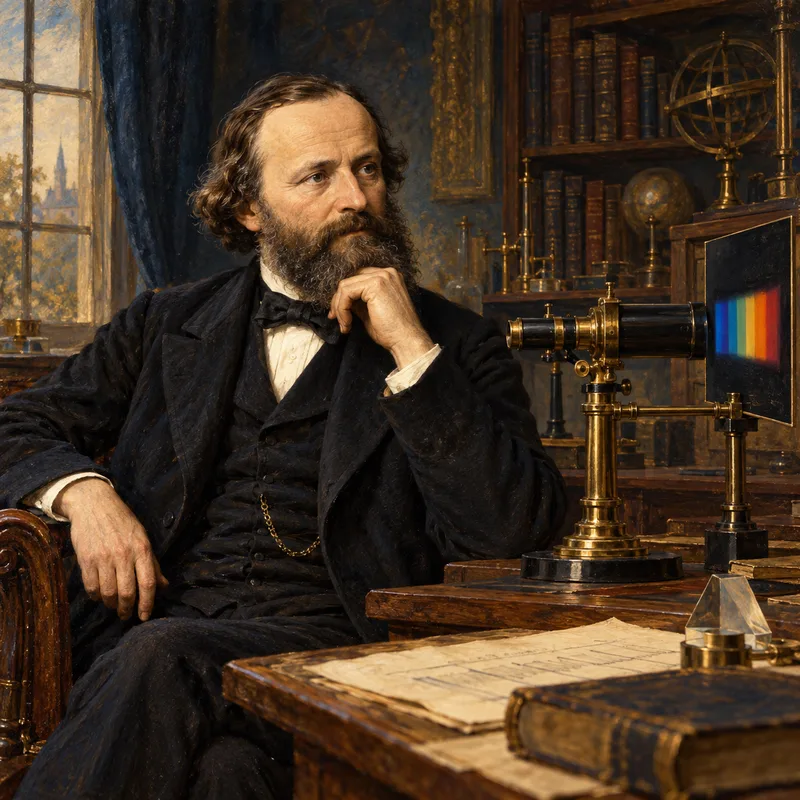
Gustav Kirchhoff
1824-1887 · Germany
Spectroscopy; Kirchhoff laws