The discovery, explained · Chemist no. 254 of 350
Kirchhoff's Laws of Spectroscopy: Reading the Sun's Chemistry from Its Light
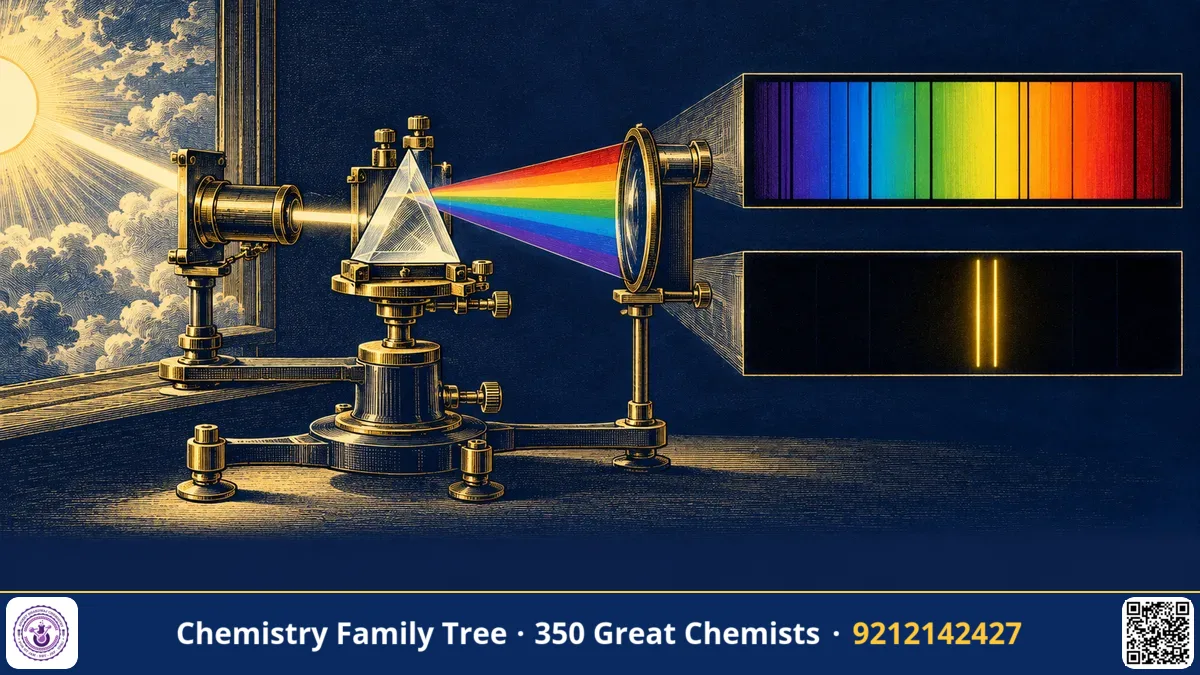
In 1859 the German physicist Gustav Robert Kirchhoff (1824-1887) answered a question that had puzzled scientists for forty years: why does the spectrum of sunlight have dark lines? His answer, found with the chemist Robert Bunsen at Heidelberg, showed that each element absorbs exactly the same wavelengths that it emits, and that the dark lines in sunlight come from elements in the cooler outer atmosphere of the Sun. For the first time, humans could find the chemical composition of an object they could never touch. Kirchhoff also formulated the law of thermal radiation that led to quantum theory and gave an equation in thermochemistry that you meet in physical chemistry. This post covers all three: spectroscopy, radiation and the thermochemical equation.
The Scientific Problem Before the Discovery
In 1814 Joseph von Fraunhofer, a German optician, had passed sunlight through a prism and saw hundreds of dark lines across the spectrum. He labelled the strongest with letters A, B, C, D and so on. He also saw that a bright yellow line in the flame of a lamp lay at the same position as the dark D line of the Sun. But nobody could explain it. Were the dark lines a property of sunlight, of the prism or of the Earth's air?
Meanwhile, chemists such as Bunsen needed a better way to identify elements from the colours they gave in a flame. Observations of flame colours by eye were uncertain. A systematic link between line patterns and elements was missing.
The Discovery / Experiment
1. The spectroscope and the sodium experiment (1859)
- Kirchhoff and Bunsen built a spectroscope using a slit, a prism and a small telescope, and looked at the flame of a Bunsen burner with different salts. Each metal gave its own set of bright lines.
- Kirchhoff passed bright sunlight through a sodium flame. He expected that the flame's yellow lines would add to the D line of sunlight and make it brighter.
- Instead, the dark D lines became darker. The flame had absorbed the sodium wavelength from the sunlight.
- When he used a brighter source, a hot lime light (calcium oxide, with a continuous spectrum), he saw dark D lines in the light after it had passed through the sodium flame, even though no dark lines were there without the flame.
He concluded that sodium vapour absorbs light at exactly the wavelengths at which it emits. The dark D lines of the Sun therefore show the presence of sodium vapour in the Sun's atmosphere.
2. Kirchhoff's three laws of spectroscopy
- A hot, dense solid, liquid or gas under high pressure gives a continuous spectrum (all colours).
- A hot, low-density gas gives an emission line spectrum: bright lines at wavelengths typical of the element.
- A continuous source viewed through a cooler, low-density gas gives an absorption line spectrum: dark lines at the same wavelengths as the emission lines of that gas.
He then compared the Fraunhofer lines with the bright lines of elements in the laboratory, using an arc spectrum, and in 1861-1862 produced a detailed map of the solar spectrum. He identified sodium, iron, calcium, magnesium, nickel and chromium in the Sun's atmosphere, and later others such as copper, zinc and barium.
3. Law of thermal radiation (1859-1860)
Kirchhoff proved that for any body in thermal equilibrium, the ratio of emissive power to absorptive power depends only on wavelength and temperature, not on the nature of the body. A good absorber is a good emitter. He introduced the idea of an ideal black body, which absorbs all radiation falling on it and so has maximum emission.
Kirchhoff's law of radiation:   E(lambda,T) / A(lambda,T) = J(lambda,T)    (universal function)
For a black body, A = 1, so E = J
Good absorber of a wavelength = good emitter of the same wavelength
The search for the function J led to Stefan's law (1879, total radiation proportional to T4), Wien's law, and then to Max Planck's quantum hypothesis in 1900. Without Kirchhoff's blackbody problem there would have been no Planck's constant.
4. Kirchhoff's equation in thermochemistry (1858)
Kirchhoff showed how the enthalpy change of a reaction varies with temperature:
d(deltaH)/dT = deltaCp
deltaH(T2) = deltaH(T1) + integral from T1 to T2 of deltaCp dT
deltaCp = sum Cp(products) - sum Cp(reactants)
For small temperature ranges where deltaCp is constant: deltaH(T2) = deltaH(T1) + deltaCp (T2 - T1).
5. Discovery of caesium and rubidium (1860-1861)
With Bunsen, Kirchhoff used spectral analysis to find two new alkali metals: caesium, from blue lines, and rubidium, from red lines. The method showed that it can find new elements from lines never seen before.
The Chemistry Behind It
Atoms have discrete energy levels. When an electron falls from a higher to a lower level, it emits a photon with energy equal to the gap. In absorption, the atom takes up a photon of exactly this energy to jump up. The same energy gap controls both processes, so emission and absorption lines of an element coincide. This is what Kirchhoff saw without knowing the quantum explanation, which came with Bohr in 1913.
Delta E = E2 - E1 = h nu = h c / lambda
Hydrogen (Balmer): 1/lambda = R (1/2^2 - 1/n^2), n = 3, 4, 5 ...
In the Sun, the inner layer (photosphere) is hot and dense, and gives a continuous spectrum. The outer, cooler, thinner layer (chromosphere and lower corona) has atoms that absorb their own characteristic wavelengths, giving the dark Fraunhofer lines. The same principle lets astronomers study the composition, temperature, density and motion (by Doppler shift) of distant stars.
For the thermochemistry equation, think of heating reactants and products separately: the reaction enthalpy at a higher temperature differs from that at a lower temperature by the difference in heat needed to warm products and reactants. Example: for N2 + 3H2 to 2NH3, deltaH at 298 K is about -92 kJ, and at the industrial 700 K it becomes a little less negative because deltaCp is negative, which you can calculate using Kirchhoff's equation.
Applications Today
- Atomic absorption spectroscopy (AAS): Measures trace metals such as lead, cadmium and arsenic in water, food and blood. Many Indian labs use AAS to check drinking water and soil. The method is directly based on Kirchhoff's law that atoms absorb the wavelengths they emit.
- Astronomy: Spectra of stars give their composition, temperature and speed; the same principle found helium in the Sun in 1868.
- Thermal imaging and radiation: Emissivity of materials, solar cookers and selective surfaces in solar water heaters in India depend on the link between absorption and emission.
- Industrial thermochemistry: Kirchhoff's equation is used to find reaction enthalpies at reactor temperatures.
- Electric circuits: Kirchhoff's current and voltage laws (1845) are used to analyse every electrical circuit and are used in electrochemical cell analysis.
Exam Corner
- Kirchhoff's three spectra: continuous (hot solid), emission (hot rarefied gas), absorption (cool gas in front of continuous source).
- Fraunhofer lines are dark absorption lines in the solar spectrum; the D line is due to sodium (about 589 nm).
- Kirchhoff's law of radiation: emissivity = absorptivity at the same wavelength and temperature; black body: absorptivity = 1.
- Kirchhoff's equation: (d deltaH / dT)P = deltaCp.
- Kirchhoff's circuit laws: sum of currents at a node is zero (charge conservation); sum of voltages round a loop is zero (energy conservation).
Common Misconceptions
- "Dark lines mean the Sun lacks that element." The dark lines show where the element's atoms in the cool atmosphere absorb light, which proves their presence.
- "A black body is always black." A black body is an ideal absorber and emitter, and the Sun and hot metals glow brightly while behaving nearly as black bodies.
- "Kirchhoff's equation gives deltaG." It gives how deltaH changes with temperature; deltaG needs the Gibbs-Helmholtz equation.
Quick Revision Box
- Gustav Kirchhoff (1824-1887), German physicist, Heidelberg and Berlin.
- 1859: absorption and emission wavelengths coincide; explains Fraunhofer lines.
- Three laws of spectroscopy: continuous, emission, absorption.
- Law of thermal radiation and the idea of the black body (1859-1860).
- Kirchhoff equation: d(deltaH)/dT = deltaCp.
- Co-discoverer with Bunsen of Cs and Rb.
FAQ
What are Kirchhoff's laws of spectroscopy?
They state that hot solids give continuous spectra, hot thin gases give bright emission lines, and a cool thin gas in front of a continuous source gives dark absorption lines.
How did Kirchhoff find the composition of the Sun?
He matched the dark Fraunhofer lines of sunlight to the bright lines of elements in the laboratory and concluded that these elements are present in the solar atmosphere.
What is Kirchhoff's equation in thermochemistry?
It relates the change of reaction enthalpy with temperature to the difference of heat capacities of products and reactants.
Why is Kirchhoff important for quantum theory?
His law of thermal radiation posed the problem of the black-body spectrum, which Planck solved in 1900 with the quantum hypothesis.
Published by ABC Chemistry — IIT-JAM | CSIR-NET | GATE Chemistry Coaching. Visit abcchemistry.com
About the chemist
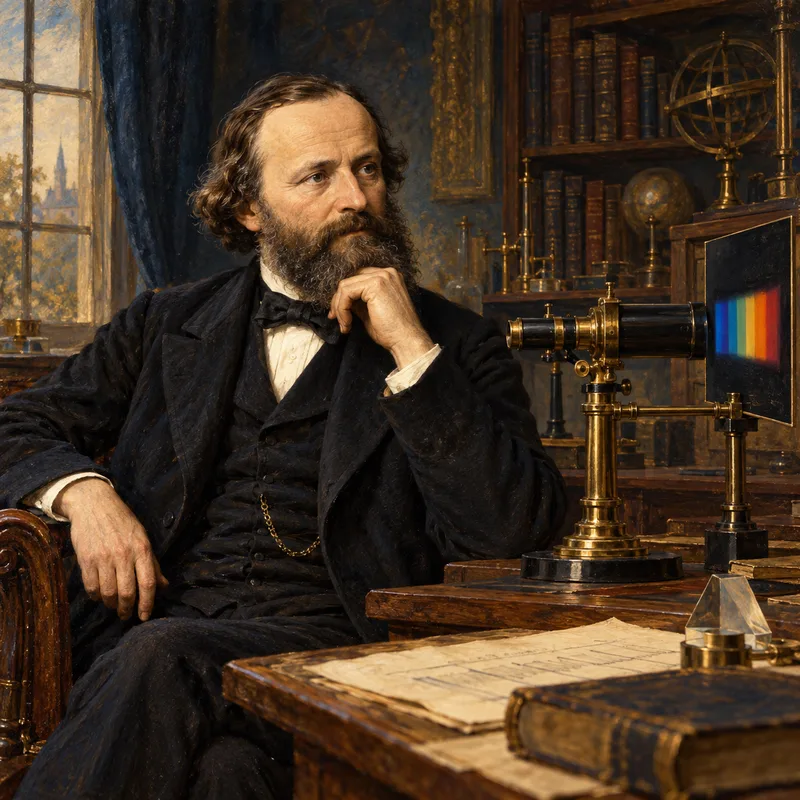
Gustav Kirchhoff
1824-1887 · Germany
Spectroscopy; Kirchhoff laws