Biography · Chemist no. 112 of 350
Hans Fischer: Complete Life and Legacy
Introduction
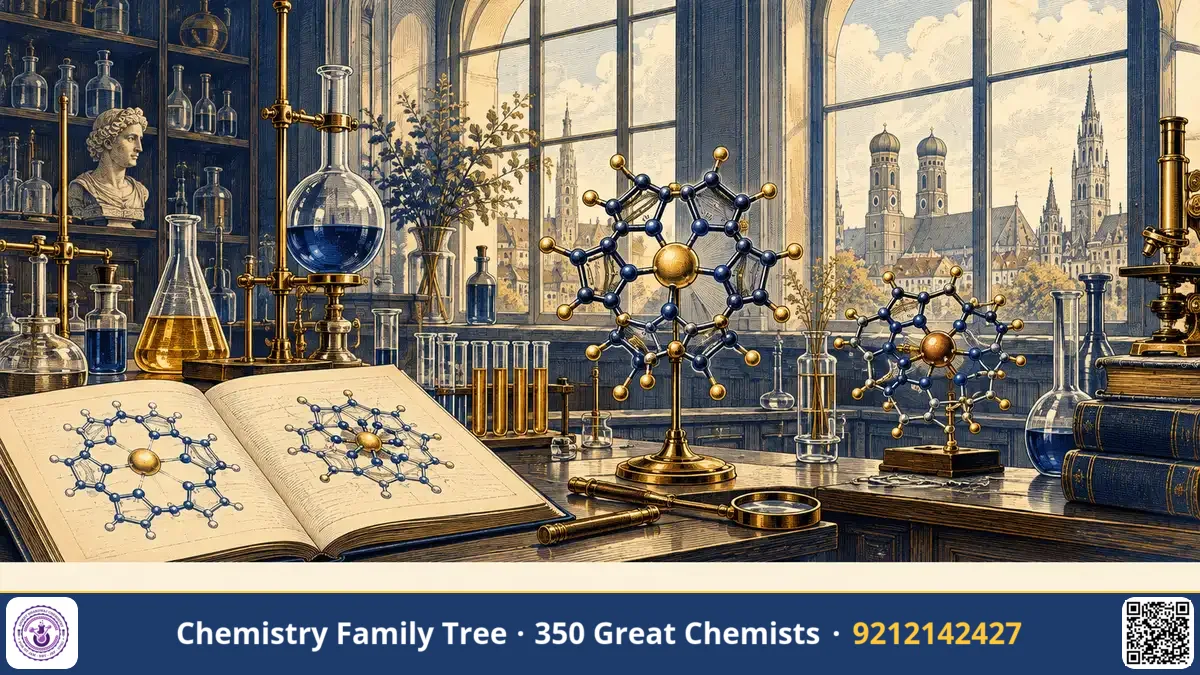
Hans Fischer (1881–1945) was a German organic chemist who devoted his life to the pigments of blood and leaves. He synthesised haemin, worked out the structures of bilirubin and chlorophyll, and gave porphyrin chemistry its modern language. He was awarded the Nobel Prize in Chemistry in 1930. He trained as a physician as well as a chemist. His career ended in tragedy in March 1945, when his laboratory was destroyed in the last months of the war. His legacy lies in the many metalloporphyrin molecules that students study today.
Early Life and Family
Hans Fischer was born on 27 July 1881 in Höchst am Main, near Frankfurt, in Germany. His father, Eugen Fischer, was a chemist who worked as a director of the Kalle company, a dye and chemical manufacturer, and later became a professor of chemistry at the Technical University in Stuttgart. He thus grew up in an environment close to the chemical industry, in the region which produced some of Germany's most famous dye factories.
He followed his father into chemistry, although his path was wider than that of a typical chemist because he also studied medicine.
Education and Mentors
Fischer studied chemistry at the Universities of Lausanne and Marburg. At Marburg he worked with Theodor Zincke, an organic chemist known for his work on rearrangements and the chemistry of quinones, and received his doctorate in chemistry in 1904. He then studied medicine in Munich and received his medical degree in 1908. After this, he worked in the laboratory of Emil Fischer (no relation) in Berlin, on amino acids and proteins, which was a famous school of organic and biological chemistry.
After this he moved into research on blood and bile pigments. This combination of chemical and medical education explains why he was so well prepared to study pigments of blood and bile: he understood the clinical significance of jaundice and anaemia as well as the molecular structure of the pigments.
Career Timeline
| Year | Event |
|---|---|
| 1881 | Born in Höchst am Main on 27 July. |
| 1904 | Doctorate in chemistry at Marburg. |
| 1908 | Medical degree at Munich. |
| 1912 | Begins his research on blood and bile pigments. |
| 1916 | Professor of medical chemistry at Innsbruck. |
| 1918 | Moves to the University of Vienna. |
| 1921 | Appointed professor of organic chemistry at the Technical University of Munich. |
| 1929 | Completes the total synthesis of haemin. |
| 1930 | Awarded the Nobel Prize in Chemistry. |
| 1930s | Works on chlorophyll structure, bilirubin synthesis and many porphyrin derivatives. |
| 1945 | Dies in Munich on 31 March, as the war ends. |
Major Scientific Contributions
- Haemin synthesis (1929): total synthesis of the iron porphyrin from pyrrole building blocks, confirming its structure. See our discovery post.
- Porphyrin nomenclature: introduced the numbering and naming conventions for porphyrins that were used for decades.
- Bilirubin: determination of the structure of the bile pigment and its synthesis, which explained jaundice at a molecular level.
- Chlorophyll: extended Willstätter's discovery of magnesium by working out the structures of chlorophyll a and b, apart from some details of stereochemistry.
- Pyrrole chemistry: developed many routes to substituted pyrroles and pyrromethenes, which became standard tools of heterocyclic synthesis.
- Training of students: his group included Alfred Treibs, whose petroporphyrin work established that petroleum has a biological origin, and many others who spread porphyrin chemistry.
Awards, Honours and Nobel Prize
The Nobel Prize in Chemistry for 1930 was awarded to Hans Fischer "for his researches into the constitution of haemin and chlorophyll and especially for his synthesis of haemin". Richard Willstätter, who had discovered magnesium in chlorophyll, had won the Chemistry Nobel Prize in 1915, and Fischer's award continued a remarkable run of German laureates in natural product chemistry.
A later step in this story is that Robert Burns Woodward synthesised chlorophyll a in 1960, building on the structural foundation that Fischer had laid.
Personality, Struggles and Lesser-Known Facts
- Chemist and physician. He held degrees in both chemistry and medicine, which was unusual and gave him a unique view of the pigments.
- Relentless worker. Fischer and his co-workers synthesised a very large number of porphyrins to fix the correct structures, a labour that required both patience and team organisation.
- Not related to Emil Fischer. Although both worked in organic chemistry and Hans spent time in Emil's laboratory, they were not relatives. The name Fischer is very common in Germany.
- War destruction. In the Second World War, the buildings of the Technical University of Munich, including his institute, were badly damaged by bombing. He reportedly saw the destruction of his life's work as a catastrophe.
- Tragic death. Fischer died on 31 March 1945. Accounts say that he took his own life when he saw his laboratory in ruins. His death is a sad reminder of the human cost of war on science.
- Later publications. His collected work on porphyrins, Die Chemie des Pyrrols, written with Orth, is a classic monograph in several volumes.
Legacy and Influence on Modern Chemistry
Fischer's synthesis of haemin stands as a milestone in the history of organic synthesis. It was a rare case in which a complex natural pigment was built from simple pieces and shown to be identical to the natural substance. His structural work on chlorophyll and the bile pigments gave biochemistry a molecular map of how haemoglobin is made and broken down, and it supported the later work on the biosynthesis of porphyrins by David Shemin and Rittenberg, using labelled glycine and succinate.
The modern fields that grew from his chemistry are wide: bioinorganic chemistry (haemoglobin, myoglobin, cytochromes, chlorophyll), photodynamic therapy, supramolecular porphyrin materials and artificial photosynthesis. Max Perutz and John Kendrew's X-ray structures of haemoglobin and myoglobin, which won them the 1962 Nobel Prize in Chemistry, showed how the haem group that Fischer had synthesised sits in the protein pocket. Dorothy Hodgkin's work on vitamin B12 extended the family of tetrapyrrole-like pigments.
Lessons for Students
- Proof in chemistry often means synthesis: build it and compare.
- Combine areas of knowledge, as Fischer did with chemistry and medicine.
- Systematic work with careful records can solve problems that look overwhelming, such as fifteen possible isomers.
- Choose one deep problem and follow it for many years.
- Remember the human side of science: the pressure of the war era affected even the greatest scientists.
Quick Facts Box
- Born: 27 July 1881, Höchst am Main, Germany.
- Died: 31 March 1945, Munich, Germany.
- Nationality: German.
- Field: Organic chemistry; porphyrins and natural pigments.
- Famous for: Synthesis of haemin; structure of chlorophyll and bilirubin.
- Nobel: Chemistry, 1930.
FAQ
What did Hans Fischer win the Nobel Prize for?
For his researches into the constitution of haemin and chlorophyll and especially for the synthesis of haemin (1930 Nobel Prize in Chemistry).
Was Hans Fischer related to Emil Fischer?
No. They shared a surname, and Hans worked for a time in Emil Fischer's laboratory, but they were not relatives.
How did Fischer's work help in medicine?
It explained bile pigment and haem chemistry, supporting the study of jaundice, anaemias and porphyrias.
What happened to him at the end of the war?
His institute in Munich was destroyed by bombing, and he died on 31 March 1945, reportedly by suicide, at the age of 63.
Published by ABC Chemistry — IIT-JAM | CSIR-NET | GATE Chemistry Coaching. Visit abcchemistry.com
About the chemist
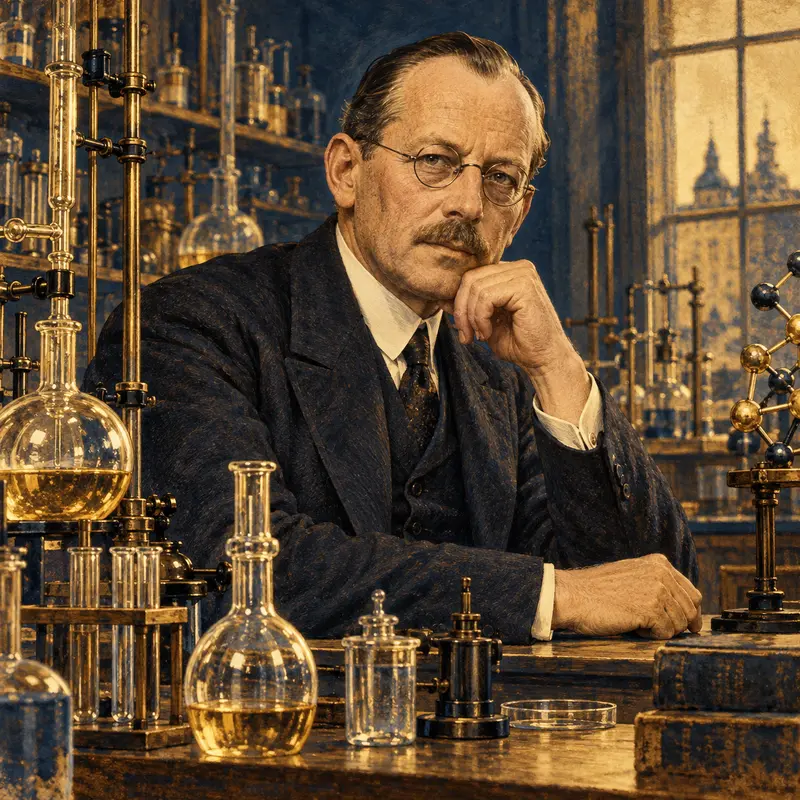
Hans Fischer
1881-1945 · Germany · Nobel Chemistry 1930
Synthesis of haemin, porphyrins