The discovery, explained · Chemist no. 112 of 350
Hans Fischer: Synthesising Haemin and Mapping the Porphyrins
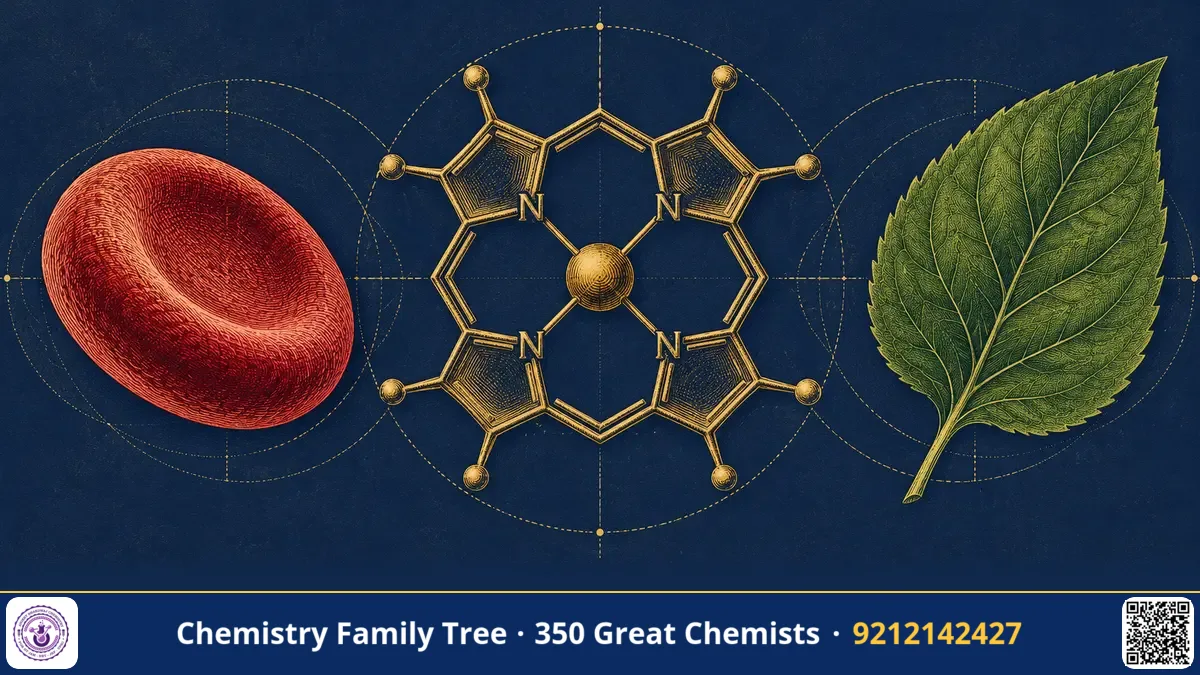
Blood is red because of haem. Leaves are green because of chlorophyll. These two vital pigments look completely different and do completely different jobs, yet they share the same chemical skeleton: a ring of four pyrrole units called a porphyrin, holding a metal ion at its centre. The German chemist Hans Fischer spent most of his career, from about 1910 to 1945, working out the structures of these pigments. In 1929 he achieved the total synthesis of haemin, the chloride of the iron(III) form of haem, proving its structure beyond doubt. He also worked out the structure of bilirubin and of chlorophyll a and b. For this he received the Nobel Prize in Chemistry in 1930 "for his researches into the constitution of haemin and chlorophyll and especially for his synthesis of haemin".
The Scientific Problem Before the Discovery
By 1900, chemists knew that haemoglobin splits into a protein (globin) and a red-brown pigment, haem. Haemin crystals were first prepared by Teichmann in 1853. The pigment was known to contain iron, and the elementary formula was close to C34H32N4O4FeCl. But what was the structure? Degradation experiments by Nencki, Küster, Willstätter and others showed that breakdown gives pyrrole derivatives, so the molecule must contain several pyrrole units. Küster had proposed a ring of four pyrroles in 1912. But the exact arrangement of the substituents on the ring was not known, and it was difficult to prove.
The difficulty was the large number of possible isomers. Each pyrrole carries side groups, such as methyl (CH3), vinyl (CH=CH2) and propionic acid (CH2CH2COOH). With four methyl groups, two vinyl groups and two propionic acid groups, there are fifteen possible isomers of the protoporphyrin. To prove the structure of the natural pigment, one had to synthesise the correct isomer and show it was identical with the natural one. This was a task of enormous patience.
The Discovery: Step by Step
- Degradation to pyrroles. Fischer began by breaking haem and related pigments with reducing agents such as hydriodic acid and with oxidants. This gave simple substituted pyrroles. By identifying them, he found the pattern of substituents on the original rings.
- Synthesis of pyrroles. He then synthesised the same pyrroles from simple starting materials, proving their identity and creating a supply of building blocks.
- Building pyrromethenes. Two pyrrole units were joined by a one-carbon (methene) bridge to give dipyrrylmethenes (pyrromethenes). These were prepared as stable salts, often as hydrobromides.
- Making the porphyrin ring. Heating two pyrromethene units together in molten succinic acid at about 190 °C closed the ring to form a porphyrin. In this way Fischer could build porphyrins in which every substituent was placed deliberately. Using different pyrromethenes, he made all the possible isomers, one by one.
- Comparison. One of the synthetic isomers, a specific arrangement of four methyls, two vinyls and two propionic acids, matched natural protoporphyrin IX. Introduction of iron then gave haemin, identical with that from blood.
- Announcement (1929). The synthesis of haemin with his co-workers was the first total synthesis of a pigment of this complexity, and one of the great achievements of classical organic synthesis.
The Chemistry Behind It
A porphyrin is a macrocycle made of four pyrrole rings joined at their α-carbons by four methine (=CH–) bridges. The ring has 18 π electrons in a conjugated circuit, which satisfies Hückel's 4n+2 rule (n = 4), so it is aromatic. This is why porphyrins are intensely coloured, with a very strong absorption near 400 nm (the Soret band) and weaker bands in the visible region.
Porphyrin ring: C20H14N4 (porphine)
Haem b:  Fe(II)-protoporphyrin IX, C34H32FeN4O4
Haemin:  Fe(III)-protoporphyrin IX chloride, C34H32ClFeN4O4
Fischer's numbering system of the positions on the porphyrin ring, still used in many textbooks, was a result of his work. In protoporphyrin IX, the eight β-positions carry: methyl (1), vinyl (2), methyl (3), vinyl (4), methyl (5), propionic acid (6), propionic acid (7), methyl (8).
Fischer also made important discoveries in related compounds:
- Bilirubin: the yellow-orange bile pigment is formed when haem is opened to a linear tetrapyrrole. Fischer determined its structure and synthesised it (1930s). Its accumulation causes jaundice.
- Chlorophylls a and b: following Willstätter's discovery of magnesium, Fischer established the structure of the pigments as magnesium complexes of a chlorin with a fifth, isocyclic ring and a phytyl ester. He and his collaborators also studied the degradation products phaeophorbide and chlorin e6.
- Metal complexation: Fe2+/Fe3+ in haem, Mg2+ in chlorophyll, Co3+ in vitamin B12 (a corrin, not a porphyrin) and Cu2+ or Zn2+ in synthetic porphyrins.
- Petroporphyrins: his student Alfred Treibs found vanadyl and nickel porphyrins in petroleum and shells, and showed that they derive from chlorophyll, giving strong evidence for the biological origin of petroleum.
The function differs by the central metal and its environment. In haemoglobin, the iron(II) sits in a hydrophobic pocket and binds O2 reversibly, Hb + O2 ⇌ HbO2. In cytochromes, the iron changes between Fe2+ and Fe3+ in electron transfer. In chlorophyll the Mg2+-chlorin absorbs red and blue light for photosynthesis.
Applications Today
- Medicine: understanding of porphyrias (disorders of haem biosynthesis), neonatal jaundice (high bilirubin, treated with phototherapy) and iron-deficiency anaemia, which affects a large proportion of women and children in India.
- Photodynamic therapy: synthetic porphyrin derivatives are used as light-activated drugs against some tumours.
- Catalysis and materials: metalloporphyrins act as models of cytochrome P450 and as oxidation catalysts; porphyrin dyes are used in solar cells and sensors.
- Petroleum geochemistry: porphyrin biomarkers help in oil exploration.
- Total synthesis tradition: Fischer's synthetic strategy is an early example of building a complex target from small, well-characterised pieces.
Exam Corner
- Hans Fischer received the 1930 Nobel Prize in Chemistry for his work on the constitution of haemin and chlorophyll and especially for the synthesis of haemin.
- Porphyrin: four pyrroles linked by four =CH– bridges; 18 π electrons are in the main conjugation path; aromatic; strong Soret band near 400 nm.
- Haem: Fe2+ in protoporphyrin IX. Chlorophyll: Mg2+ in a chlorin. Vitamin B12: Co in a corrin ring.
- Bilirubin is the linear tetrapyrrole produced from haem breakdown; its excess causes jaundice.
- Willstätter showed Mg in chlorophyll; Fischer completed the structure; Woodward synthesised chlorophyll a in 1960.
Common Misconceptions
- "Haem and chlorophyll have different skeletons." Both are tetrapyrroles; chlorophyll has a slightly reduced ring (chlorin) and an extra ring.
- "Porphyrin is the metal complex." A porphyrin is the ligand without metal; with the metal it is a metalloporphyrin.
- "The structure of haem was solved by degradation alone." Proof needed total synthesis.
Quick Revision Box
- Fischer synthesised haemin in 1929 using pyrromethenes heated with succinic acid.
- Protoporphyrin IX: 4 methyl, 2 vinyl, 2 propionic acid groups.
- Porphine: C20H14N4, aromatic, 18 π electrons in the conjugation path.
- Haem: Fe; chlorophyll: Mg; B12: Co.
- Nobel Prize in Chemistry, 1930.
- Bilirubin structure and synthesis also due to Fischer.
FAQ
What is the difference between haem and haemin?
Haem contains iron in the +2 state; haemin is the chloride of the iron(III) form obtained by crystallising from blood in the presence of chloride.
Why is synthesis considered proof of structure?
If a compound made by a known route has identical properties to the natural material, the structure of the natural material must be the same. This was the standard of proof before spectroscopy and X-ray crystallography.
Is chlorophyll related to haemoglobin?
Yes, both are metal complexes of tetrapyrrole rings. The relationship was suggested by degradation products and proven by the work of Willstätter and Fischer.
How does this help in competitive exams?
Questions on metalloporphyrins, aromaticity of porphyrins, biological roles of Fe, Mg and Co, and bioinorganic chemistry often come in JAM, NET and GATE.
Published by ABC Chemistry — IIT-JAM | CSIR-NET | GATE Chemistry Coaching. Visit abcchemistry.com
About the chemist
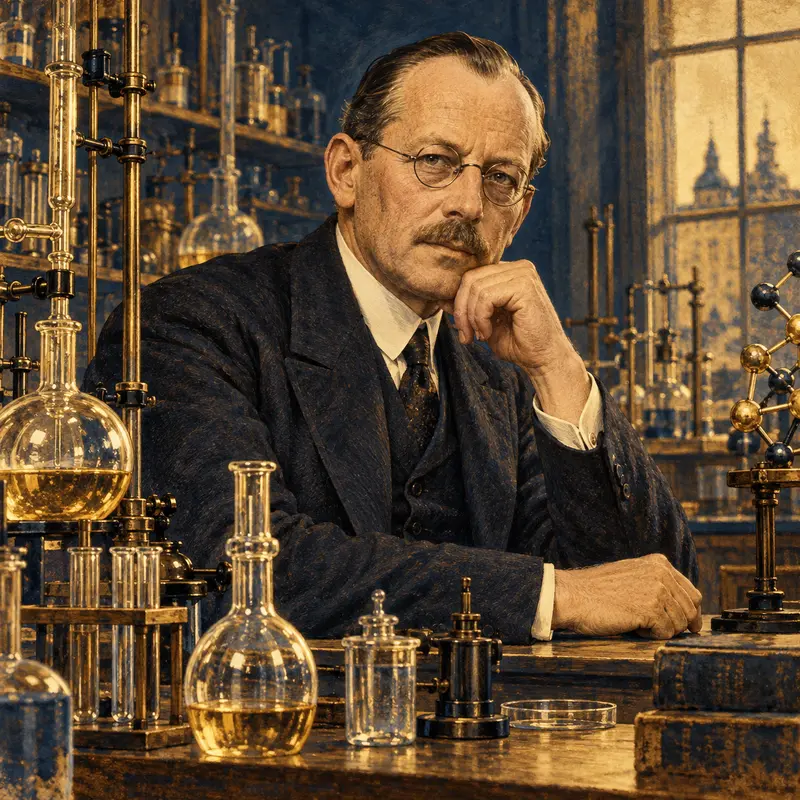
Hans Fischer
1881-1945 · Germany · Nobel Chemistry 1930
Synthesis of haemin, porphyrins