The discovery, explained · Chemist no. 72 of 350
Hans Krebs and the Cycles of Metabolism: Urea Cycle and Citric Acid Cycle
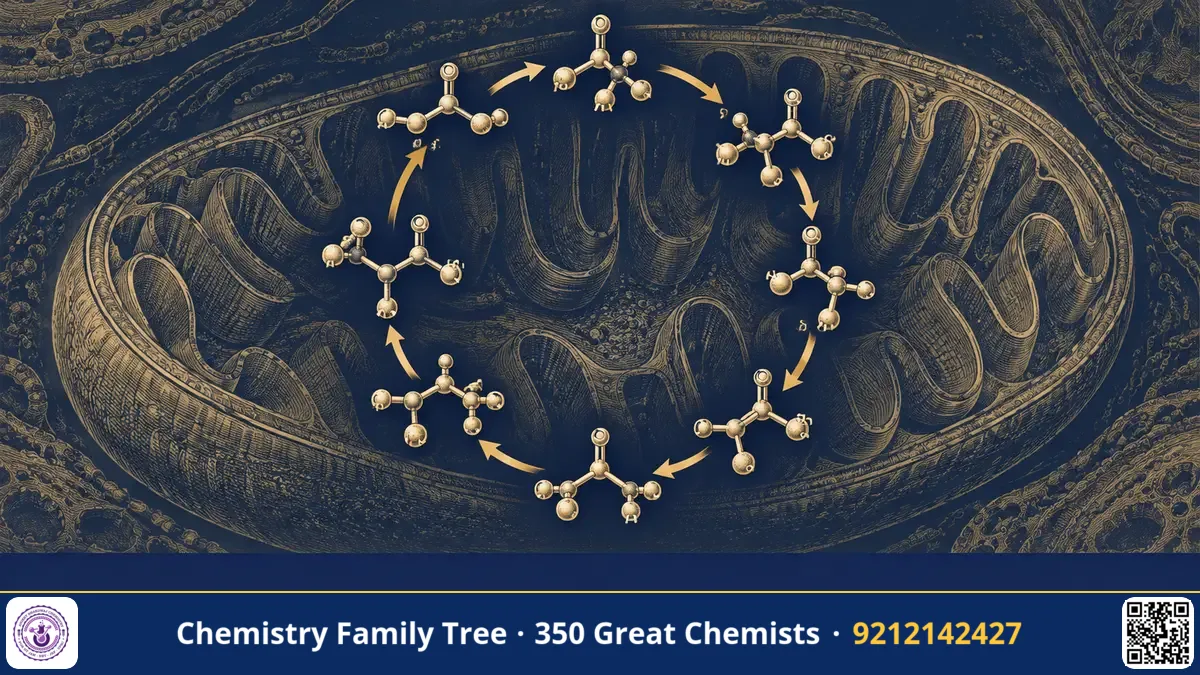
Every time you walk, think or breathe, your cells burn fuel through a circular series of reactions called the citric acid cycle, the Krebs cycle or the TCA cycle. It is the central hub of metabolism, where the breakdown products of carbohydrates, fats and proteins are completely oxidised to carbon dioxide while capturing energy as NADH, FADH2 and GTP. The German-born British biochemist Hans Krebs worked out this cycle in 1937, five years after he had discovered the urea cycle, the first metabolic cycle ever described. He shared the 1953 Nobel Prize in Physiology or Medicine with Fritz Lipmann, but his work is core material for any chemistry student studying biochemistry.
The Scientific Problem Before the Discovery
In the 1920s and 1930s biochemists knew that cells consume oxygen and release CO2, and that foods such as glucose are burned in the process. Albert Szent-Györgyi had found that small organic acids such as succinate, fumarate, malate and oxaloacetate speed up oxygen consumption in minced muscle. Franz Knoop and Carl Martius had shown that citrate can be converted to other acids. But these facts did not fit together. A key question was how a two-carbon fragment derived from sugar could be completely oxidised. Nobody knew whether the acids formed a straight chain or something more subtle. Similarly, the formation of urea in the liver was a mystery: it was known that ammonia is toxic and that mammals convert it to urea, but the pathway was unknown.
The Discovery: Step-by-Step
The urea cycle (1932)
While working in Freiburg with the medical student Kurt Henseleit, Krebs used thin slices of liver tissue and measured urea formation in the presence of ammonium ions and different compounds. He found that the amino acid ornithine strongly increased urea production, though it was not used up. This suggested a cycle: ornithine picks up carbon and nitrogen atoms, and releases urea while ornithine is regenerated.
The citric acid cycle (1937)
Working at the University of Sheffield, Krebs used minced pigeon breast muscle, which has a very high respiration rate. His experiments were:
- He confirmed that citrate, succinate, fumarate, malate and others stimulate oxygen uptake in catalytic amounts.
- He used malonate, a competitive inhibitor of succinate dehydrogenase, to block the oxidation of succinate to fumarate. Succinate then accumulated, showing it was an intermediate.
- He found that adding oxaloacetate and pyruvate led to formation of citrate, which closed the circle.
- He proposed that the compounds form a cycle in which a two-carbon unit is oxidised in each turn.
A well-known story says the first journal to which Krebs sent the paper, Nature, declined it; it was published in the journal Enzymologia in 1937.
The Chemistry Behind It
The acetyl group enters as acetyl-CoA, which comes from pyruvate by the pyruvate dehydrogenase complex. The cycle then has eight steps:
- Acetyl-CoA + oxaloacetate → citrate (citrate synthase)
- Citrate → isocitrate (aconitase, via cis-aconitate)
- Isocitrate + NAD⁺ → α-ketoglutarate + CO2 + NADH (isocitrate dehydrogenase)
- α-Ketoglutarate + NAD⁺ + CoA → succinyl-CoA + CO2 + NADH (α-ketoglutarate dehydrogenase)
- Succinyl-CoA + GDP + Pi → succinate + GTP + CoA (succinyl-CoA synthetase)
- Succinate + FAD → fumarate + FADH2 (succinate dehydrogenase)
- Fumarate + H2O → malate (fumarase)
- Malate + NAD⁺ → oxaloacetate + NADH (malate dehydrogenase)
The net equation for one turn is:
Acetyl-CoA + 3NAD⁺ + FAD + GDP + Pi + 2H2O → 2CO2 + 3NADH + FADH2 + GTP + 2H⁺ + CoA
Each NADH gives about 2.5 ATP and each FADH2 about 1.5 ATP in oxidative phosphorylation, so one turn of the cycle is worth about 10 ATP. The two carbons released as CO2 are not the same carbons that entered as acetyl in that same turn.
The urea cycle has these steps: carbamoyl phosphate (from NH3, CO2 and 2 ATP) combines with ornithine to form citrulline; citrulline reacts with aspartate to form argininosuccinate; this splits into arginine and fumarate; finally arginase hydrolyses arginine into urea and ornithine. The overall equation is:
2NH3 + CO2 + 3ATP + H2O → urea + 2ADP + AMP + 4Pi
Applications Today
- Medicine: Defects in urea cycle enzymes cause hyperammonaemia. Metabolic diseases and mitochondrial disorders are diagnosed through cycle intermediates.
- Cancer research: Mutations in isocitrate dehydrogenase (IDH1/IDH2) are found in some brain tumours and leukaemias, leading to targeted drugs.
- Industry: Citric acid is produced in large quantities by the fungus Aspergillus niger for food and beverages.
- Nutrition: The cycle links carbohydrate, fat and protein metabolism and explains why all fuels give energy.
- Toxicology: Fluoroacetate poisoning works by forming fluorocitrate, which blocks aconitase.
Exam Corner
- One turn of the TCA cycle produces 3 NADH, 1 FADH2, 1 GTP (or ATP) and 2 CO2.
- Citrate synthase condenses acetyl-CoA (C2) with oxaloacetate (C4) to form citrate (C6).
- Two decarboxylation steps: isocitrate to α-ketoglutarate and α-ketoglutarate to succinyl-CoA.
- Succinate dehydrogenase is the only cycle enzyme bound to the inner mitochondrial membrane and uses FAD.
- Malonate competitively inhibits succinate dehydrogenase.
Common Misconceptions
- "The Krebs cycle directly uses oxygen." It does not, but it needs oxygen indirectly, because NAD⁺ and FAD are regenerated through the electron transport chain.
- "Krebs won the Chemistry Nobel." His 1953 Nobel Prize was in Physiology or Medicine.
- "The cycle makes most ATP directly." Only one GTP per turn is made by substrate-level phosphorylation. Most ATP comes from reoxidation of NADH and FADH2.
Quick Revision Box
- Urea cycle discovered 1932 (with Henseleit); TCA cycle 1937.
- Per turn: 3 NADH, 1 FADH2, 1 GTP, 2 CO2.
- Citrate synthase: C2 + C4 → C6.
- Malonate blocks succinate dehydrogenase.
- Location: mitochondrial matrix.
- Nobel Prize in Physiology or Medicine 1953.
FAQ
Why is it called a cycle?
Because oxaloacetate is regenerated in the last step and can combine with another acetyl-CoA.
Where does the cycle occur?
In the mitochondrial matrix of eukaryotic cells, and in the cytoplasm of bacteria.
Is the cycle also called the TCA cycle?
Yes. TCA stands for tricarboxylic acid, referring to citrate and isocitrate, which have three carboxyl groups.
What is the link between the urea and TCA cycles?
Fumarate produced in the urea cycle enters the TCA cycle, and aspartate from oxaloacetate supplies nitrogen to the urea cycle.
Published by ABC Chemistry — IIT-JAM | CSIR-NET | GATE Chemistry Coaching. Visit abcchemistry.com
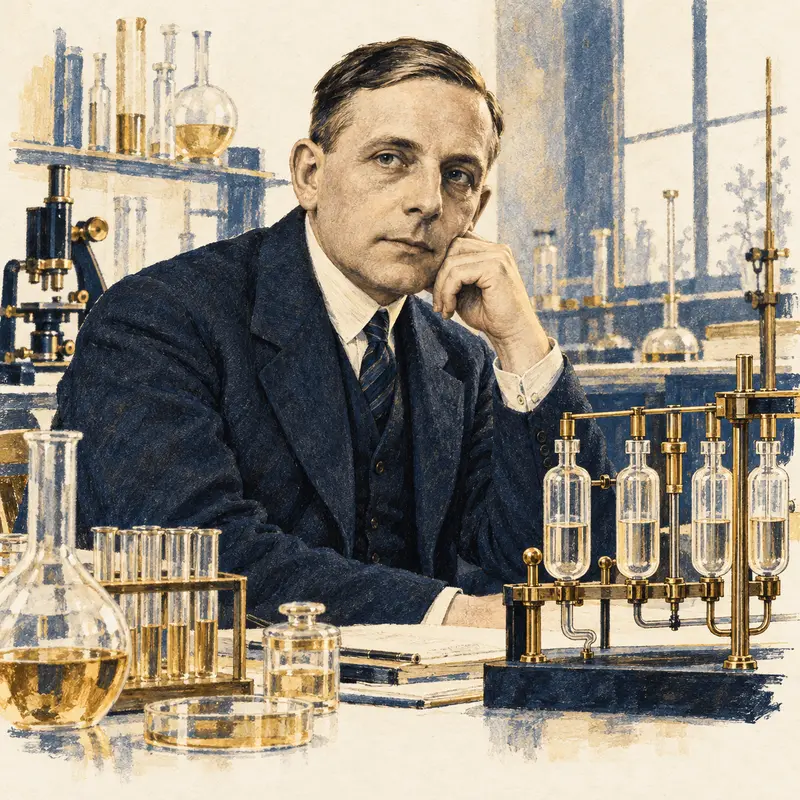
About the chemist
Hans Krebs
1900-1981 · Germany/United Kingdom · Nobel Physiology/Medicine 1953
Citric acid cycle; urea cycle