Biography · Chemist no. 288 of 350
Hans Meerwein (1879–1965): A Lifetime of Reactive Intermediates
Introduction
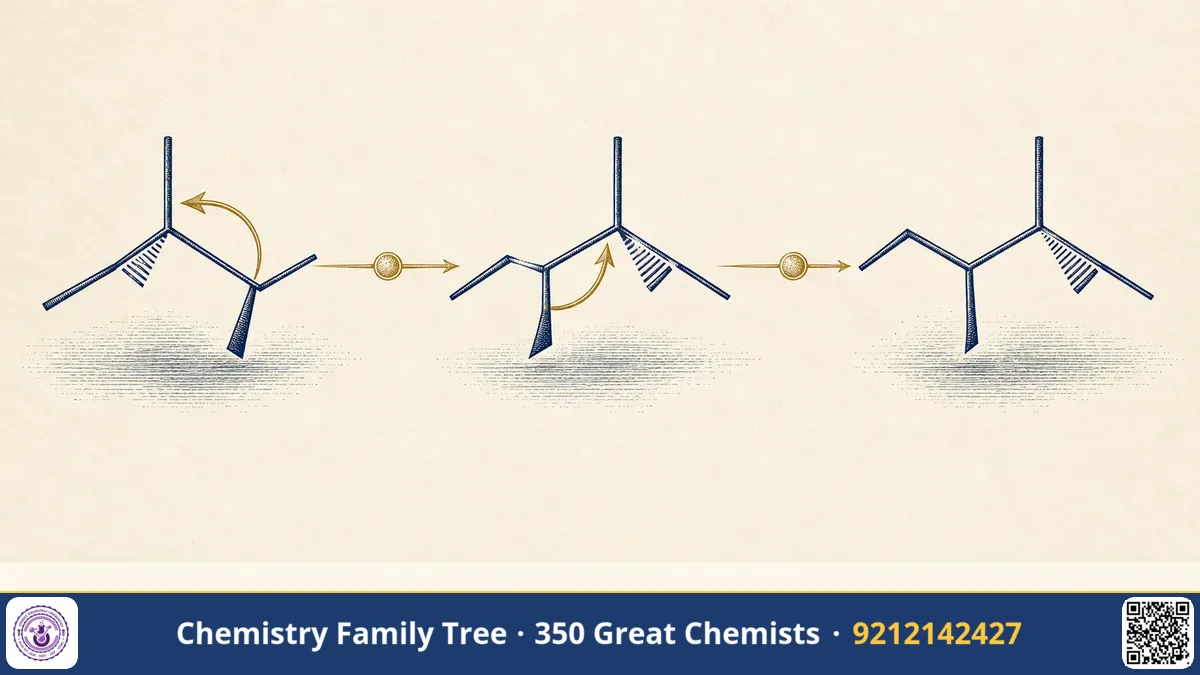
Hans Meerwein was a German organic chemist whose career stretched across two world wars and almost six decades of research. He is best known for establishing that carbocations are real intermediates in rearrangements, and for several reactions and reagents that bear his name: the Wagner–Meerwein rearrangement, the Meerwein–Ponndorf–Verley reduction, the Meerwein arylation and the Meerwein salts. In one line: Meerwein taught chemists to see and use the short-lived charged intermediates that decide how organic reactions proceed.
Early Life & Family
Hans Meerwein was born on 20 May 1879 in Hamburg, the large port city of northern Germany. Reliable details about his parents and childhood are limited, so we will focus on documented facts. Hamburg was a prosperous trading city with strong links to the chemical and pharmaceutical business of Germany, and Meerwein grew up in the final decades of the German Empire's rapid industrial rise. He was drawn toward science and chose to study chemistry at university.
Education & Mentors
Meerwein studied chemistry at the University of Bonn, where he worked in the laboratory of Richard Anschütz, a noted organic chemist and the biographer of Kekulé. He received his doctorate at Bonn in 1903. Bonn had a proud tradition in organic chemistry because Kekulé had worked there for many years, and this tradition of structural thinking influenced Meerwein's approach. After his doctorate, he remained in Bonn as an assistant and began independent research, in which he turned to the chemistry of terpenes and bicyclic compounds, the field in which he made his first major discovery.
Career Timeline
| Year | Event |
|---|---|
| 1879 | Born in Hamburg |
| 1903 | Doctorate at Bonn under Anschütz |
| 1914 | Publishes the study of camphene hydrochloride and isobornyl chloride, establishing the carbocation view of the Wagner–Meerwein rearrangement |
| 1922 | Appointed professor at Königsberg |
| 1925 | Reports hydride transfer from aluminium alkoxides (MPV reduction) with Schmidt |
| 1929 | Moves to Marburg as professor and director of the chemical institute |
| 1939 | Reports the arylation of alkenes with diazonium salts (Meerwein arylation) |
| 1950s | Develops trialkyloxonium salts (Meerwein's salts) |
| 1965 | Dies on 24 October in Marburg |
Major Scientific Contributions
- Carbocation rearrangements: His 1914 kinetic study showed that the isomerisation of isobornyl chloride to camphene hydrochloride goes through an ionic intermediate, making him a founder of carbocation chemistry long before physical-organic chemists accepted the idea widely.
- Hydride-transfer reductions: His work on aluminium alkoxides led to the MPV reduction and the study of equilibrium between alcohols and carbonyl compounds.
- Meerwein arylation: a radical-type reaction that attaches an aryl group to an alkene using a diazonium salt and copper catalysis.
- Oxonium salts: trialkyloxonium tetrafluoroborates, the so-called Meerwein reagents, are widely used alkylating agents.
- Acetals and orthoesters: he studied the chemistry of acetals, orthoesters and related compounds, and their reactions with Lewis acids.
- Cationic polymerisation: his observations of how Lewis acids start reactions of ethers and alkenes contributed to understanding of cationic ring-opening polymerisation.
For mechanisms and exam points, see our companion discovery post on Hans Meerwein.
Awards, Honours & Nobel Prize
Meerwein did not win a Nobel Prize. He received recognition through senior chairs at Königsberg and Marburg and through the lasting use of his name. In his later decades he was widely regarded as one of the grand old men of German organic chemistry. Four distinct reactions and reagents carry his name, which is itself a rare distinction.
Personality, Struggles & Lesser-Known Facts
- Ahead of his time. The idea that carbocations are intermediates was still controversial in 1914, and only decades later, with the work of Whitmore, Ingold, Winstein and others, was it widely accepted. Olah's later direct observation of stable carbocations in superacid (Nobel Prize 1994) confirmed the picture.
- A teacher through eras. He lived through the German Empire, the First World War, the Weimar Republic, the Nazi period, the Second World War and the post-war Federal Republic. Maintaining a research group through such times required adaptability.
- A long working life. He published scientific papers across almost sixty years.
- Multiple namesakes. Because the Wagner–Meerwein, Meerwein–Ponndorf–Verley, and Meerwein arylation all carry his name, students often confuse them, so keep their features separate.
- Shared credit. The MPV reduction is a good example of a reaction found independently by several chemists at about the same time, hence a three-name label.
Legacy & Influence on Modern Chemistry
Meerwein's name is built into the vocabulary of organic chemistry. Wagner–Meerwein shifts explain the formation of products in terpene chemistry, cholesterol biosynthesis and acid-catalysed hydrocarbon rearrangements. MPV and Oppenauer reactions remain valuable for selective redox changes in sensitive molecules. Meerwein's salts are used when mild, strongly electrophilic alkylation is needed, and Meerwein arylation led to modern radical arylation methods. His observations on Lewis-acid-initiated reactions also helped explain cationic polymerisation. For Indian students, Meerwein's contributions provide a reliable theme in questions on carbocation stability, rearrangements and selective reduction.
Lessons for Students
- Ask what is happening to the intermediate, not just the product. Meerwein's insight came from kinetics and solvent effects.
- Be patient: a correct idea may take decades to become widely accepted.
- Study reaction families together, such as MPV with Oppenauer and carbocation shifts with pinacol rearrangement.
- Reliable tools like mild reagents can matter as much as big discoveries.
- Keep working: a long, steady career can have more impact than one famous year.
Quick Facts Box
- Born: 20 May 1879, Hamburg, Germany
- Died: 24 October 1965, Marburg, Germany
- Nationality: German
- Field: Organic chemistry
- Famous for: Wagner–Meerwein rearrangement, MPV reduction, Meerwein salts, Meerwein arylation
- Nobel Prize: None
FAQ
Where did Meerwein work?
He worked at Bonn, then as professor at Königsberg from 1922, and from 1929 at Marburg, where he spent the rest of his career.
What is Meerwein's salt?
A trialkyloxonium tetrafluoroborate such as [Et₃O]⁺[BF₄]⁻, used as a powerful alkylating agent.
Did Meerwein discover the carbocation?
He gave strong early evidence that carbocations are intermediates; the field was later developed by Ingold, Winstein, Olah and others.
Did he win a Nobel Prize?
No. His recognition is mainly through the reactions that bear his name.
Published by ABC Chemistry — IIT-JAM | CSIR-NET | GATE Chemistry Coaching. Visit abcchemistry.com
About the chemist
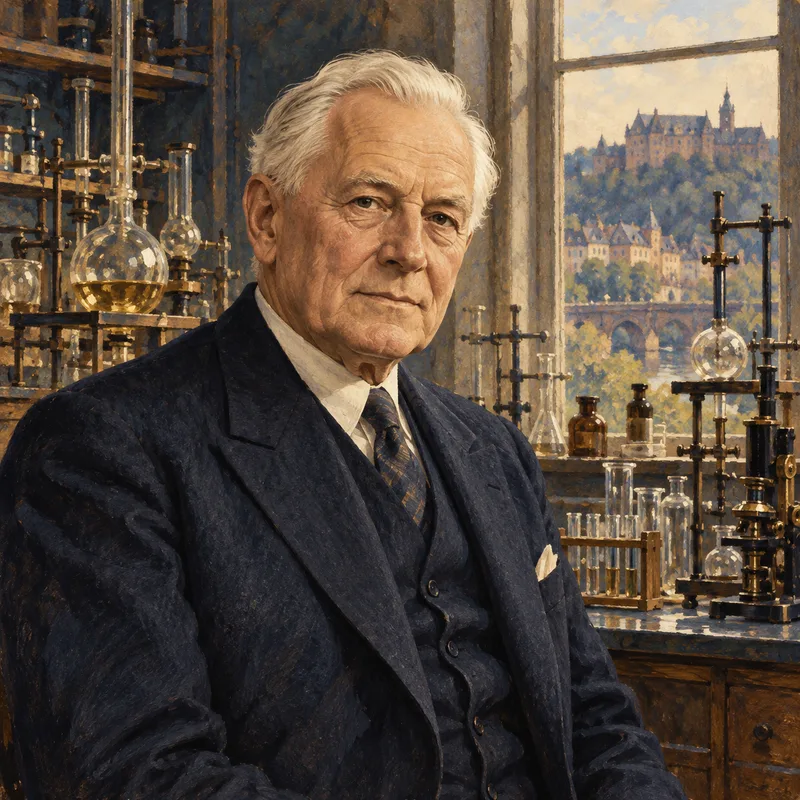
Hans Meerwein
1879-1965 · Germany
Wagner-Meerwein rearrangement; MPV reduction