The discovery, explained · Chemist no. 288 of 350
Hans Meerwein: Carbocation Shifts, Hydride Transfer and Powerful Alkylating Salts
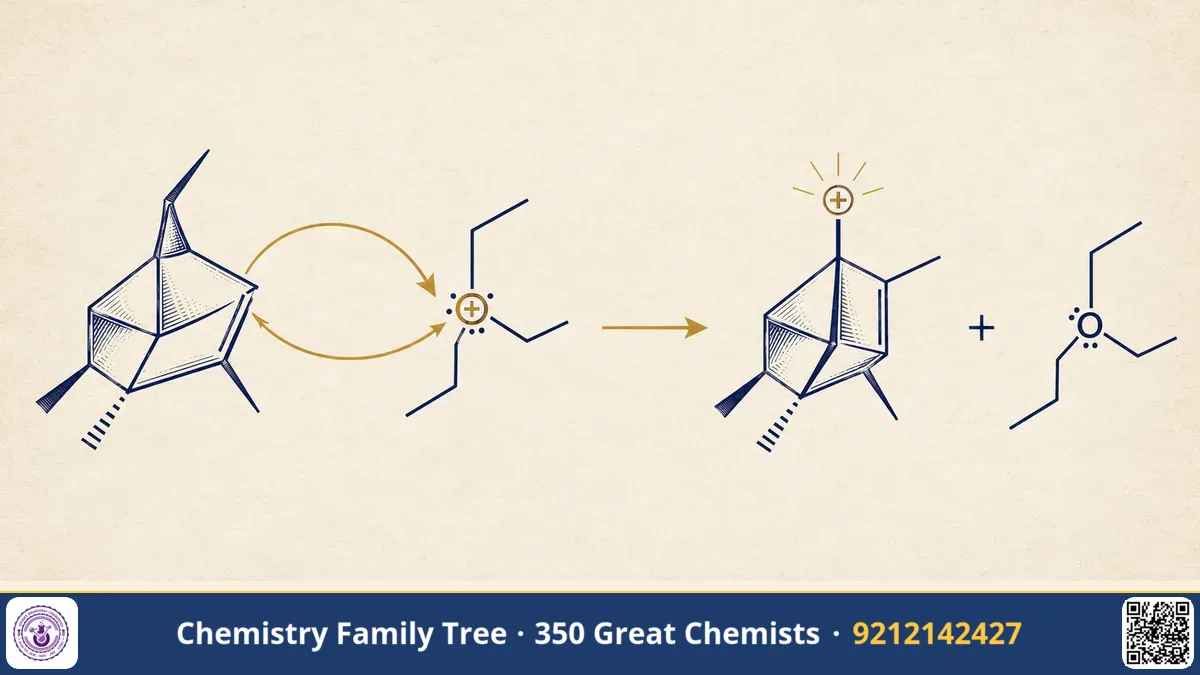
When a student sees a carbocation suddenly change its structure by shifting a methyl group or a hydrogen, the name Meerwein should come to mind. Hans Meerwein, a German chemist, put the carbocation rearrangement on firm ground in the 1910s and 1920s. He also developed a reduction of ketones that uses aluminium isopropoxide, a family of super-reactive alkylating salts, and a method of attaching aryl groups to alkenes. All four topics appear in the JAM, NET and GATE syllabus. This post explains each one in plain steps.
The Scientific Problem Before the Discovery
In the early 1900s, terpene chemistry was a puzzle. Chemists such as Georg Wagner at Warsaw and Aschan in Finland noticed that when bicyclic terpenes like camphene or pinene were treated with acids, they formed products with a different carbon skeleton from the starting material. For instance, pinene hydrochloride was not the simple expected product but a rearranged compound, bornyl chloride. These changes seemed random. No one could explain why a carbon skeleton would change under such mild conditions. Many chemists doubted that rearrangements of this kind were general.
Another gap concerned reductions. Reducing a ketone to an alcohol typically required metals or hydrides that attacked many functional groups. A gentle and selective reagent was needed.
The Discovery / Experiment
1. Wagner–Meerwein rearrangement (1914). Meerwein studied the isomerisation of isobornyl chloride to camphene hydrochloride. He found that the reaction was faster in polar solvents, and that adding a Lewis acid like SnCl₄ or anhydrous FeCl₃ speeded it up. He concluded that the rearrangement involved ionisation to a carbocation: a positively charged carbon, followed by a 1,2-shift of an alkyl group or hydrogen to give a more stable cation. This was one of the first clear pieces of evidence for carbocations as real intermediates.
(CH₃)₃C–CH₂⁺ → (CH₃)₂C⁺–CH₂CH₃ (neopentyl to tert-amyl cation, 1,2-methyl shift)
2. Meerwein–Ponndorf–Verley reduction (1925). Working with Schmidt, Meerwein showed that aluminium ethoxide reduces aldehydes to alcohols while oxidising ethanol to acetaldehyde. Verley (1925) and Ponndorf (1926) developed the practical version using aluminium isopropoxide in isopropanol:
R₂C=O + (CH₃)₂CH–OH ⇌ R₂CH–OH + (CH₃)₂C=O [Al(OiPr)₃ catalyst]
3. Meerwein's salts (1930s–1950s). He prepared trialkyloxonium tetrafluoroborates, such as triethyloxonium tetrafluoroborate, [Et₃O]⁺[BF₄]⁻, from boron trifluoride etherate and epichlorohydrin. These are crystalline powerful alkylating agents.
4. Meerwein arylation (1939). Aryl diazonium salts react with electron-poor alkenes in the presence of a copper salt to give arylated products.
The Chemistry Behind It
Why do carbocations rearrange? A carbocation is stabilised by alkyl groups (hyperconjugation and inductive effect). The order of stability is 3° > 2° > 1° > methyl. If a neighbouring carbon carries a hydrogen or alkyl group that can migrate with its bonding pair of electrons, the less stable cation can become a more stable one. Typical shifts are the 1,2-hydride shift and the 1,2-alkyl (methyl) shift. The word Wagner–Meerwein is often used for any 1,2-shift of an alkyl, aryl or hydride group in a carbocation.
The shifting group moves with its two bonding electrons, via a three-centre transition state. Ring expansions and contractions are common, for example a cyclobutylcarbinyl cation expanding to a cyclopentyl cation, which relieves ring strain. The pinacol rearrangement is also a related 1,2-shift.
MPV mechanism. The ketone coordinates to aluminium through oxygen, which activates the carbonyl carbon. A hydride is then transferred directly from the isopropoxide carbon to the carbonyl carbon through a six-membered cyclic transition state. The reaction is reversible, and the reverse is called the Oppenauer oxidation, which uses acetone in excess to push alcohols toward ketones. To drive the MPV forward, the acetone formed is distilled off. The reaction is chemoselective: C=C bonds, nitro groups and esters survive.
Meerwein salts. The oxonium ion [R₃O]⁺ is an extremely good alkylating agent because the leaving group is a neutral ether. It converts carboxylic acids into esters, amides into imidates, and alcohols into ethers under mild neutral conditions.
Applications Today
- Terpene and fragrance chemistry: Wagner–Meerwein shifts are involved in the conversion of pinene into camphene and isoborneol, important for camphor synthesis.
- Biosynthesis: Cells use carbocation shifts when making steroids and terpenes; for example, the conversion of lanosterol precursors involves several 1,2-methyl and hydride shifts.
- Petroleum industry: Isomerisation and cracking of hydrocarbons proceed by carbocation rearrangements on acidic catalysts.
- Fine chemicals: The MPV reduction and Oppenauer oxidation give selective redox control in steroid and flavour chemistry.
- Laboratory reagents: Meerwein's salt is used for mild alkylation of sensitive compounds; and Meerwein arylation makes aryl-substituted compounds used in pharmaceutical intermediates.
Exam Corner
- Wagner–Meerwein: 1,2-shift of H, alkyl or aryl in a carbocation to give a more stable cation.
- Neopentyl systems (such as neopentyl bromide in SN1 conditions) rearrange because a primary cation shifts to tertiary.
- MPV reduction: Al(OiPr)₃/iPrOH reduces C=O to CH–OH; six-membered cyclic transition state; reverse is Oppenauer.
- MPV leaves C=C and NO₂ groups intact (chemoselective).
- Meerwein's reagent: [Et₃O]⁺BF₄⁻, a strong ethylating agent.
Common Misconceptions
- "Rearrangement always occurs in carbocations." Only if a more stable cation can form; otherwise, the original cation reacts directly.
- "MPV uses free hydride." No hydride ion is free; the hydride moves within the cyclic transition state.
- "Wagner–Meerwein only means methyl shift." It covers hydride, alkyl and aryl shifts.
Quick Revision Box
- Wagner–Meerwein: carbocation 1,2-shifts to a more stable cation.
- MPV: Al(OiPr)₃ in iPrOH reduces ketone to alcohol.
- Oppenauer is the reverse: Al(OtBu)₃ with acetone oxidises alcohol.
- Meerwein salt: R₃O⁺ BF₄⁻, a powerful alkylator.
- Meerwein arylation: ArN₂⁺ + alkene with Cu salt.
- Ring strain relief drives ring expansion shifts.
FAQ
What is a Wagner–Meerwein rearrangement?
It is a 1,2-shift of a hydrogen, alkyl or aryl group in a carbocation that converts a less stable cation into a more stable one.
Why is the MPV reduction so selective?
Because the hydride transfers through a cyclic aluminium alkoxide complex that targets only the carbonyl group and leaves other reducible groups untouched.
What is Meerwein's reagent?
Typically triethyloxonium tetrafluoroborate, a stable salt that transfers an ethyl group to nucleophiles.
What is the Oppenauer oxidation?
The reverse of the MPV reduction: an alcohol is oxidised to a ketone by an aluminium alkoxide and excess acetone.
Published by ABC Chemistry — IIT-JAM | CSIR-NET | GATE Chemistry Coaching. Visit abcchemistry.com
About the chemist
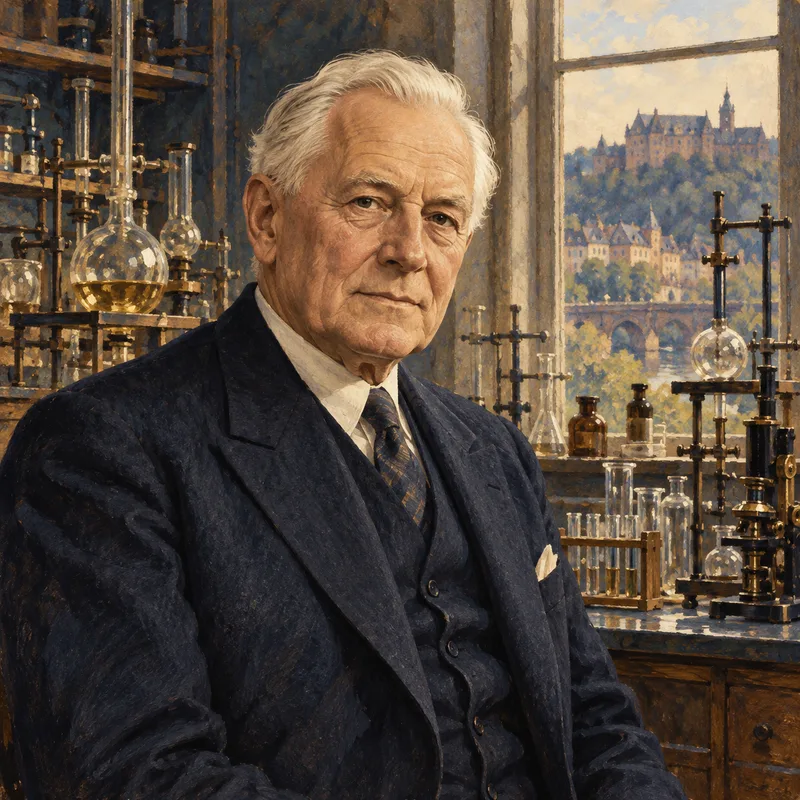
Hans Meerwein
1879-1965 · Germany
Wagner-Meerwein rearrangement; MPV reduction