Biography · Chemist no. 111 of 350
Hans von Euler-Chelpin: Complete Life and Legacy
Introduction
Hans Karl August Simon von Euler-Chelpin (1873–1964) was a German-born Swedish biochemist who spent most of his life in Stockholm. He is best known for his studies of the fermentation of sugar and for isolating and characterising the coenzyme cozymase, today called NAD+. He shared the 1929 Nobel Prize in Chemistry with Arthur Harden. He also worked on vitamins, carotenoids and enzyme kinetics. He studied painting before he took up chemistry, and he was the father of Ulf von Euler, who won the Nobel Prize in Physiology or Medicine in 1970. His life is a story of two countries and two passions, art and science.
Early Life and Family
Hans von Euler was born on 15 February 1873 in Augsburg, Bavaria, Germany. His father, Rigas von Euler, was an army officer, and the family belonged to the educated middle class. He later used the double name Euler-Chelpin professionally.
As a young man he had a strong interest in art, and he decided to study painting rather than science. This training remained with him all his life. He painted in his free time even as a famous professor, and some of his paintings have survived. At a certain point he decided that science offered a better future for him, and he turned to chemistry.
Education and Mentors
Euler-Chelpin studied chemistry, physics and mathematics at the universities of Berlin, Göttingen and Paris. In Göttingen he studied physical chemistry with Walther Nernst, who was later a Nobel laureate (Chemistry, 1920) and he received his doctorate in Berlin in 1895. The physical chemistry he learned gave him a strong foundation for the study of reaction kinetics.
After his doctorate, he worked in Göttingen with Nernst. In 1897 he moved to Stockholm to work with Svante Arrhenius, the pioneer of ionic theory and Nobel laureate in Chemistry for 1903. He decided to stay in Sweden.
Career Timeline
| Year | Event |
|---|---|
| 1873 | Born in Augsburg, Germany on 15 February. |
| 1895 | Doctorate at the University of Berlin. |
| 1897 | Moves to Stockholm to work with Arrhenius. |
| 1902 | Becomes a Swedish citizen. |
| 1906 | Professor of general and organic chemistry at Stockholm University College (Högskola). |
| 1914–1918 | Serves in the German army during the First World War. |
| 1929 | Shares the Nobel Prize in Chemistry with Arthur Harden. |
| 1930s | Works on structure of cozymase, carotenoids, and vitamin A. |
| 1941 | Retires from his professorship but continues research. |
| 1964 | Dies in Stockholm on 6 November. |
Major Scientific Contributions
- Cozymase (NAD+): isolation and structural characterisation of the coenzyme of fermentation. See our discovery post.
- Enzyme kinetics: early application of physical chemistry to the action of invertase and other enzymes.
- Phosphate esters in fermentation: with Karl Myrbäck, studied fermentation and the roles of phosphate and magnesium.
- Vitamin A and carotenoids: showed in the late 1920s that carotene has vitamin A activity, and worked on its relation to vitamin A with Paul Karrer.
- Cancer metabolism: studied enzyme activity in tumour tissue, and attempted to find cancer-inhibiting substances.
Awards, Honours and Nobel Prize
The Nobel Prize in Chemistry for 1929 was awarded jointly to Arthur Harden and Hans von Euler-Chelpin "for their investigations on the fermentation of sugar and of fermentative enzymes". Their work on yeast juice and coenzymes was seen as the logical next step after Buchner's Nobel-winning discovery of cell-free fermentation in 1907.
His son Ulf von Euler won the Nobel Prize in Physiology or Medicine in 1970, shared with Julius Axelrod and Bernard Katz, for discoveries about the humoral transmitters in nerve terminals (Ulf von Euler identified noradrenaline as the sympathetic neurotransmitter). It is one of the few cases of father and son both being Nobel laureates. Hans von Euler-Chelpin's own Nobel Prize was in Chemistry.
Personality, Struggles and Lesser-Known Facts
- Artist turned chemist. He originally trained as a painter in Munich, and kept painting alongside science.
- Between two countries. Born German and naturalised Swedish, he served as an officer in the German army during the First World War, even though he lived in Sweden. This shows how complex loyalties could be.
- Two marriages. His first wife was the Swedish botanist and chemist Astrid Cleve, with whom he had children, including Ulf. They later divorced, and he married again to Elisabeth, Baroness af Ugglas.
- Astrid Cleve. Cleve was one of the first Swedish women to earn a doctorate in science, and she became an authority on plants and geology.
- Active into old age. He continued research well after retirement and lived until the age of ninety-one.
Legacy and Influence on Modern Chemistry
The coenzyme NAD+ that Euler-Chelpin helped to characterise is today considered a central molecule of life. The idea of metabolic pathways in which a handful of carriers, NAD+, FAD, ATP and coenzyme A, shuttle chemical groups between hundreds of enzymes is at the heart of modern biochemistry.
The link between vitamins and coenzymes that he demonstrated has become part of every nutrition textbook: niacin to NAD+, riboflavin to FAD, thiamine to TPP, pantothenic acid to coenzyme A. His early use of physical chemistry on biological problems helped to build the bridge between chemistry and biology that we call chemical biology and molecular biology today.
Lessons for Students
- Do not be afraid to change your path. He moved from painting to chemistry, and from chemistry to biochemistry.
- Physical chemistry is a powerful tool for biology: kinetics, equilibria and thermodynamics explain enzymes.
- Build on the work of others. Buchner, Harden and Euler-Chelpin each added a piece to the same puzzle.
- Scientific greatness and political judgement are different things; keep ethics in view.
- Science can run in families: curiosity can be passed on to children.
Quick Facts Box
- Born: 15 February 1873, Augsburg, Germany.
- Died: 6 November 1964, Stockholm, Sweden.
- Nationality: German-born; Swedish citizen from 1902.
- Field: Biochemistry and organic chemistry.
- Famous for: Cozymase (NAD+), fermentation enzymes, carotene-vitamin A.
- Nobel: Chemistry, 1929 (shared with Arthur Harden).
FAQ
Was Euler-Chelpin German or Swedish?
He was born German and became a Swedish citizen in 1902. He is described as a German-Swedish biochemist.
Which of his children won a Nobel Prize?
His son Ulf von Euler won the Nobel Prize in Physiology or Medicine in 1970.
How was his Nobel Prize connected to Harden's?
They shared the 1929 Chemistry Prize. Harden discovered the role of phosphate and the coferment, while Euler-Chelpin characterised the coenzyme and fermentative enzymes.
What was his earlier career?
He trained as a painter in Munich before turning to chemistry, a rare path for a Nobel laureate.
Published by ABC Chemistry — IIT-JAM | CSIR-NET | GATE Chemistry Coaching. Visit abcchemistry.com
About the chemist
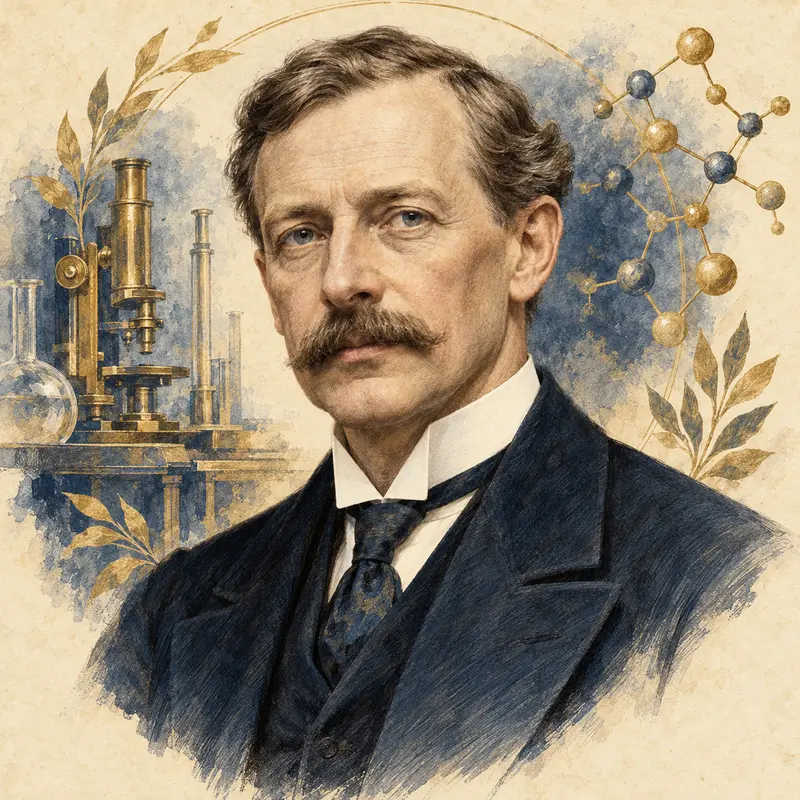
Hans von Euler-Chelpin
1873-1964 · Germany · Nobel Chemistry 1929
Sugar fermentation and enzymes