The discovery, explained · Chemist no. 111 of 350
Hans von Euler-Chelpin: Cozymase, NAD+ and the Chemistry of Fermentative Enzymes
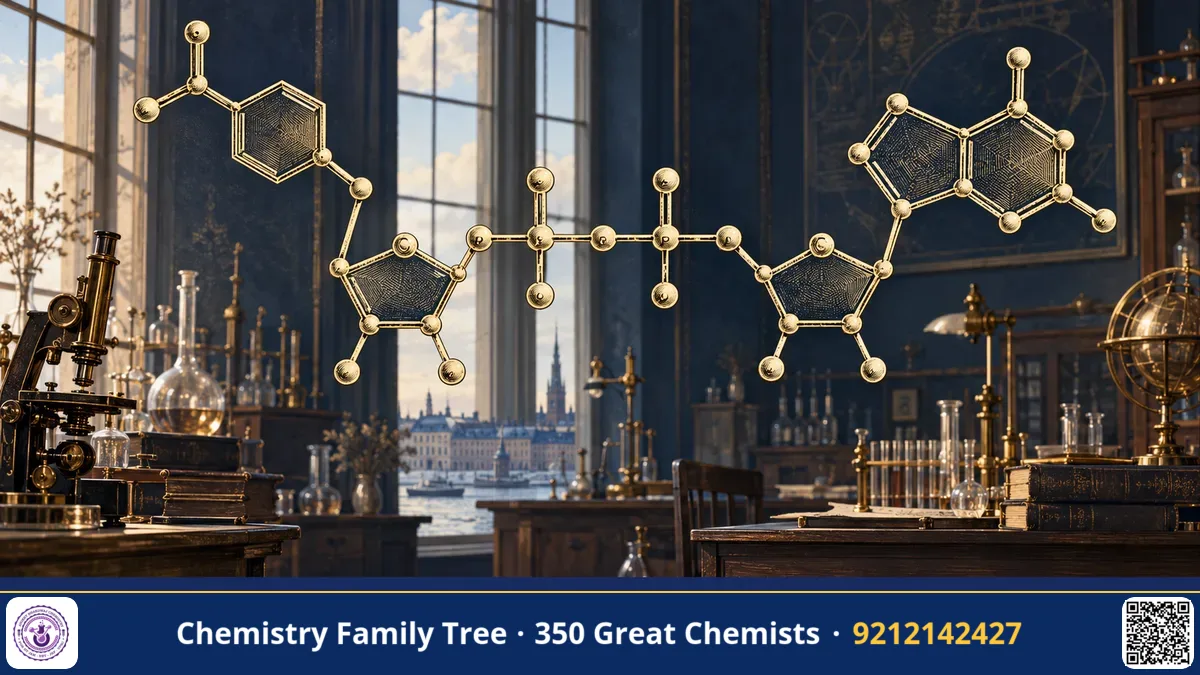
If you ask a biochemistry student to name the most important coenzyme in metabolism, a common answer is NAD+. This small molecule picks up hydride ions in the oxidation of sugars, fats and alcohols and carries them to the cell's power plants. The long road to understanding NAD+ began with yeast and fermentation. Arthur Harden had found in 1906 that yeast juice contains a heat-stable, dialysable "coferment". The German-born Swedish chemist Hans von Euler-Chelpin, working in Stockholm, set out to isolate this factor, which he called cozymase, and to find out what it was. By the mid-1930s he and his co-workers had shown that cozymase is a nucleotide containing the vitamin nicotinamide. For his work on fermentation and fermentative enzymes, he shared the 1929 Nobel Prize in Chemistry with Harden.
The Scientific Problem Before the Discovery
After Buchner's work in 1897 and the discoveries of Harden and Young in 1905–1906, it was clear that alcoholic fermentation needs a complex set of enzymes and at least one non-protein factor. But what was this factor? It was present in minute amounts in yeast, it survived boiling, it passed through a dialysis membrane, and nobody had obtained it in a pure state. Without knowing what it was, it was impossible to understand how it worked.
There was also a more general problem about enzymes. Were they proteins, or small molecules carried by colloidal materials, as Richard Willstätter was arguing? How did they combine with their substrates? What was the role of the small factors? Euler-Chelpin approached the problem with a physical chemist's training: he studied the kinetics of enzyme reactions, including the action of invertase on sucrose, and he applied the ideas of reaction rates to enzymes.
The Discovery: Step by Step
- Study of fermentation. In the first decades of the 20th century, in Stockholm, Euler-Chelpin and his students, including Karl Myrbäck, studied the fermentation of sugar by yeast and the roles of phosphate and the coferment, following Harden's discoveries.
- Naming the coferment. The heat-stable dialysable factor was named cozymase. His group developed methods to measure its activity in extracts by its effect on fermentation and on the rate of reactions catalysed by yeast enzymes.
- Concentration and purification. From large amounts of yeast, the group purified cozymase by precipitation and extraction. Euler-Chelpin demonstrated that it was an acidic, nitrogen-containing phosphoric ester of a type related to the nucleotides.
- Chemical analysis. Degradation experiments showed that cozymase contains adenine, a pentose sugar (ribose), phosphate groups and a further nitrogen base later identified as nicotinamide, a vitamin of the B group. The final structure was proposed in the mid-1930s by Euler-Chelpin, Schlenk and others in his school, and confirmed by the work of Otto Warburg, who identified NADP and showed that the nicotinamide ring is the reactive centre.
- Function. Together with Warburg and others, it was shown that cozymase takes up two hydrogen atoms (a hydride ion and a proton) from a substrate and passes them on to another. It is the carrier in the alcoholic fermentation: acetaldehyde is reduced to ethanol and cozymase is oxidised.
The Chemistry Behind It
Cozymase is now called nicotinamide adenine dinucleotide, NAD+. It is a dinucleotide: two nucleotides joined through their phosphate groups, one containing adenine and the other nicotinamide.
NAD+  =  Nicotinamide-ribose-P-P-ribose-Adenine
Nicotinamide ring (pyridinium) is the redox-active part
The key redox reaction is hydride transfer to the C-4 position of the pyridinium ring:
NAD+ + H⁻ (hydride) ⇌ NADH
Substrate-H2 + NAD+  ⇌  Substrate (oxidised) + NADH + H+
In alcoholic fermentation, the last step is catalysed by alcohol dehydrogenase:
CH3CHO + NADH + H+ → CH3CH2OH + NAD+
The reverse reaction takes place in the human liver when ethanol is oxidised to acetaldehyde. NADH absorbs light at 340 nm while NAD+ does not, a property which became the basis of countless spectrophotometric enzyme assays. The oxidised form NAD+ is mostly used for catabolic reactions such as glycolysis and the citric acid cycle, whereas the phosphorylated form NADP+/NADPH is mainly used in biosynthesis and in the Calvin cycle.
NAD+ is made in the body from the vitamin niacin (nicotinic acid or nicotinamide) and from the amino acid tryptophan. Niacin deficiency causes pellagra, a disease marked by dermatitis, diarrhoea and dementia, which is still reported in populations that depend heavily on maize or millet such as jowar in some Indian regions.
Other work of Euler-Chelpin
- Carotenoids and vitamin A: he showed in the late 1920s that carotene has vitamin A activity, and he worked with Paul Karrer on the link between carotene and vitamin A. This supported the idea of provitamins.
- Enzyme kinetics: his early work on invertase and other enzymes contributed to quantitative enzymology.
- Cancer research: in later life he studied metabolism in tumour cells and tried to find ways to inhibit them, although these studies led to no therapy.
Applications Today
- Metabolism and energy: NAD+/NADH links glycolysis, the citric acid cycle and oxidative phosphorylation, which generate ATP in every living cell.
- Clinical chemistry: assays of lactate dehydrogenase, alcohol dehydrogenase and glucose-6-phosphate dehydrogenase follow NADH at 340 nm. These tests are used in Indian pathology laboratories.
- Nutrition: food fortification with niacin to prevent pellagra.
- Biotechnology: industrial biocatalysis uses NAD(P)H-dependent enzymes, with recycling systems to regenerate the cofactor.
- Ageing and medicine research: NAD+ precursors are being studied as supplements, and enzymes like sirtuins and PARPs use NAD+ as a substrate.
- Alcohol metabolism: understanding of ethanol oxidation, including the genetic variation in ALDH2 that causes flushing in some people.
Exam Corner
- Hans von Euler-Chelpin shared the 1929 Nobel Prize in Chemistry with Arthur Harden for work on the fermentation of sugar and fermentative enzymes.
- Cozymase is the old name of NAD+ (nicotinamide adenine dinucleotide). It contains adenine, two ribose units, two phosphates and nicotinamide.
- NAD+ accepts a hydride ion at C-4 of the nicotinamide ring to form NADH; NADH absorbs at 340 nm.
- Vitamin precursors: niacin (B3) gives NAD+ and NADP+; deficiency causes pellagra.
- Last step of alcoholic fermentation: CH3CHO + NADH + H+ → C2H5OH + NAD+ (alcohol dehydrogenase, contains Zn2+).
Common Misconceptions
- "NAD+ is an enzyme." It is a coenzyme, a small organic cofactor that is not made of protein.
- "NADH carries two hydrogen atoms." More precisely it carries a hydride ion (H⁻) with two electrons, and releases a proton to the solution.
- "Euler-Chelpin alone discovered NAD+." Harden found the coferment, Euler-Chelpin isolated and characterised it, and Warburg identified its working mechanism and related coenzymes.
Quick Revision Box
- Cozymase = NAD+; contains nicotinamide, adenine, two ribose, two phosphate.
- Redox: NAD+ + H⁻ ⇌ NADH (hydride at C-4).
- NADH absorbs strongly at 340 nm.
- Niacin (vitamin B3) is the vitamin precursor; deficiency causes pellagra.
- Nobel Prize in Chemistry 1929, shared with Arthur Harden.
- Showed that carotene has vitamin A activity.
FAQ
What is the difference between NAD+ and NADP+?
NADP+ has an extra phosphate group on the 2' position of the adenosine ribose. NAD+ is mainly used in catabolism, and NADPH mainly in biosynthesis.
Why did Euler-Chelpin work in Sweden?
He was born in Germany but moved to Stockholm in 1899, became a Swedish citizen in 1902 and spent most of his career at Stockholm University.
How is NAD+ related to vitamins?
Nicotinamide, part of NAD+, is a form of niacin (vitamin B3). Lack of niacin leads to pellagra.
Why are coenzymes in the competitive exam syllabus?
They are central to biochemistry and enzymology sections: questions often ask about the structure, function and vitamin sources of NAD+, FAD, CoA, TPP and PLP.
Published by ABC Chemistry — IIT-JAM | CSIR-NET | GATE Chemistry Coaching. Visit abcchemistry.com
About the chemist
Hans von Euler-Chelpin
1873-1964 · Germany · Nobel Chemistry 1929
Sugar fermentation and enzymes