Biography · Chemist no. 324 of 350
Har Gobind Khorana: Complete Life and Legacy of the Indian-Born Nobel Laureate
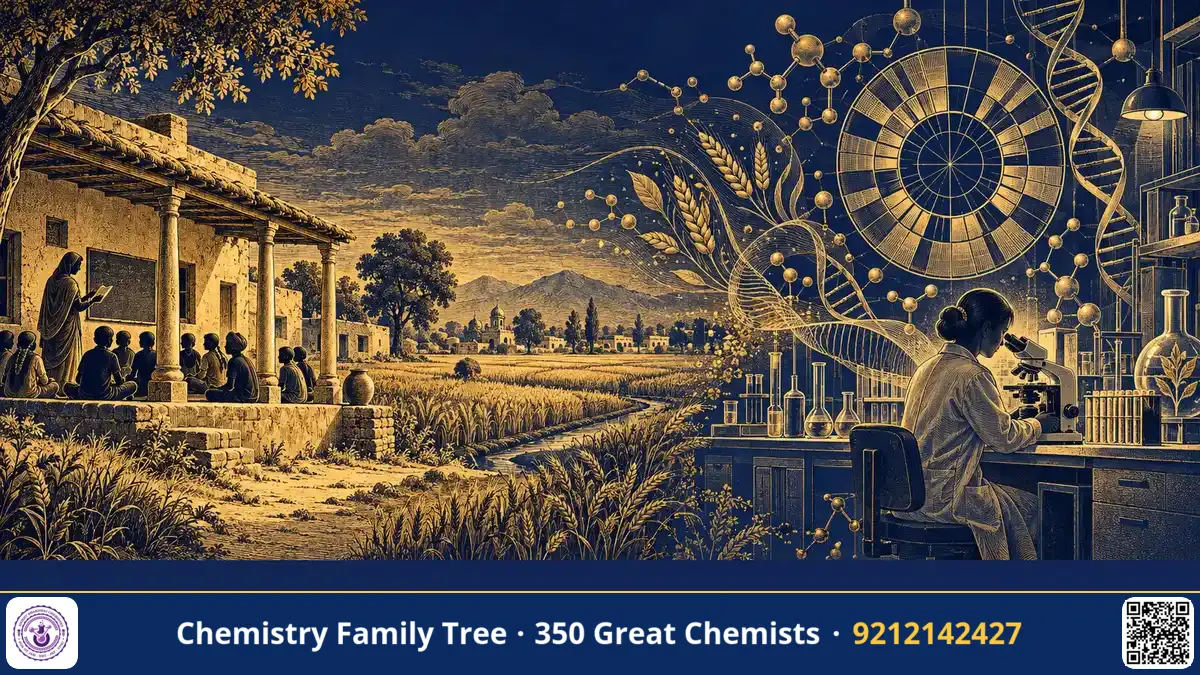
Har Gobind Khorana (1922-2011) rose from a tiny village in Punjab, in a family of modest means, to become one of the greatest organic chemists and molecular biologists of the twentieth century. He decoded the genetic code with chemically synthesised RNA and made the first synthetic gene, and shared the 1968 Nobel Prize in Physiology or Medicine with Marshall Nirenberg and Robert Holley. For Indian students he is an inspiring example: a government-school student whose education began under a village tree and ended on the Nobel stage.
Early Life and Family
Khorana was born on 9 January 1922, though his exact birth date is not documented with certainty in Raipur, a small village in the Multan district of Punjab, British India, today in Pakistan. His father, Ganpat Rai Khorana, was a patwari, a village tax and land-records clerk in the British administration. His mother was Krishna Devi Khorana. Khorana was the youngest of five children, in one of the very few families in the village who could read and write. The family was poor, but his father was determined to educate his children and often said that education was the only wealth worth having. Young Khorana first studied under a tree in the village, and later in the school in Multan (DAV High School). The family had little money, but he received scholarships throughout his studies.
Education and Mentors
He studied chemistry at the Punjab University in Lahore, earning his B.Sc. (Honours) in 1943 and M.Sc. in 1945. At Lahore, his teacher Mahan Singh inspired him with a love of chemistry, and he worked on organic chemistry. With a Government of India fellowship, he went to England and studied at the University of Liverpool under Roger J. S. Beer, obtaining a Ph.D. in 1948. He then won a fellowship from the Swiss Federal Institute of Technology (ETH) in Zurich, to work with Vladimir Prelog (Nobel Prize in Chemistry 1975) on alkaloid chemistry. He later joined Alexander Todd (Nobel Prize 1957) at Cambridge in 1950-52, where he learned nucleotide chemistry. These years laid the base of his work on the chemical synthesis of nucleic acids. After a brief return visit to India, he found that no suitable research job was available, and he decided to move abroad again.
Career Timeline
| Year | Event |
|---|---|
| 1922 | Born in Raipur, Punjab, British India |
| 1943 | B.Sc. (Hons) in Chemistry, Punjab University, Lahore |
| 1945 | M.Sc., Punjab University, Lahore |
| 1948 | Ph.D., University of Liverpool |
| 1948-1949 | Postdoctoral work with Vladimir Prelog, ETH Zurich |
| 1950-1952 | Postdoctoral work with Alexander Todd, Cambridge |
| 1952 | Moved to the British Columbia Research Council, Vancouver, Canada |
| 1960 | Joined the Institute for Enzyme Research, University of Wisconsin-Madison |
| 1960s | Decoded the genetic code with synthetic RNA |
| 1966 | Became a United States citizen |
| 1968 | Nobel Prize in Physiology or Medicine |
| 1970 | First synthesis of a gene (yeast alanine tRNA) |
| 1970 | Moved to MIT as Alfred P. Sloan Professor of Biology and Chemistry |
| 1976 | Synthesised a functional gene (tyrosine suppressor tRNA) that worked in bacteria |
| 1970s-80s | Studied rhodopsin and bacteriorhodopsin |
| 2011 | Died on 9 November in Concord, Massachusetts |
Major Scientific Contributions
- Chemical synthesis of nucleotides and oligonucleotides: Development of protecting-group strategies and DCC coupling.
- Deciphering the genetic code: Use of repeating RNA copolymers to assign codons and find stop signals.
- First synthetic gene: From 1970; the start of synthetic biology.
- Coenzyme A: Early work on the chemistry of coenzyme A and phosphate esters.
- Membrane proteins: The first complete amino acid sequence of the light-sensitive protein bacteriorhodopsin, and the study of vertebrate rhodopsin, the visual pigment, which paved the way to understanding G-protein-coupled receptors.
- Methods: His work led to the techniques used in primer synthesis, site-directed mutagenesis and later PCR.
The chemistry of the genetic code work is explained in our discovery blog on Khorana.
Awards, Honours and Nobel Prize
Khorana, Marshall Nirenberg and Robert Holley shared the 1968 Nobel Prize in Physiology or Medicine "for their interpretation of the genetic code and its function in protein synthesis". He also received the Louisa Gross Horwitz Prize (1968), the Albert Lasker Basic Medical Research Award (1968), the Merck Award of the Chemical Institute of Canada (1958), and the National Medal of Science (US, 1987). He was a member of the US National Academy of Sciences and foreign member of the Royal Society. In his memory, the Indo-US Science and Technology Forum and the University of Wisconsin-Madison set up the Khorana Program, which gives Indian students research experience in the United States.
Personality, Struggles and Lesser-Known Facts
- Humble beginnings: Khorana often remembered that his family was the only literate one in the village, and that his teachers and a scholarship made all the difference.
- Struggle for a job in India: After his Ph.D. he returned to India but could not find a suitable scientific position. This episode was a painful memory, and it made him leave India for research opportunities in Canada and then the US.
- Married Esther Elizabeth Sibler: He married Esther, a Swiss woman, in 1952; they had three children, Julia Elizabeth, Emily Anne and Dave Roy. Esther died in 2001.
- Hard worker: His colleagues recall long hours and extremely high standards; his laboratory trained generations of nucleic acid chemists.
- Deep connection to India: Khorana visited India and encouraged Indian students; he supported the scholarship scheme that sends Indian students to American labs.
- Quiet personality: He avoided publicity and spoke little about himself.
Legacy and Influence on Modern Chemistry
Khorana's work lives on every time a researcher orders a PCR primer, synthesises a gene or designs a drug against a G-protein-coupled receptor. His idea that chemistry can write and read the language of life led to synthetic biology. His students and postdoctoral fellows led laboratories around the world, including several from India. For Indian students, his name appears in the school syllabus on the genetic code, and his story is used as a model of hard work and scholarship. The IIT-JAM and CSIR-NET exams frequently touch topics such as protecting groups, oligonucleotide synthesis and the genetic code, all connected to his work. Scholarship programmes named after him continue his link with Indian students.
Lessons for Students
- Background does not decide destiny. A village boy with scholarships and teachers became a Nobel laureate.
- Master chemistry first. Strong organic chemistry gave him the tool to solve a biological problem.
- Be willing to move for opportunity. He travelled across four countries to find the right research environment.
- Be grateful to teachers. He always credited his school and university teachers in Punjab.
Quick Facts Box
- Born: 9 January 1922, Raipur (Multan district), Punjab, British India (now Pakistan)
- Died: 9 November 2011, Concord, Massachusetts, USA
- Nationality: Indian-born; American citizen from 1966
- Field: Organic chemistry, molecular biology
- Famous for: Genetic code, first synthetic gene, rhodopsin studies
- Nobel: 1968, Physiology or Medicine (with Nirenberg and Holley)
FAQ
Was Khorana born in India?
He was born in a village in Punjab in British India, an area which is now in Pakistan. He is regarded as an Indian-origin scientist.
Where did Khorana study in India?
At Punjab University, Lahore, where he took his B.Sc. (Honours) in 1943 and M.Sc. in 1945, before going to Liverpool on a government fellowship.
Did Khorana win the Nobel Prize in Chemistry?
No. It was the Nobel Prize in Physiology or Medicine in 1968, even though he was a chemist.
What is the Khorana Program?
It is a scholarship and research exchange programme set up in his name that brings Indian students to US university laboratories for summer research.
Published by ABC Chemistry — IIT-JAM | CSIR-NET | GATE Chemistry Coaching. Visit abcchemistry.com
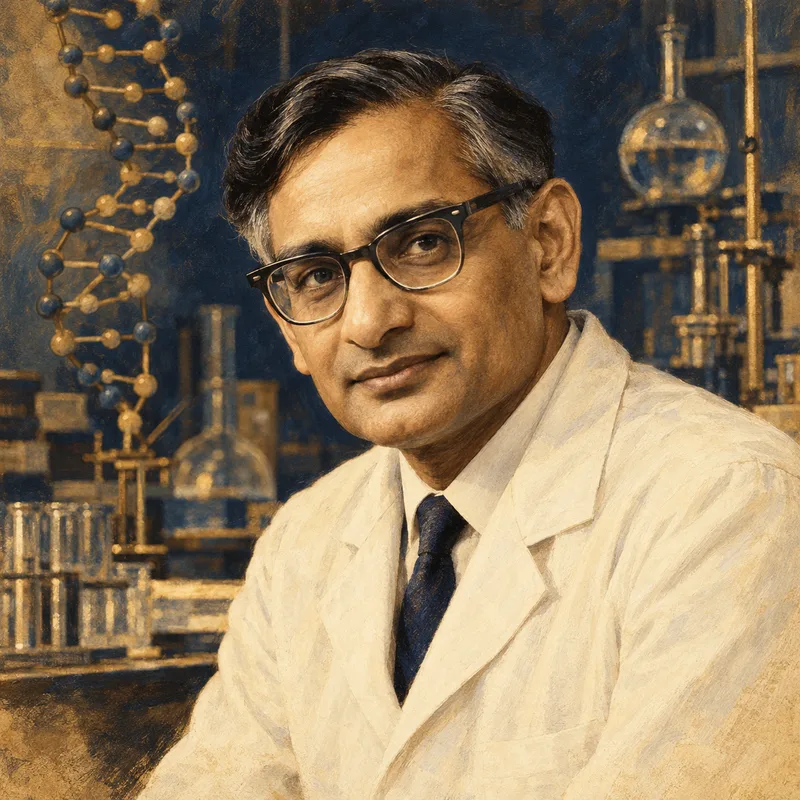
About the chemist
Har Gobind Khorana
1922-2011 · United States · Nobel Physiology/Medicine 1968
Genetic code; synthesis of oligonucleotides