The discovery, explained · Chemist no. 324 of 350
Har Gobind Khorana: Chemistry Meets the Genetic Code
Nirenberg's poly-U experiment in 1961 showed that UUU codes for phenylalanine, but it opened only one door of 64. The Indian-born organic chemist Har Gobind Khorana (1922-2011) unlocked most of the others. Using his skill in nucleotide chemistry, he synthesised RNA chains with known repeating sequences and fed them to cell-free protein-making systems. From the proteins formed, he read the meaning of the codons with great accuracy. Later, in 1970, he and his team made the first chemically synthesised gene, a 77-base-pair DNA for a yeast alanine tRNA. For this work Khorana shared the 1968 Nobel Prize in Physiology or Medicine with Marshall Nirenberg and Robert Holley. He was an organic chemist, and his career shows how synthetic chemistry can answer biological questions.
The Scientific Problem Before the Discovery
After Nirenberg and Matthaei's poly-U experiment, the next problem was how to assign the other codons. Random RNA copolymers made with polynucleotide phosphorylase (Ochoa's enzyme) gave only the base composition of the codons, but not their order. For instance, a copolymer of U and G would contain UUU, UUG, UGU, GUU, UGG, GUG, GGU, GGG, but one could not tell which codon gave which amino acid. A method was needed to make RNA with defined sequences.
The Discovery / Experiment
Step 1: Chemical synthesis of oligonucleotides
Khorana had developed methods of joining nucleotides by chemistry while working with Alexander Todd in Cambridge and in Vancouver. The central problem is to form a 3'-5' phosphodiester bond between two nucleotides without making unwanted bonds at other hydroxyl and amino groups. His solution used protecting groups and a coupling agent:
- Protect the 5'-OH of one nucleotide with a dimethoxytrityl (DMT) or similar group, and the amino groups of the bases with acyl groups (benzoyl, isobutyryl).
- Activate the 3'-phosphate of that nucleotide with dicyclohexylcarbodiimide (DCC), which removes water and drives formation of the ester bond.
- React it with the free 5'-OH of the second nucleotide.
- Remove the protecting groups with acid or base, and purify by ion-exchange chromatography.
R-O-P(O)(OH)-OH + HO-R' --DCC--> R-O-P(O)(OH)-O-R' + dicyclohexylurea
Repeating this process, he built short DNA chains of defined sequence, such as di-, tri- and tetranucleotides, which could be joined to make longer repeating polymers with the enzyme DNA polymerase and later RNA polymerase.
Step 2: Repeating copolymers
Short DNA repeats, e.g. (TC)n, were copied by DNA polymerase to give long double-stranded DNA with repeating units, and then by RNA polymerase to give RNA with repeating sequences. For example:
(UC)n  = UCUCUCUC...  → codons alternate UCU and CUC → Ser-Leu-Ser-Leu... polypeptide
(UG)n  = UGUGUG...    → UGU and GUG → Cys-Val-Cys-Val...
(AAG)n → can be read as AAG AAG, AGA AGA or GAA GAA → three homopolypeptides: polylysine, polyarginine, polyglutamic acid
The pattern of amino acids in the product told which codons were present, and the order in which they were read. The repeating dinucleotides gave alternating amino acids, and the repeating trinucleotides gave one amino acid, depending on where reading started. Using these, along with the trinucleotide-binding method of Nirenberg and Leder, which showed which aminoacyl-tRNA binds to a given triplet on ribosomes, the entire code was assigned by about 1966.
Step 3: Stop codons and the start
Repeating tetranucleotides, which contain stop codons, gave only short peptides, and this type of experiment helped identify the termination codons UAA, UAG and UGA. AUG, which codes for methionine, was recognised as the start codon in later work by several laboratories.
Step 4: The first synthetic gene
Beginning in the late 1960s at Wisconsin, Khorana set out to synthesise a complete gene. His team chemically synthesised short single-stranded DNA fragments, around 8 to 12 nucleotides each, designed so that the pieces overlapped and formed a double-stranded structure through base pairing. The enzyme DNA ligase then joined the nicks. By 1970 they had assembled the gene for the yeast alanine tRNA, 77 base pairs, which Holley had sequenced earlier. Later at MIT, in 1976, his team made a larger gene for the E. coli tyrosine suppressor tRNA, together with its control regions, and showed that it worked inside living bacterial cells.
The Chemistry Behind It
- Protecting group chemistry: the use of acid-labile DMT on 5'-OH, base-labile acyl groups on amino groups; a basic idea in all organic synthesis.
- DCC coupling: carbodiimides activate phosphates (and carboxylic acids in peptide synthesis) by forming a reactive O-acylisourea-like intermediate.
- Enzymatic amplification: polymerases and ligases are used to extend and join chemically made pieces.
- Triplet code: 64 codons, 61 sense and 3 stop; degenerate and non-overlapping.
- Overlapping fragments: Staggered, overlapping complementary pieces hold themselves together by hydrogen bonding until ligase seals the backbone. The same logic is used today in gene assembly.
Applications Today
- Automated DNA synthesis: Modern oligonucleotide synthesisers use phosphoramidite chemistry (Caruthers), an improvement of Khorana's approach, to make PCR primers in Indian laboratories every day.
- Gene synthesis: Companies make entire genes to order; synthetic biology and vaccine design use this.
- Protein engineering: Site-directed mutagenesis uses synthetic oligonucleotides.
- Rhodopsin and membrane proteins: Khorana's later work on bacteriorhodopsin and rhodopsin laid the basis for understanding G-protein coupled receptors, targets of many drugs.
- Genetic diagnostics: Probes and primers are synthetic oligonucleotides.
Exam Corner
- Khorana used synthetic repeating copolymers of known sequence to decipher the genetic code; he shared the 1968 Nobel Prize in Physiology or Medicine with Nirenberg and Holley.
- DCC is the condensing agent used in chemical synthesis of the phosphodiester bond.
- (UC)n gives alternating Ser-Leu; (UG)n gives alternating Cys-Val.
- Stop codons: UAA, UAG, UGA; start codon: AUG.
- First complete synthetic gene: yeast alanine tRNA gene, 1970.
Common Misconceptions
- "Khorana discovered the genetic code alone." Nirenberg, Ochoa, Leder and others were essential. Khorana provided the sequence-defined RNAs and confirmed the order.
- "Khorana won the Chemistry Nobel." It was Physiology or Medicine (1968), although he was an organic chemist.
- "He made the first artificial life." The 1970 gene was not replicating inside a cell; it was a DNA molecule synthesised by chemistry and enzymes. The 1976 gene did work in vivo as a tRNA gene.
Quick Revision Box
- Method: chemical synthesis of defined oligonucleotides, repeating copolymers and cell-free translation.
- Coupling agent: DCC; protecting groups on 5'-OH and bases.
- Repeating dinucleotides give alternating amino acids; trinucleotides give homopolymers.
- Identified stop codons and completed the codon table.
- First synthetic gene: yeast alanine tRNA, 1970.
- Nobel 1968 with Nirenberg and Holley, Physiology or Medicine.
FAQ
How did Khorana know which codon codes for which amino acid?
He used RNA with defined repeating sequences and found which amino acids appeared in the polypeptides made by cell-free ribosome systems. Comparing different repeats gave the order of the codons.
Why is the first synthetic gene important?
It proved that genes can be made from scratch by chemistry, opening the way to recombinant DNA and synthetic biology.
Is Khorana an Indian scientist?
He was born in India, in a village in what was then British India (now Pakistan), studied at Punjab University, Lahore, and later became a citizen of the United States. His legacy is described in our biography post.
What exam questions are based on Khorana's work?
Typical questions are on codons from repeating copolymers, DCC, protecting groups, stop codons and synthetic oligonucleotides.
Published by ABC Chemistry — IIT-JAM | CSIR-NET | GATE Chemistry Coaching. Visit abcchemistry.com
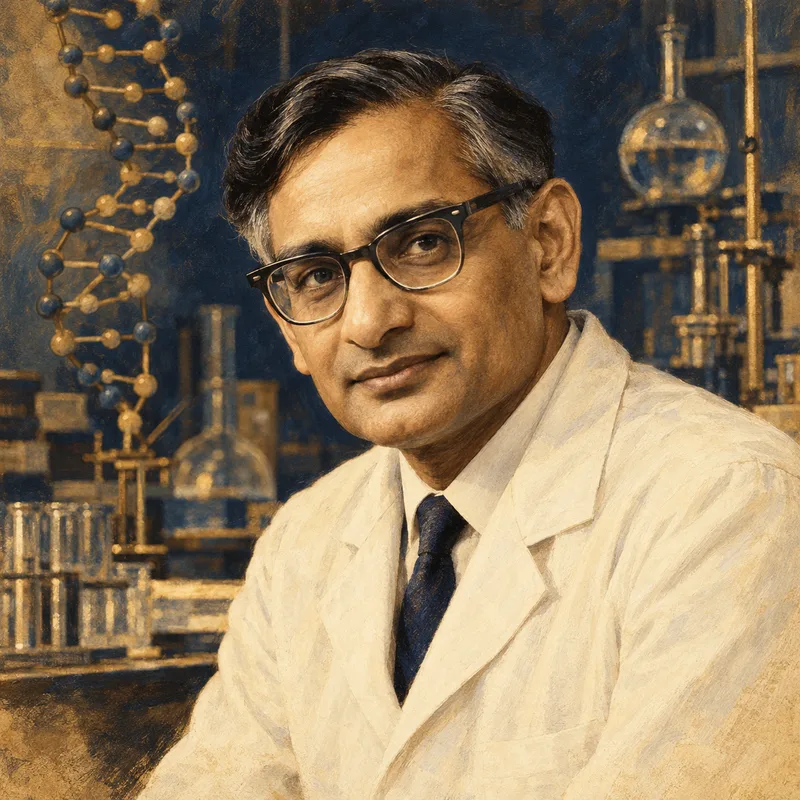
About the chemist
Har Gobind Khorana
1922-2011 · United States · Nobel Physiology/Medicine 1968
Genetic code; synthesis of oligonucleotides