Biography · Chemist no. 85 of 350
Sir Harold Kroto (1939-2016): The Curious Chemist Who Found the Buckyball
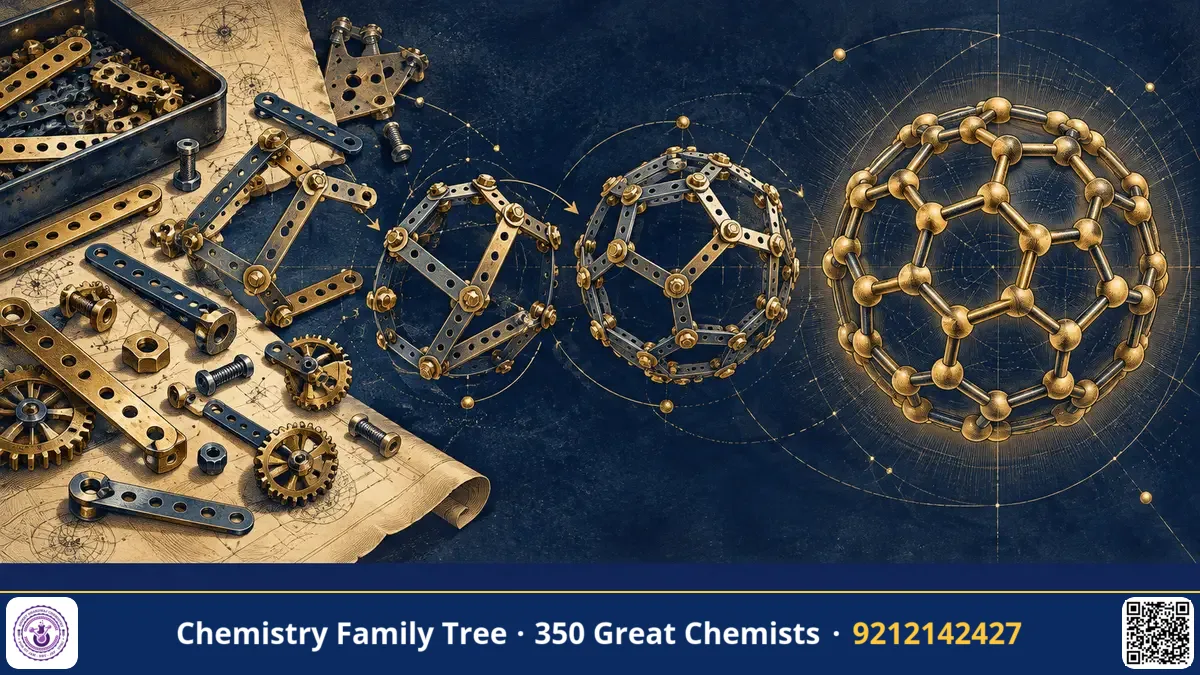
Sir Harold Walter Kroto was a British chemist who shared the 1996 Nobel Prize in Chemistry for the discovery of fullerenes, the third known form of pure carbon after graphite and diamond. His legacy in one line: he was a scientist who combined radio-astronomy, spectroscopy and a love of design to find C60, and who then spent much of his life trying to inspire students and the public about science. He is a role model for any student who wants to follow curiosity across subject boundaries.
Early Life & Family
Kroto was born on 7 October 1939 in Wisbech, Cambridgeshire, England. His birth name was Harold Krotoschiner. His parents had come from Berlin: his father, Heinz, had left Nazi Germany in the 1930s as a refugee, and the family later shortened its name. During the Second World War the family moved to Bolton in Lancashire, where Harold grew up and his father ran a small business making balloons and similar items. As a boy he loved drawing, building and playing with the construction toy Meccano, and he later said that these experiences gave him a feel for structure and geometry that proved useful when he thought about the shape of C60. He attended Bolton School, where he did well in science and also developed his skills in art and sport, especially tennis.
Education & Mentors
Kroto studied chemistry at the University of Sheffield, receiving his bachelor's degree in 1961 and a PhD in 1964. His research there was in molecular spectroscopy, studying the way molecules absorb light and microwaves. After his doctorate he did postdoctoral research at the National Research Council in Ottawa, Canada, and then at Bell Telephone Laboratories in New Jersey in the United States. These years exposed him to the new tools of spectroscopy and to collaboration with physicists, and they prepared him to work on molecules in space. In 1967 he returned to Britain and joined the University of Sussex, where he stayed for decades.
Career Timeline
| Year | Event |
|---|---|
| 1939 | Born in Wisbech, England (7 October) |
| 1961 | Bachelor's degree in chemistry, University of Sheffield |
| 1964 | PhD, University of Sheffield |
| 1964-1967 | Research in Ottawa (NRC Canada) and at Bell Labs, USA |
| 1967 | Joins the University of Sussex |
| 1970s | Studies carbon-chain molecules and shows their presence in interstellar space with astronomers |
| 1985 | Co-discovers C60 at Rice University, Houston (September) |
| 1990 | Elected a Fellow of the Royal Society |
| 1995 | Co-founds the Vega Science Trust to bring science to the public by video |
| 1996 | Receives a knighthood and the Nobel Prize in Chemistry |
| 2004 | Moves to Florida State University in the United States |
| 2016 | Dies in Lewes, East Sussex (30 April) |
Major Scientific Contributions
- Interstellar carbon chains: laboratory and radio-astronomy work on cyanopolyynes such as HC5N and HC7N, showing that long carbon-chain molecules exist in space.
- Discovery of C60 fullerene: with Curl, Smalley, Heath and O'Brien, in 1985.
- Multiple bonds to heavier elements: work on unstable molecules containing C=S and C≡P bonds, studied by microwave and photoelectron spectroscopy.
- Fullerene chemistry: the formation of fullerenes and the idea that carbon-rich stars could produce them.
- Science communication: video lectures and a worldwide outreach programme.
For the experiment, the structure of C60 and the rotational spectroscopy basics, see the companion discovery blog on Kroto and the fullerene story.
Awards, Honours & Nobel Prize
Kroto, Robert F. Curl Jr. and Richard E. Smalley shared the Nobel Prize in Chemistry 1996 "for their discovery of fullerenes". He was knighted in 1996, was elected a Fellow of the Royal Society in 1990, and received many other medals and honorary degrees. He also won recognition for his work in graphic design, for which he had a deep personal interest, and for science outreach.
Personality, Struggles & Lesser-Known Facts
- He was born Harold Krotoschiner; the family name was shortened to Kroto after the move to Britain.
- As a child he played with Meccano and he later said that this helped him think in three dimensions, which was valuable for fullerene structure.
- He was a talented graphic artist and designer, and he enjoyed drawing and creating illustrations as much as running experiments.
- He originally came to Rice University to test a hypothesis about carbon in red giant stars, not to find a new molecule. The discovery came from a side track.
- He founded the Vega Science Trust to make science films and interviews with leading scientists freely available online.
- He was a strong supporter of science education and often said that curiosity-driven research must be protected.
- He died of motor neurone disease (amyotrophic lateral sclerosis) in 2016, aged 76.
Legacy & Influence on Modern Chemistry
The discovery of C60 started the new science of nanocarbons. Fullerenes led the way to single-walled carbon nanotubes and, in a conceptual sense, helped chemists think of graphene as an unrolled sheet. Fullerene derivatives are widely used in organic solar-cell research. Kroto's astrochemical work gave radio astronomers molecular fingerprints for studying star formation, and later observations found fullerenes in space, supporting his original idea. For education, he left a lasting example of how outreach and research can go together.
Lessons for Students
- Follow your curiosity, even across departments. Astronomy and chemistry met in his work.
- Develop non-scientific skills too. Art, design and play helped him visualise molecules.
- Learn to build models. Cardboard and paper models were part of the discovery of C60.
- Share your knowledge. A discovery grows when many people can understand it.
Quick Facts Box
- Born: 7 October 1939, Wisbech, Cambridgeshire, England
- Died: 30 April 2016, Lewes, East Sussex, England
- Nationality: British
- Field: Spectroscopy, astrochemistry, nanoscience
- Famous for: Co-discovery of C60 fullerene; interstellar carbon chains
- Nobel Prize: Chemistry, 1996 (with R. F. Curl Jr. and R. E. Smalley)
FAQ
Why did Kroto change his name?
He was born Harold Krotoschiner. His family, who had fled Berlin, shortened the surname to Kroto.
What university did Kroto work at for most of his career?
The University of Sussex in England, from 1967 until 2004, followed by Florida State University.
Was Kroto a chemist or an astronomer?
He was a chemist who used spectroscopy to study molecules in space, so his work was in the area of astrochemistry.
What was the Vega Science Trust?
It was an educational organisation he co-founded in 1995 to share science through video programmes and interviews.
Published by ABC Chemistry — IIT-JAM | CSIR-NET | GATE Chemistry Coaching. Visit abcchemistry.com
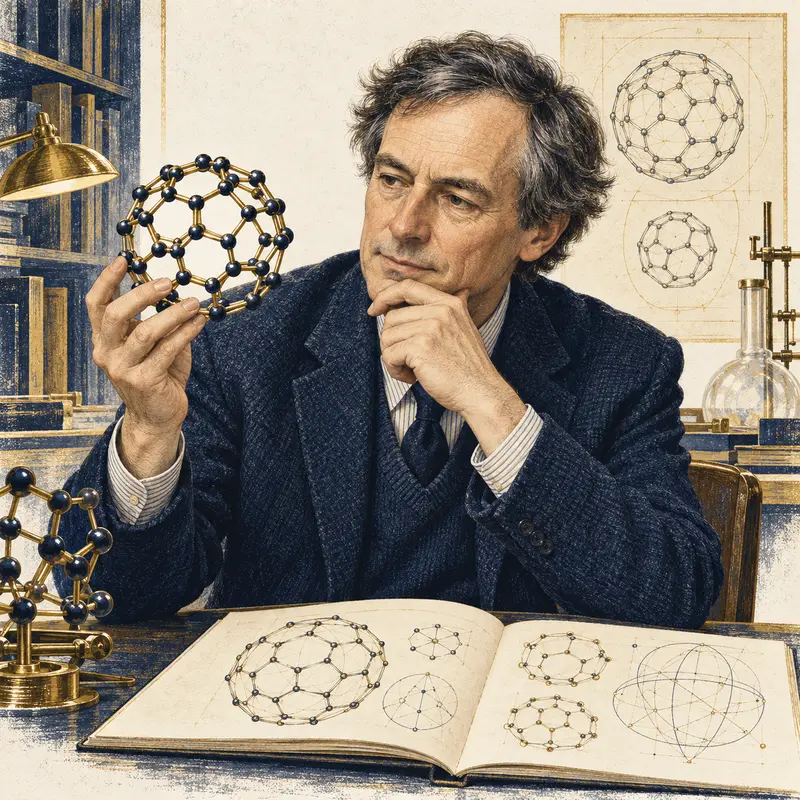
About the chemist
Harold Kroto
1939-2016 · United Kingdom · Nobel Chemistry 1996
Discovery of fullerenes