The discovery, explained · Chemist no. 85 of 350
Harold Kroto: From Carbon Chains in Space to the Discovery of C 60 Fullerene
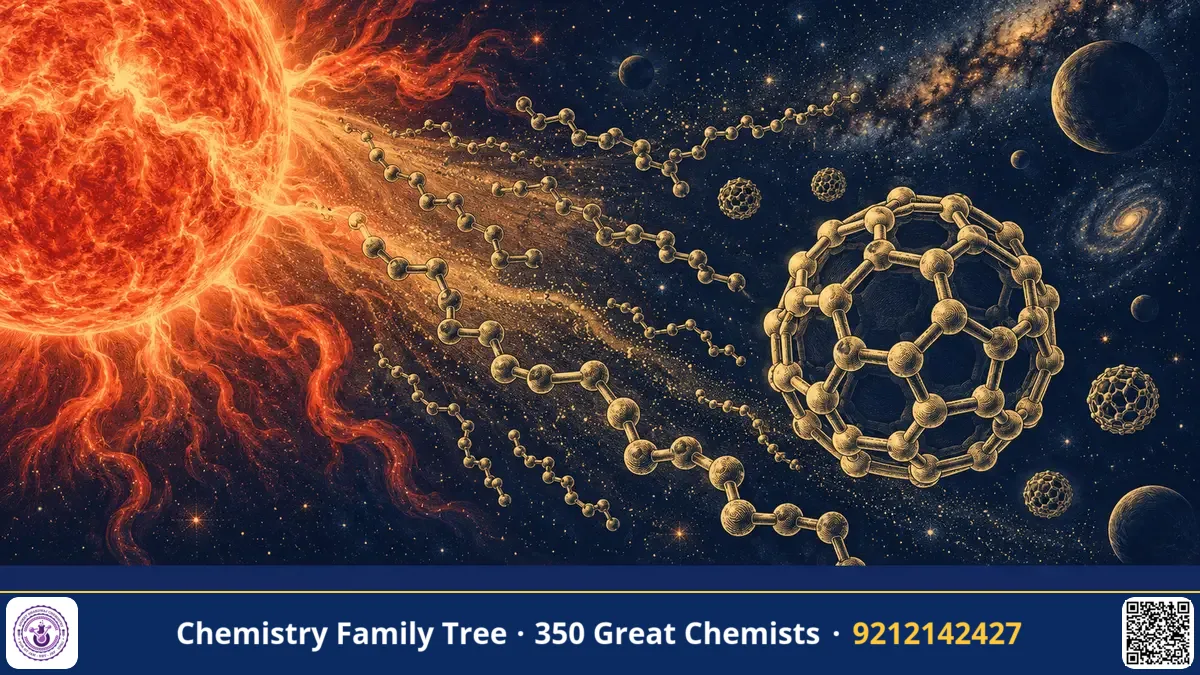
Most great discoveries begin with a simple question. For Harold Kroto the question was: how do long chains of carbon atoms form in space? He used microwave spectroscopy, the science of how molecules rotate, to detect strange molecules like HC7N in dark interstellar clouds. Searching for the source of these chains led him in 1985 to Rice University, where he, Robert Curl, Richard Smalley, James Heath and Sean O'Brien found a hollow carbon cage of 60 atoms: buckminsterfullerene. The three senior scientists shared the 1996 Nobel Prize in Chemistry. This blog tells the story from Kroto's side, so you can learn rotational spectroscopy and fullerene structure together.
The Scientific Problem Before the Discovery
In the 1970s radio astronomers began to detect molecules in interstellar clouds, the cold gas between the stars. Many were small, such as CO, NH3 and H2O. But in 1971-1976 astronomers detected unusually long molecules, including the cyanopolyyne HC5N, a chain with the structure H-C≡C-C≡C-C≡N. Kroto and his colleagues, working at the University of Sussex, prepared HC5N and longer members in the laboratory, measured their microwave spectra, and then helped astronomers find them in space. They also helped to identify HC7N in interstellar clouds. Longer chains such as HC9N and HC11N were also found by other groups.
The puzzle was that these long carbon chains should be reactive and fragile. How could they survive in large amounts and how were they made? Kroto suspected that the chains were made in the atmospheres of cool, carbon-rich red giant stars and were then expelled into space. To test this idea he wanted to vaporise carbon in the laboratory and see what kinds of chains and clusters formed.
The Discovery / Experiment — Step by Step
Part 1: Identifying molecules by their rotation
A linear molecule behaves as a rigid rotor. Its rotational energy levels are:
E(J) = B · J(J + 1)     (J = 0, 1, 2 ...)
B = h / (8π² c I)       (in wavenumber units),  I = Σ m r²
Here J is the rotational quantum number, B is the rotational constant and I is the moment of inertia. The selection rule for absorption is ΔJ = ±1 and the molecule must have a permanent dipole moment. The lines in the spectrum are separated by 2B, so measuring them gives I and, therefore, bond lengths. For HC5N the lines are spaced very closely, because the molecule is long and I is large. Each molecule has its own set of lines, like a fingerprint. By comparing the laboratory spectrum with radio telescope signals, astronomers could say with certainty that the molecule was present in space. Note that symmetric molecules without a dipole moment, such as C2H2 or O2, show no pure rotational spectrum.
Part 2: The Rice University experiment (1985)
Kroto came to Smalley's laboratory in Houston with a request to use the laser-vaporisation cluster machine to vaporise graphite. In September 1985 the team found something unexpected: instead of a smooth distribution of chains, the mass spectrum showed a very strong peak at 60 carbon atoms. Kroto's contribution was crucial in interpreting it. He recalled geodesic domes, such as the one Buckminster Fuller designed for the 1967 Montreal Expo, and the idea that a polyhedron with pentagons and hexagons could close into a ball. Using paper and then cardboard models, the team showed that a truncated icosahedron has exactly 60 vertices. Their report was published in Nature in 1985.
Graphite (laser vaporisation, He gas) → C2, C3, ... Cn clusters → C60 (cage, M = 720)
The Chemistry Behind It
Why a cage and not a chain?
A flat graphene sheet of 60 atoms would have many edge atoms with dangling bonds. A chain has two reactive ends. A closed cage has no edges, so every carbon atom is bonded to three others. The price is strain, because sp2 carbons prefer a flat 120° angle. The strain is spread over the sphere by the 12 pentagons. In C60, the sum of angles at each carbon is about 348° instead of 360° for flat graphite, which is the mark of curvature.
| Property | Graphite | Diamond | C60 |
|---|---|---|---|
| Hybridisation | sp2 | sp3 | nearly sp2 (curved) |
| Structure | Layers of hexagons | 3D network | Molecular cage, 12 pentagons + 20 hexagons |
| Solubility | Insoluble | Insoluble | Soluble in benzene, toluene, CS2 |
| Electrical behaviour | Conductor (in plane) | Insulator | Semiconductor/insulator solid |
Another part of Kroto's chemistry
Kroto also spent many years making and studying unusual short-lived molecules with double and triple bonds between carbon and heavier elements, such as C=S and C≡P, using microwave and photoelectron spectroscopy. These studies showed that the idea that "only second-row elements form multiple bonds" is too simple, a point that appears in inorganic chemistry courses.
Applications Today
- Astrochemistry: C60 and C70 have been detected in some planetary nebulae and other space environments, supporting Kroto's idea that carbon-rich stars make large carbon molecules.
- Organic photovoltaics: fullerene derivatives act as electron acceptors in plastic solar cells.
- Nanomedicine and materials: modified fullerenes are studied for antioxidant action, drug delivery and as lubricants and composites.
- Education: molecular models of C60 built from pentagons and hexagons are common in school and college outreach, a cause Kroto strongly supported.
- Nanotubes and graphene: the fullerene discovery inspired a search for related carbon nanostructures.
Exam Corner — 5 Likely Points
- Rigid rotor: E(J) = BJ(J+1); ΔJ = ±1; line spacing 2B; needs a permanent dipole moment.
- Rotational constant B = h/(8π²cI) falls as the moment of inertia I increases.
- HC5N, HC7N, HC9N are cyanopolyynes, H-(C≡C)n-C≡N.
- C60: 12 pentagons, 20 hexagons, 60 vertices, 90 edges, Ih symmetry.
- Homonuclear diatomics (H2, N2) show no pure rotational microwave spectrum.
Common Misconceptions
- "Microwave spectroscopy measures vibrations." It measures rotation. Vibration is the domain of infrared spectroscopy.
- "C60 was discovered by Kroto alone." It was a team discovery at Rice University, with a Nobel Prize shared by three scientists.
- "Interstellar space is empty, so no chemistry occurs." Dense clouds and stellar envelopes have rich chemistry on dust grains and in the gas phase.
Quick Revision Box
- Kroto studied cyanopolyynes in space by comparing lab and radio-telescope spectra.
- Rotational energy: E = BJ(J+1); spectral lines are separated by 2B.
- C60 was found in September 1985 at Rice University.
- Name inspired by Buckminster Fuller's geodesic domes.
- C60 mass is 720; shape is a truncated icosahedron.
- Nobel Prize in Chemistry 1996: Curl, Kroto, Smalley.
FAQ
Why did Kroto go to Rice University?
Smalley's laser-vaporisation machine could vaporise graphite and analyse the carbon clusters, which allowed Kroto to test his idea about carbon chains in red giant stars.
What is a cyanopolyyne?
It is a linear molecule with alternating triple and single bonds ending with a nitrile group, with the general formula H-(C≡C)n-C≡N.
Why does a linear polar molecule give a rotational spectrum?
Its rotation changes the direction of the dipole moment, which interacts with microwave radiation. A molecule with no dipole moment cannot absorb in this way.
How can I remember the structure of C60?
Think of a football: 12 black pentagons and 20 white hexagons. Every vertex is a carbon atom.
Published by ABC Chemistry — IIT-JAM | CSIR-NET | GATE Chemistry Coaching. Visit abcchemistry.com
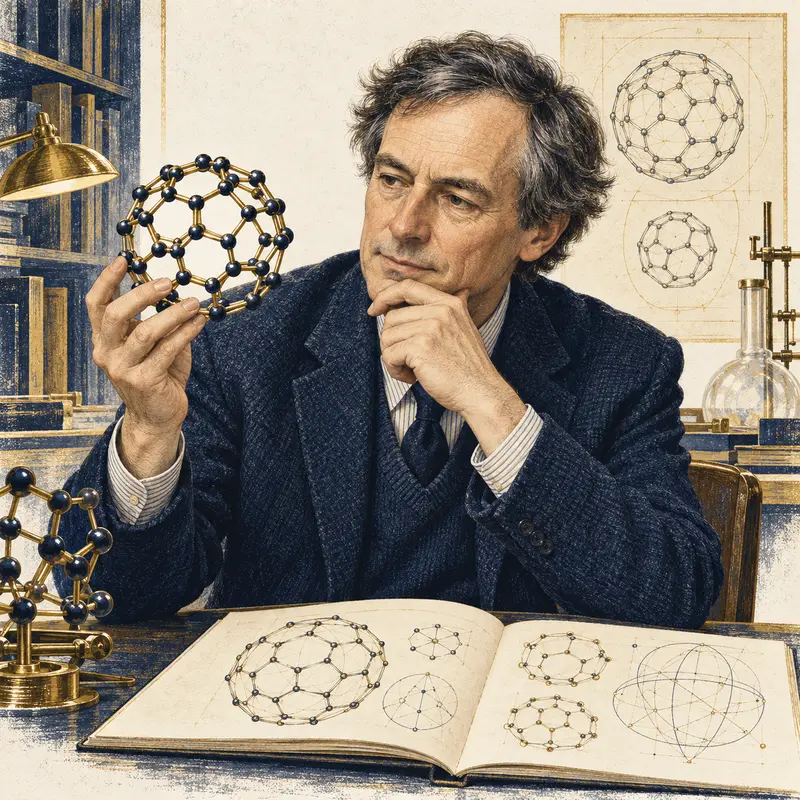
About the chemist
Harold Kroto
1939-2016 · United Kingdom · Nobel Chemistry 1996
Discovery of fullerenes