Biography · Chemist no. 39 of 350
Harold Urey: From Deuterium to the Origin of Life
Introduction
Harold Clayton Urey (1893-1981) was an American physical chemist who discovered deuterium in 1931, led a major part of the wartime effort to separate uranium isotopes, and later helped to found cosmochemistry, the chemical study of the Moon, meteorites and the early Earth. He received the Nobel Prize in Chemistry in 1934. A teacher at heart, he guided students such as Stanley Miller to famous experiments. His legacy in one line: he taught chemists to use isotopes as a tool to read the history of molecules, oceans, planets and life.
Early Life and Family
Urey was born on 29 April 1893 in Walkerton, a small town in Indiana, USA. His father, Samuel Clayton Urey, was a schoolteacher and minister in the Church of the Brethren, and died when Harold was still a young child. The boy grew up in rural Indiana in modest circumstances and attended country schools. He became a teacher himself at a young age, teaching in rural schools in Indiana and later in Montana to earn money for college.
Education and Mentors
After finishing school and teaching for a time, he entered the University of Montana, where he received his bachelor's degree in zoology in 1917. During the First World War he worked as a research chemist for a chemical company in Philadelphia that made explosives. He then returned to Montana as an instructor in chemistry. He went to the University of California, Berkeley, for his PhD, which he completed in 1923 under Gilbert N. Lewis, working on the entropy of gases and the theory of thermodynamics. In 1923-24 he spent a year with Niels Bohr in Copenhagen on an American-Scandinavian Foundation fellowship, learning the new atomic physics. He then returned to the United States and worked at Johns Hopkins University.
Career Timeline
| Year | Event |
|---|---|
| 1893 | Born in Walkerton, Indiana (29 April) |
| 1917 | Bachelor's degree in zoology, University of Montana |
| 1923 | PhD at Berkeley under G. N. Lewis |
| 1923-24 | Studies with Niels Bohr in Copenhagen |
| 1924-29 | Research at Johns Hopkins University |
| 1929 | Joins Columbia University |
| 1931-32 | Discovers deuterium, with Brickwedde and Murphy |
| 1934 | Wins the Nobel Prize in Chemistry |
| 1940-45 | Directs research on isotope separation for the Manhattan Project at Columbia |
| 1945 | Moves to the University of Chicago |
| 1947 | Proposes the oxygen-18 method for measuring ancient ocean temperatures |
| 1952-53 | Early Earth atmosphere ideas; Miller experiment performed in his laboratory |
| 1958 | Joins the University of California, San Diego (La Jolla) |
| 1981 | Dies in La Jolla, California (5 January) |
Major Scientific Contributions
- Discovery of deuterium (1931-32): by fractional evaporation of liquid hydrogen and spectroscopy.
- Isotope separation: methods for separating isotopes of hydrogen, nitrogen, oxygen, carbon and sulphur, and the leadership of a large project on separating uranium isotopes by gaseous diffusion during the Second World War.
- Isotope geochemistry (1947): showing that the ratio of oxygen-18 to oxygen-16 in the calcium carbonate of shells depends on the temperature of the water in which they formed. This is the paleothermometer used to reconstruct ancient climates.
- Urey-Miller experiment (1952-53): his student Stanley Miller passed electrical sparks through a mixture of methane, ammonia, hydrogen and water vapour and obtained amino acids, which supports the idea that organic molecules can form on a young Earth. Urey proposed the strongly reducing early atmosphere that inspired the experiment.
- Cosmochemistry: his book The Planets (1952) helped to start the study of the chemical origin of the Solar System, and he later studied lunar samples from the Apollo missions.
- Molecular vibrations: the Urey-Bradley force field, a model used in vibrational spectroscopy.
For the science of deuterium, see our companion post on the discovery of heavy hydrogen.
Awards, Honours and Nobel Prize
- Nobel Prize in Chemistry, 1934, for the discovery of heavy hydrogen.
- Davy Medal (1940) of the Royal Society, Franklin Medal (1943), National Medal of Science (1964) and the Priestley Medal (1973) of the American Chemical Society.
- Member of the US National Academy of Sciences.
- A crater on the Moon is named after him.
Personality, Struggles and Lesser-Known Facts
- Humble beginnings. From a rural school teacher in Indiana to a Nobel laureate, his path was unusual. He began in zoology, not chemistry.
- A founder of a journal. He was the first editor of the Journal of Chemical Physics, founded in 1933, which brought together chemistry and physics.
- Thinking about weapons. After the Second World War he turned against nuclear weapons and spoke publicly for international control of atomic energy.
- A Moon enthusiast. In his later years he argued about the origin of the Moon, and he was keenly interested in lunar rocks brought by Apollo astronauts. He changed his views as new evidence came in.
- Generous teacher. At Chicago and San Diego he had many students and associates who won distinction. Among them was Stanley Miller, and other students included Harmon Craig and Cesare Emiliani.
Legacy and Influence on Modern Chemistry
Deuterium is essential in NMR spectroscopy, reaction mechanism studies, neutron moderation in heavy water reactors, and medical research. The oxygen-isotope thermometer underlies the study of past climates from ocean sediments and ice cores. The Urey-Miller experiment launched the experimental study of the origin of life. Cosmochemistry, the study of the chemical composition of meteorites and planets, owes much to his guidance. Few chemists have worked across so wide a range, from molecular spectra to the Solar System.
Lessons for Students
- It is never too late to change fields. He started in zoology and ended in planetary science.
- Use simple physics to chase small effects. A 0.18 nm shift revealed a new isotope.
- Collaborate across disciplines. Chemistry, spectroscopy and cryogenics came together in the discovery.
- Teach and inspire others. Some of his most important results came from his students.
- Update your ideas. He changed his theories when new data appeared.
Quick Facts Box
- Born: 29 April 1893, Walkerton, Indiana, USA
- Died: 5 January 1981, La Jolla, California, USA
- Nationality: American
- Field: Physical chemistry, isotope chemistry, cosmochemistry
- Famous for: Discovery of deuterium, oxygen-18 paleothermometry, origin-of-life research
- Nobel Prize: Chemistry, 1934
FAQ
Why did Harold Urey win the Nobel Prize?
For his discovery of heavy hydrogen (deuterium) in 1931-32.
What was the Urey-Miller experiment?
It was an experiment in 1953 in which Stanley Miller, working with Urey, simulated early Earth conditions with sparks in a gas mixture and produced amino acids.
Where did Urey work?
At Johns Hopkins, Columbia, the University of Chicago and finally the University of California, San Diego.
How did Urey contribute to climate science?
He showed that the oxygen isotope ratio in shells depends on water temperature, giving a method to measure ancient ocean temperatures.
Published by ABC Chemistry — IIT-JAM | CSIR-NET | GATE Chemistry Coaching. Visit abcchemistry.com
About the chemist
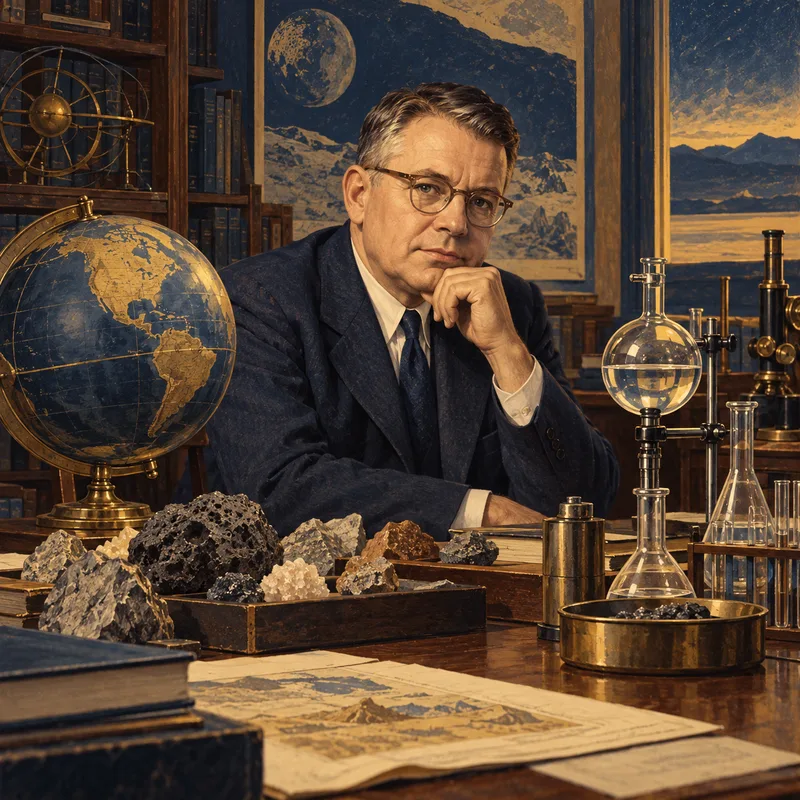
Harold Urey
1893-1981 · United States · Nobel Chemistry 1934
Discovery of deuterium