The discovery, explained · Chemist no. 39 of 350
Harold Urey and the Discovery of Deuterium
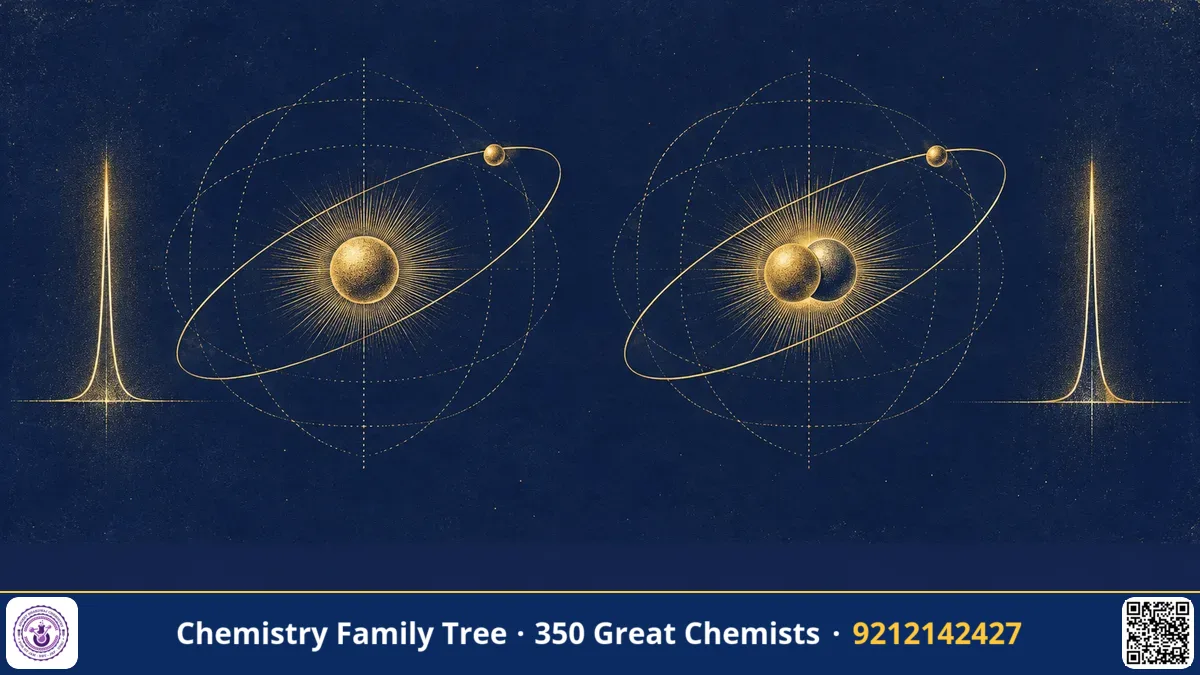
At the end of 1931 a young American chemist at Columbia University photographed the spectrum of evaporated liquid hydrogen and noticed something very small: next to each bright line of ordinary hydrogen there was a faint companion, shifted slightly towards shorter wavelength. Harold Urey had discovered deuterium, the heavy isotope of hydrogen with one proton and one neutron in its nucleus. Hydrogen is the lightest element, so the mass ratio of its two isotopes is the largest possible (2:1). This made the chemical and physical differences between isotopes much larger than anyone had expected. Urey received the 1934 Nobel Prize in Chemistry for the discovery of heavy hydrogen. Heavy water, prepared soon afterwards, became a key material in nuclear reactors, including those of India.
The Scientific Problem Before the Discovery
After Soddy's concept of isotopes (1913) and Aston's mass spectrograph (1919), scientists had found isotopes in most elements. Oxygen was shown in 1929 to have isotopes of mass 17 and 18 as well as 16, by Giauque and Johnston. This led to a confusing situation: chemists defined atomic weights by setting the natural mixture of oxygen to 16, while physicists set pure oxygen-16 to 16. If oxygen had heavy isotopes, then the hydrogen atomic weight measured by chemists and by physicists (mass spectrometry) should differ slightly. In 1931 Raymond Birge and Donald Menzel pointed out that this small difference could be explained if hydrogen also had a heavier isotope of mass 2, present in a ratio of about 1 part in 4500.
The challenge was to prove it. A mass spectrograph at that time was not sensitive enough to detect such a rare isotope. Chemical methods could not separate isotopes. Urey needed a way to enrich the rare isotope and a method to detect it.
The Discovery: Step by Step
Step 1: Predicting the spectral shift
Urey knew the Bohr theory. In the Bohr model, the Rydberg constant depends slightly on the mass of the nucleus through the reduced mass of the electron-nucleus system:
R_M = R∞ / (1 + mₑ/M)
Here R∞ is the Rydberg constant for an infinitely heavy nucleus, mₑ is the electron mass and M is the nuclear mass. For hydrogen M is one proton mass (1836 times the electron mass), and for deuterium it is twice as much. So the lines of a hydrogen atom of mass 2 should be shifted very slightly:
R_H = 109,677.58 cm⁻¹        R_D = 109,707.42 cm⁻¹
H-alpha (Balmer, n = 3 → 2):   λ(H) = 656.28 nm        λ(D) = 656.10 nm
The shift of about 0.18 nm is small but measurable with a good spectrograph.
Step 2: Enriching deuterium by evaporation
Urey worked with Ferdinand Brickwedde at the US National Bureau of Standards in Washington. Isotopes differ in vapour pressure, and the lighter molecules evaporate faster. Brickwedde took about 4 litres of liquid hydrogen and allowed it to evaporate slowly at a temperature near 14 K, close to hydrogen's triple point, until only about a millilitre remained. The last fraction was therefore enriched in the heavier isotope.
Step 3: Spectroscopy
Urey, together with his student George Murphy at Columbia University, photographed the Balmer spectrum of the residue. In the enriched sample, faint lines appeared next to the hydrogen lines, exactly at the positions predicted for an atom of mass 2. In the original sample the faint lines were barely visible, but in the enriched sample they were stronger. This confirmed that hydrogen has a heavy isotope, deuterium (symbol D or ²H), with natural abundance of about 0.015 percent (roughly 1 atom in 6400). The discovery was announced in 1932.
Step 4: Heavy water
Gilbert N. Lewis at Berkeley prepared nearly pure heavy water (D₂O) in 1933 by electrolysis. In electrolysis, the light isotope is liberated more readily as H₂ gas, so the remaining water becomes richer in D₂O. Heavy water was soon being studied for its chemical and biological effects.
The Chemistry Behind It
The three isotopes of hydrogen
| Isotope | Name | Composition | Notes |
|---|---|---|---|
| ¹H | Protium | 1 proton | 99.985 percent natural abundance |
| ²H (D) | Deuterium | 1 proton, 1 neutron | About 0.015 percent; stable |
| ³H (T) | Tritium | 1 proton, 2 neutrons | Radioactive, t½ about 12.3 years, beta emitter |
Physical properties of heavy water
Heavy water differs measurably from ordinary water: its melting point is about 3.8 °C, its boiling point about 101.4 °C and its density about 1.107 g/cm³ at 25 °C. The O-D bond is slightly stronger than the O-H bond because of lower zero-point energy.
Kinetic isotope effect
Because D is twice as heavy as H, the zero-point vibrational energy of a C-D bond is lower than that of a C-H bond. The C-D bond therefore needs more energy to break, and reactions that involve breaking this bond are slower, often by a factor of 2 to 7 at room temperature (k_H/k_D). This is the primary kinetic isotope effect. It is used to find out whether a C-H bond is broken in the rate-determining step.
ν ∝ √(k/μ) zero-point energy = ½hν μ(C-D) > μ(C-H) → ν(C-D) < ν(C-H)
Exchange reactions
Acidic hydrogens exchange rapidly with D₂O, for example the O-H and N-H protons of alcohols and amines. This is used in NMR spectroscopy to identify such protons: after shaking with D₂O, their signals disappear.
Applications Today
- Nuclear reactors: heavy water is an excellent neutron moderator because it slows neutrons while absorbing very few. India's pressurised heavy water reactors and the Canadian CANDU design can use natural uranium because of this property. India has built several heavy water plants.
- NMR spectroscopy: deuterated solvents, such as CDCl₃, D₂O and DMSO-d₆, avoid strong solvent signals in ¹H NMR.
- Mechanism studies: deuterium labelling and kinetic isotope effects show which bonds break in a reaction.
- Medicine and biology: deuterium-labelled compounds track metabolism, and deuterated drugs can have longer half-lives in the body.
- Fusion research: deuterium and tritium are the fuel in the most studied fusion reaction, D + T → He-4 + n.
- Environmental science: D/H ratios in water and ice record climate and the origin of water.
Exam Corner
- Deuterium was discovered by Urey, Brickwedde and Murphy in 1931-32 through the spectrum of evaporated liquid hydrogen. Urey received the 1934 Nobel Prize in Chemistry.
- Isotopic shift arises from the reduced mass: R_M = R∞/(1 + mₑ/M). Heavier nucleus gives a slightly larger R and shorter wavelength.
- Heavy water: higher melting point, boiling point and density than H₂O. Used as a moderator.
- Kinetic isotope effect: C-H bonds break faster than C-D bonds because of zero-point energy.
- Natural abundance of deuterium is about 0.015 percent; tritium is radioactive.
Common Misconceptions
- "Heavy water is radioactive." Ordinary heavy water (D₂O) is not radioactive. Tritiated water is.
- "Isotopes have identical chemistry." They are similar but hydrogen isotopes show noticeable differences in rates and equilibria.
- "Heavy water is toxic like a poison." It is harmless in small amounts, but very high levels of deuterium in the body disturb biological processes.
Quick Revision Box
- 1931-32: Urey, Brickwedde and Murphy discover deuterium.
- Method: fractional evaporation of liquid hydrogen, then atomic spectroscopy.
- H-alpha shift between H and D is about 0.18 nm.
- Natural abundance: about 0.015 percent.
- Heavy water D₂O: melting point 3.8 °C, boiling point 101.4 °C.
- Nobel Prize in Chemistry 1934.
FAQ
Why did the deuterium lines appear shifted?
The heavier nucleus changes the reduced mass of the electron-nucleus system, which increases the Rydberg constant slightly and moves the lines to shorter wavelengths.
Who prepared the first heavy water?
G. N. Lewis prepared almost pure D₂O by electrolysis in 1933.
Why is heavy water a good moderator?
Deuterium nuclei are light enough to slow neutrons efficiently by collisions, but they absorb neutrons far less than ordinary hydrogen, so more neutrons remain for the chain reaction.
Is deuterium found in ordinary water?
Yes. About one in every 6400 hydrogen atoms in natural water is deuterium.
Published by ABC Chemistry — IIT-JAM | CSIR-NET | GATE Chemistry Coaching. Visit abcchemistry.com
About the chemist
Harold Urey
1893-1981 · United States · Nobel Chemistry 1934
Discovery of deuterium