Biography · Chemist no. 159 of 350
Hartmut Michel: Complete Life and Legacy of the Membrane Protein Crystallographer
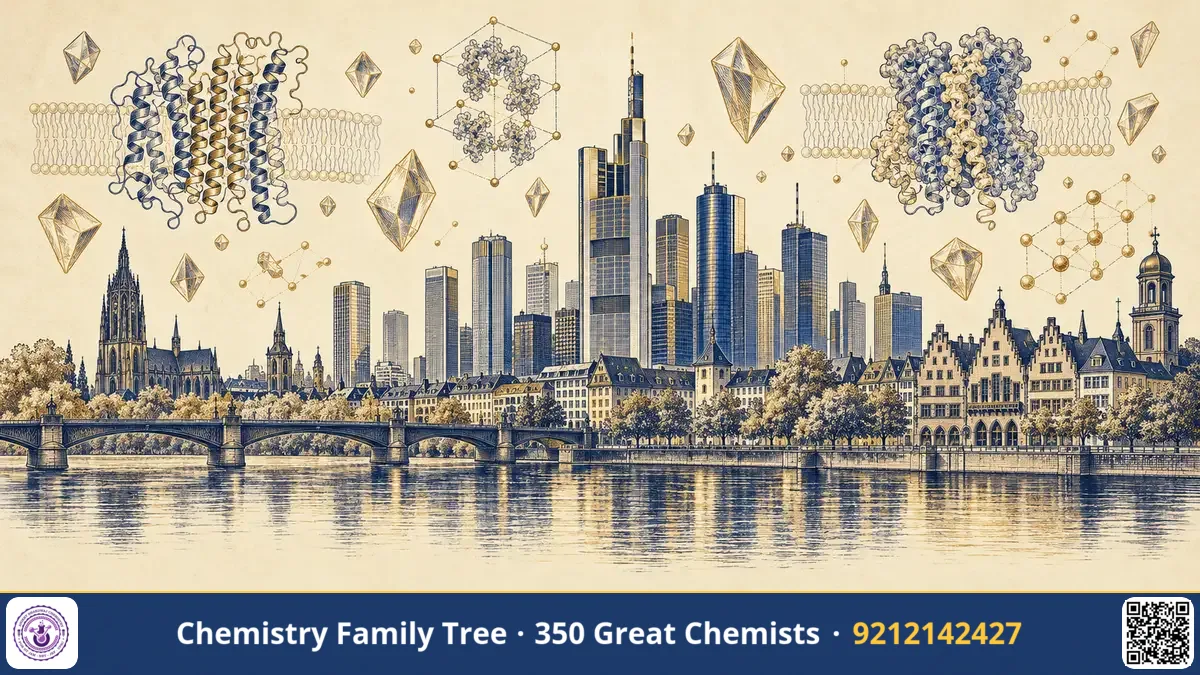
Hartmut Michel, born in 1948 in Ludwigsburg, Germany, is a biochemist who did what many scientists of his time thought impossible: he grew three-dimensional crystals of a membrane protein complex good enough for X-ray structure analysis. This gave the world the first atomic view of a photosynthetic reaction centre, and earned him, Johann Deisenhofer and Robert Huber the 1988 Nobel Prize in Chemistry. At the time he was one of the youngest Nobel laureates in chemistry. He later became director of the Max Planck Institute of Biophysics in Frankfurt. His legacy is the entire modern field of membrane protein structural biology.
Early Life and Family
Hartmut Michel was born on 18 July 1948 in Ludwigsburg, in the state of Baden-Württemberg in southern Germany. He grew up in the years after the Second World War, when Germany was rebuilding. He attended school in the region and developed an interest in the natural sciences. He has mentioned in later interviews a strong interest in biology and in the way living things work, which later led him to biochemistry rather than pure chemistry or physics.
Education and Mentors
Michel studied biochemistry at the University of Tübingen, from 1969 to 1972, completing the diploma. He then did his doctoral research under Dieter Oesterhelt, a biochemist who studied bacteriorhodopsin, the light-driven proton pump of halophilic archaea, and completed his doctorate in 1977. Oesterhelt's group trained him to work with membrane proteins and sensitive pigments. In the late 1970s Michel worked at the Max Planck Institute of Biochemistry in Martinsried, where he started the project on the reaction centre.
Career Timeline
| Year | Event |
|---|---|
| 1948 | Born in Ludwigsburg, Germany |
| 1969–1972 | Studied biochemistry at the University of Tübingen |
| 1977 | Doctorate with work in the group of Dieter Oesterhelt |
| 1979 | Research group at the Max Planck Institute of Biochemistry, Martinsried |
| 1982 | Obtained crystals of the Rh. viridis photosynthetic reaction centre |
| 1984–1985 | Structure of the reaction centre published with Deisenhofer and Huber |
| 1987 | Became director of the Max Planck Institute of Biophysics, Frankfurt |
| 1988 | Shared the Nobel Prize in Chemistry |
| 1995 | Structure of cytochrome c oxidase from Paracoccus denitrificans |
Major Scientific Contributions
The central contribution is the crystallisation of the photosynthetic reaction centre. Michel worked out how to dissolve the complex with mild detergents, purify it and slowly bring it to crystals, using small amphiphilic molecules to improve packing. His crystals made it possible for Deisenhofer and Huber to determine the structure at about 3 Å resolution. Michel took part in analysing the structure and in explaining the arrangement of cofactors and the route of electron transfer.
At the Frankfurt institute he focused on respiratory enzymes and other membrane proteins:
- Cytochrome c oxidase: the 1995 structure of this terminal oxidase, which reduces oxygen to water and pumps protons, was solved by using an antibody fragment to provide crystal contacts.
- Other respiratory complexes: structures and mechanisms of proton-pumping enzymes and related membrane proteins.
- Methods: development of strategies for membrane protein crystallisation, including the use of antibody fragments as crystallisation aids.
Awards, Honours and Nobel Prize
The Nobel Prize in Chemistry 1988 was awarded to Johann Deisenhofer, Robert Huber and Hartmut Michel "for the determination of the three-dimensional structure of a photosynthetic reaction centre." This was a Chemistry prize. Michel has also received other awards and honorary degrees, and is a member of scientific academies. He remains an active researcher and teacher.
Personality, Struggles and Lesser-Known Facts
- Against the consensus: Many senior scientists thought membrane protein crystals were not possible. Michel continued, even when progress was slow.
- Young laureate: He was only in his mid-thirties when he obtained the crystals, and he was awarded the Nobel Prize at age 40.
- Trial and error: The path to crystals involved testing many detergents, precipitants and additives, a patient and systematic search.
- Combining ideas: The antibody-fragment trick he used for cytochrome c oxidase showed how a creative idea from immunology could solve a problem in crystallography.
- Interest in science and society: He has spoken publicly on energy and on the need for sustainable technology, given his knowledge of how nature converts energy.
Legacy and Influence on Modern Chemistry
The entire structural biology of membrane proteins rests on the idea that these proteins can be extracted with detergents and crystallised. Structures of channels, pumps, transporters and receptors now appear every year, and they have been central to drug discovery. The reaction centre and respiratory enzymes studied by Michel provide a molecular explanation for how cells convert energy, an idea at the heart of bioenergetics courses. In India, the principles he established are used in labs studying membrane proteins of pathogens, and the topic of micelles and surfactants in physical chemistry has a direct biological application through his work.
Lessons for Students
- Challenge "impossible". Check why something is believed to be impossible, then test it.
- Use chemistry creatively. Surfactant science solved a biological problem.
- Be systematic. Crystallisation is a search through many conditions.
- Borrow tools. An antibody fragment from immunology became a crystallisation aid.
Quick Facts Box
- Born: 18 July 1948, Ludwigsburg, Germany
- Died: Not covered here
- Nationality: German
- Field: Biochemistry, membrane protein crystallography
- Famous for: First crystals of a membrane protein complex (reaction centre)
- Nobel: 1988, Chemistry (shared with Deisenhofer and Huber)
FAQ
Who was Hartmut Michel's mentor?
Dieter Oesterhelt, whose group studied bacteriorhodopsin and photosynthetic bacteria.
Where is Michel based?
At the Max Planck Institute of Biophysics in Frankfurt, which he has led as director since 1987.
What is cytochrome c oxidase?
The final enzyme of the respiratory chain, which reduces oxygen to water and pumps protons across the membrane.
Was the 1988 prize in Chemistry or Medicine?
Chemistry.
Published by ABC Chemistry — IIT-JAM | CSIR-NET | GATE Chemistry Coaching. Visit abcchemistry.com
About the chemist
Hartmut Michel
1948- · Germany · Nobel Chemistry 1988
Crystallized photosynthetic reaction centre