Biography · Chemist no. 282 of 350
Heinrich Caro (1834–1910): From Calico Printer to Architect of the German Chemical Industry
Introduction
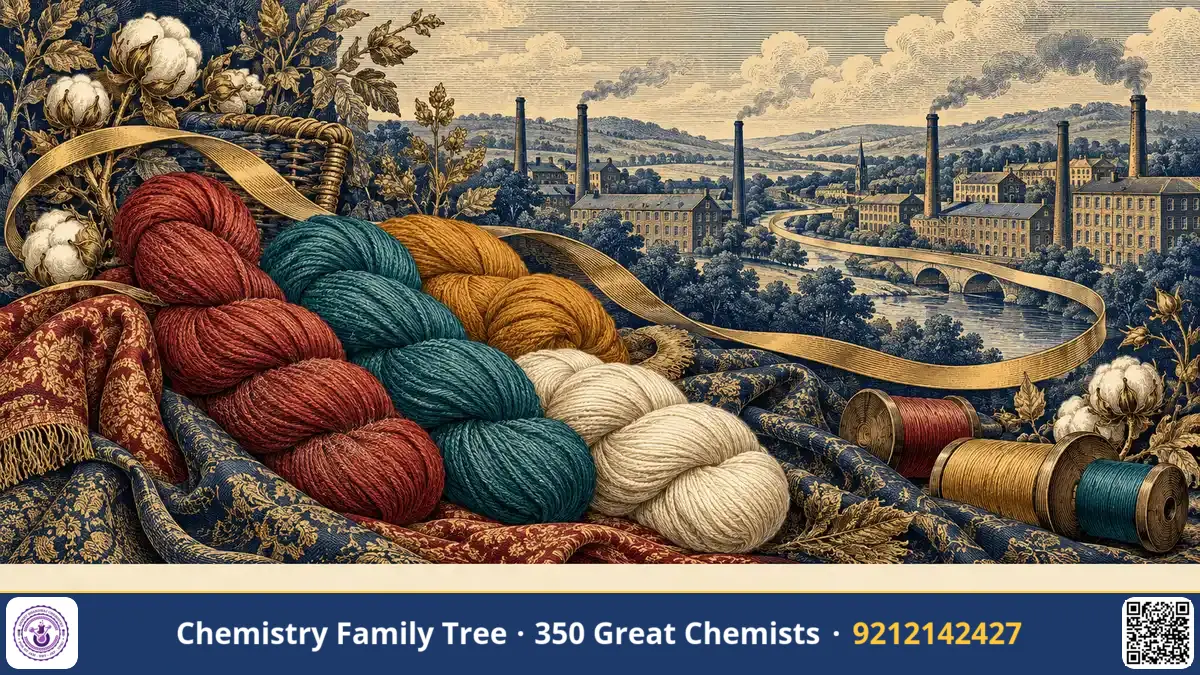
Heinrich Caro was a German chemist who linked the laboratory to the factory. He started his career in the textile and dye business, spent years in England at the heart of the Industrial Revolution, and then returned to Germany to help build BASF into one of the world's largest chemical companies. He is remembered for methylene blue and other dyes, for the industrial synthesis of alizarin, and for peroxymonosulphuric acid, called Caro's acid. In one line: Caro was the chemist who showed that research could become industry.
Early Life & Family
Heinrich Caro was born on 13 February 1834 in Posen, then in the Prussian province of Posen (today Poznań, Poland). He came from a Jewish family, and the stable commercial background of the family helped him get an education. As a boy he showed practical interest in chemistry and colour. This was a good time and place to have such interests, since the textile industries of Europe were hungry for chemists who could improve printing and dyeing.
Education & Mentors
Caro studied at the Gewerbeinstitut (trade institute) in Berlin and then at the University of Berlin, and he also trained in the practical chemistry of calico printing. His early education combined the theory of chemistry with the hands-on requirements of dyeing cloth. He then gained experience in the calico-printing industry near Manchester. He did not earn a classical academic doctorate in the usual sense at that time; his training came from industrial practice and scientific study, which was not unusual for early dye chemists.
Career Timeline
| Year | Event |
|---|---|
| 1834 | Born in Posen, Prussia |
| 1850s | Studies in Berlin; trains in dyeing and calico printing |
| 1859 | Moves to England to work in the Manchester calico printing industry |
| 1860s | Contributes to production of aniline dyes including Bismarck brown with Martius, and to azo dye chemistry |
| 1866 | Returns to Germany |
| 1868 | Joins Badische Anilin- und Soda-Fabrik (BASF) in Mannheim and Ludwigshafen; leads research |
| 1868–1869 | With Graebe and Liebermann, industrialises the synthesis of alizarin |
| 1876 | Methylene blue is introduced |
| 1884 | Leaves BASF's management role and continues as scientific advisor |
| 1898 | Discovers peroxymonosulphuric acid (Caro's acid) |
| 1910 | Dies on 11 September in Dresden |
Major Scientific Contributions
- Bismarck brown and azo dyes: early work on diazo and azo colours helped establish a whole class of dyes that dominate the textile industry today.
- Alizarin: the commercial route from anthracene to alizarin, the red dye of madder root, replaced a major agricultural crop with a coal tar product and shows the first big triumph of industrial organic synthesis.
- Methylene blue and eosin: dyes still used in medicine and microscopy.
- Caro's acid: a strong peroxy-acid, H₂SO₅, with wide use as an oxidant.
- Industrial research model: Caro organised BASF's laboratories so that scientists, not only technicians, worked on problems systematically. This became the template for industrial research laboratories across the world.
- Dye intermediates: his work on intermediates from aniline derivatives paved the way for methylene blue and several other dyes.
For the chemistry of Caro's acid and of azo dyes, see our companion discovery post on Heinrich Caro.
Awards, Honours & Nobel Prize
Caro did not receive a Nobel Prize. He was widely respected in Germany and abroad as a leader of the chemical industry. He is regarded as one of the founders of the coal tar dye industry along with Perkin, Hofmann and Graebe.
Personality, Struggles & Lesser-Known Facts
- Perkin's rival and friend in the dye world. Caro knew the English dye industry well, and the competition between English and German firms is a major theme of nineteenth-century chemical history. Germany eventually took the lead, partly because its chemists, like Caro, were trained in science.
- Alizarin race. In 1869 Caro, Graebe and Liebermann filed a German patent for alizarin synthesis. Perkin independently found a similar route in England and filed his patent the very next day, an episode that students of patent history often cite.
- Tough manager. At BASF, Caro was known as an energetic organiser who insisted on mixing pure research with factory needs.
- Mentor to many. Many chemists trained in the BASF laboratories under him and went on to run other chemical companies.
- Late discovery. His work on peroxymonosulphuric acid came in 1898 at the age of 64, showing that his curiosity lasted long after his management career.
Legacy & Influence on Modern Chemistry
Caro's legacy is both scientific and organisational. Scientifically, dyes like methylene blue and the broad class of azo dyes are still in daily use, and Caro's acid is still a textbook example of a peroxy acid. Organisationally, the BASF research model, where a company employs PhD chemists to invent new products, became the engine of the German chemical industry. Later achievements, such as the Haber–Bosch process developed at BASF by Carl Bosch, grew out of the culture Caro helped create. For India, with its large textile, dye and pharmaceutical sectors, the Caro story shows how basic organic chemistry can power a whole industry.
Lessons for Students
- Industry and academic science can work together, as Caro showed by combining factory problems with research methods.
- Waste can be a resource. Coal tar was once an unwanted by-product but became the raw material for dyes, drugs and explosives.
- Patents and publication speed matter; the alizarin story shows how close the race can be.
- Keep exploring new topics. Caro's most famous inorganic discovery came late in life.
- Know your oxidation states, and remember that peroxide oxygen is –1, a favourite exam trap on H₂SO₅.
Quick Facts Box
- Born: 13 February 1834, Posen, Prussia
- Died: 11 September 1910, Dresden, Germany
- Nationality: German
- Field: Industrial and dye chemistry
- Famous for: Methylene blue, alizarin industrial synthesis, Bismarck brown, Caro's acid (H₂SO₅)
- Nobel Prize: None
FAQ
Which company did Heinrich Caro help build?
BASF (Badische Anilin- und Soda-Fabrik), where he led research from 1868 and helped industrialise alizarin and other dyes.
What is Caro's acid?
It is peroxymonosulphuric acid, H₂SO₅, a strong oxidising agent prepared from sulphuric acid and hydrogen peroxide.
Did Caro win a Nobel Prize?
No. He received other honours and is considered a founder of the synthetic dye industry.
Why is alizarin synthesis important?
It was the first natural dye to be synthesised industrially from a coal tar product, anthracene, and it proved that laboratory chemistry could replace farming for a valuable commodity.
Published by ABC Chemistry — IIT-JAM | CSIR-NET | GATE Chemistry Coaching. Visit abcchemistry.com
About the chemist
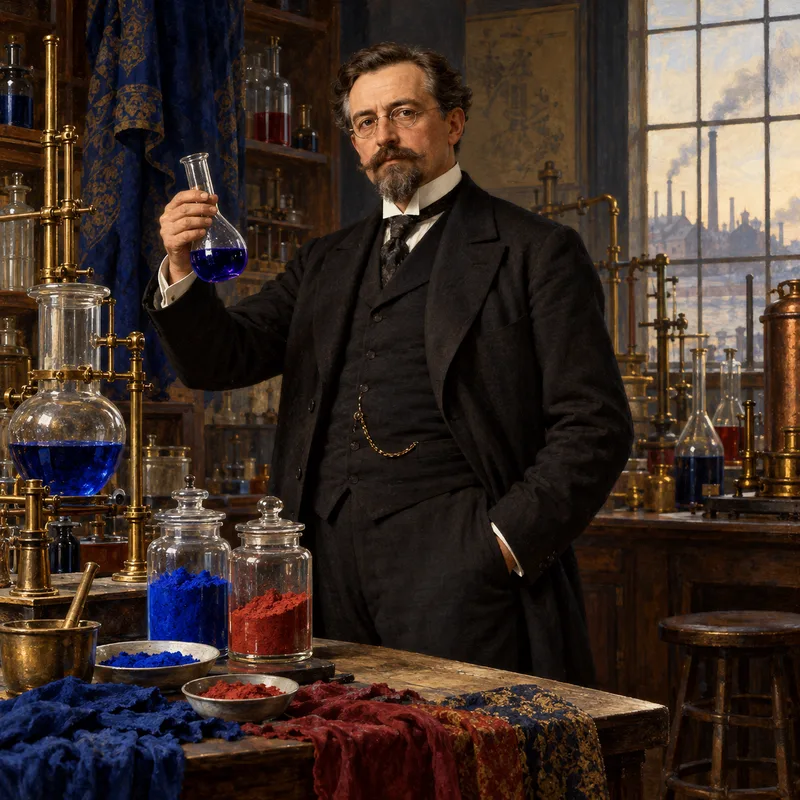
Heinrich Caro
1834-1910 · Germany
Synthetic dyes; BASF alizarin, methylene blue