The discovery, explained · Chemist no. 282 of 350
Heinrich Caro: The Industrial Chemist Who Coloured the World and Discovered Caro's Acid
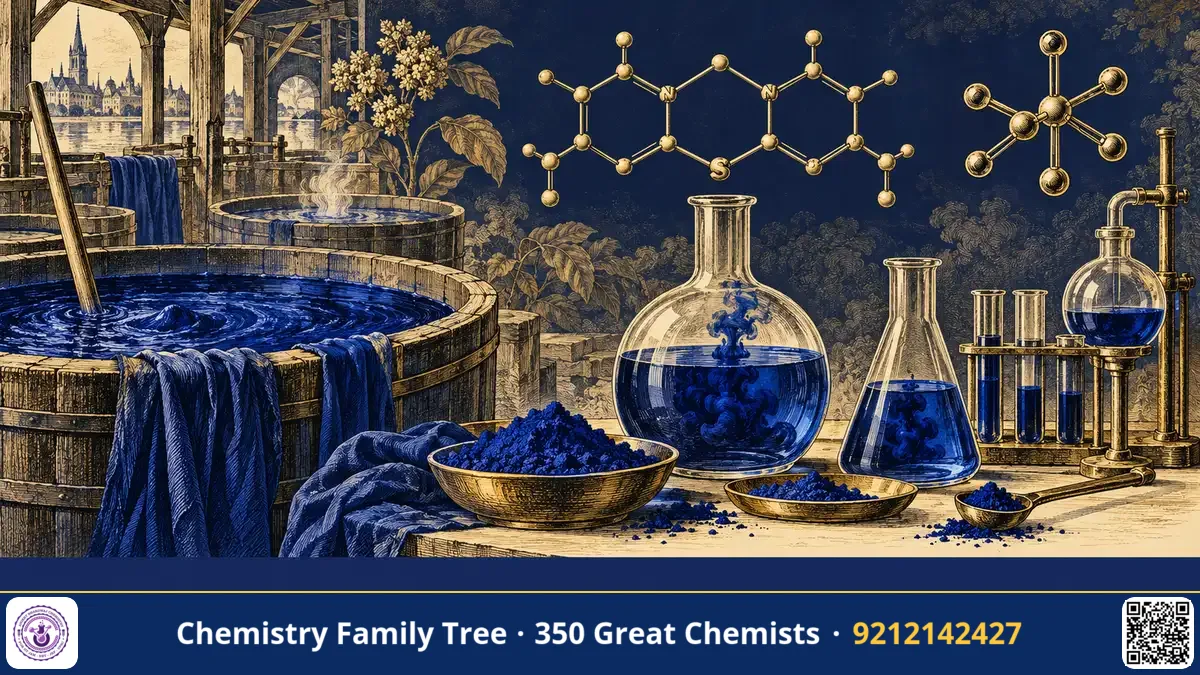
Look at a blue school uniform, a jar of laboratory stain or a bottle of ink and you are looking at the legacy of the synthetic dye industry. In the second half of the nineteenth century, a small group of chemists turned coal tar, a black waste product of gas works, into bright, cheap colours. Heinrich Caro was one of the most important of them. He worked in England and then in Germany, helped create the first great chemical company BASF, developed dyes such as methylene blue, Bismarck brown and eosin, and also discovered peroxymonosulphuric acid, still known as Caro's acid. This post explains the chemistry behind his achievements.
The Scientific Problem Before the Discovery
Before 1856, all dyes came from nature: indigo from plants, madder red from roots, cochineal from insects. These were expensive and often unreliable. Then William Henry Perkin, as a teenager, accidentally made mauveine from aniline in 1856, showing that bright dyes could be made from coal tar chemicals. But the early industry needed more than accidents. Manufacturers had to understand how to make intermediates such as aniline, how to convert them into dyes in a controlled way, and how to scale up reactions from flasks to vats.
The chemistry of oxidants was also a problem. Strong oxidising agents were needed for making dyes and for bleaching, but available oxidants such as chromates and permanganate were costly or left coloured residues. A cheap, strong, clean oxidising agent would be valuable.
The Discovery / Experiment
Dyes. Caro trained as a dyer and chemist and worked in the English calico-printing industry around Manchester. There he contributed to the production of aniline and rosaniline dyes, and in 1860s collaborations he helped develop Bismarck brown, an azo dye made by treating m-phenylenediamine with nitrous acid (diazotisation and coupling with itself). Later, at BASF, he led the work that brought methylene blue (1876), eosin (with Baeyer's fluorescein chemistry) and, in cooperation with Carl Graebe and Carl Liebermann, the industrial production of alizarin, the red dye of madder, from anthracene.
Methylene blue: a phenothiazinium dye, made from N,N-dimethyl-p-phenylenediamine
oxidised in the presence of H₂S/thiosulphate and dimethylaniline.
Caro's acid (1898). While investigating the action of persulphates and strong sulphuric acid on oxidisable substances, Caro found that concentrated sulphuric acid reacts with hydrogen peroxide to give peroxymonosulphuric acid:
H₂SO₄ + H₂O₂  ⇌  H₂SO₅ + H₂O
or:   HSO₃Cl + H₂O₂  →  H₂SO₅ + HCl
Structurally it is HO–O–SO₂–OH, a sulphuric acid in which one OH is replaced by OOH. It is a very strong oxidant, which Caro showed could, among other reactions, oxidise aniline to nitrosobenzene.
The Chemistry Behind It
Azo dye chemistry. Many of the first synthetic dyes are azo compounds, containing the –N=N– chromophore. They are made in two steps:
- Diazotisation: ArNH₂ + NaNO₂ + 2 HCl, 0–5 °C → ArN₂⁺Cl⁻ + NaCl + 2 H₂O
- Coupling: ArN₂⁺ + Ar'OH (or Ar'NH₂) → Ar–N=N–Ar' + H⁺, an electrophilic aromatic substitution at the para position of the activated ring.
Colour arises because the extended π system, with electron donating groups (auxochromes like –OH or –NR₂) and acceptor groups, absorbs visible light. The chromophore-auxochrome picture is a standard exam topic.
Methylene blue belongs to the thiazine class, with a tricyclic phenothiazinium ring. It is a redox dye: the blue oxidised form (MB⁺) is reduced to colourless leucomethylene blue by agents such as glucose in alkaline solution. This is the "blue bottle" experiment, shaken to blue, rested to colourless.
Caro's acid. The O–O bond is weak, and the peroxy-acid is a powerful electrophilic oxygen donor. Related peracids such as m-CPBA epoxidise alkenes in the same way. Potassium peroxymonosulphate (Oxone, 2KHSO₅·KHSO₄·K₂SO₄) is the stable, solid commercial form of the same chemistry.
Applications Today
- Medicine and microscopy: Methylene blue stains bacteria and cell nuclei in biology classes, and it is used in medicine to treat methaemoglobinaemia.
- Textile industry: Azo dyes make up the majority of dyes in use, including those used in Indian textile hubs such as Tiruppur, Surat and Panipat.
- Water treatment: Oxone and Caro's-acid-type oxidants disinfect swimming pools and treat wastewater, and are used to oxidise dyes in effluents.
- Pulp and paper, mining: Caro's acid is used to destroy cyanide in gold mine effluents.
- Organic synthesis: Peroxy-acids prepare epoxides, Baeyer–Villiger oxidation products and sulphoxides.
Exam Corner
- Caro's acid is H₂SO₅ (peroxymonosulphuric acid); Marshall's acid is H₂S₂O₈ (peroxydisulphuric acid).
- Caro's acid contains one peroxide –O–O– link; the oxidation state of sulphur is +6 and two oxygen atoms are at –1.
- Caro's acid is prepared from H₂SO₄ + H₂O₂ or from chlorosulphonic acid + H₂O₂.
- Diazotisation must be done at 0–5 °C because diazonium salts decompose on warming.
- Methylene blue is a thiazine dye and acts as a redox indicator.
Common Misconceptions
- "Sulphur is in +8 oxidation state in H₂SO₅." Sulphur remains +6; the extra oxygen in the peroxide group has oxidation state –1.
- "Caro's acid and Marshall's acid are the same." Caro's acid has one peroxy link and one sulphur; Marshall's acid has two sulphurs joined through a peroxy link.
- "Synthetic dyes were invented in a university." The early dye industry grew in factories, where chemists and engineers solved scale-up problems.
Quick Revision Box
- Caro's acid: H₂SO₅, structure HO–O–SO₂–OH.
- Prepared: H₂SO₄ + H₂O₂ ⇌ H₂SO₅ + H₂O.
- Marshall's acid: H₂S₂O₈.
- Azo dyes: diazotisation (0–5 °C) then coupling.
- Methylene blue: thiazine dye, redox indicator.
- Caro helped industrialise alizarin and develop Bismarck brown, eosin and methylene blue.
FAQ
What is the structure of Caro's acid?
It is HO–O–SO₂–OH, with sulphur at the centre bound to two oxygens by double bonds, one OH and one O–OH group.
How is Caro's acid different from H₂SO₄?
One of the OH groups of sulphuric acid is replaced by a peroxy OOH group, making it a much stronger oxidising agent and hydrolysable to H₂O₂.
Why do azo dyes show colour?
The –N=N– group connects two aromatic rings in a conjugated system, which absorbs visible light, and electron donating groups deepen the colour.
Is Caro's acid stable?
No. It decomposes slowly and is usually made fresh, or used as the stable salt potassium peroxymonosulphate (Oxone).
Published by ABC Chemistry — IIT-JAM | CSIR-NET | GATE Chemistry Coaching. Visit abcchemistry.com
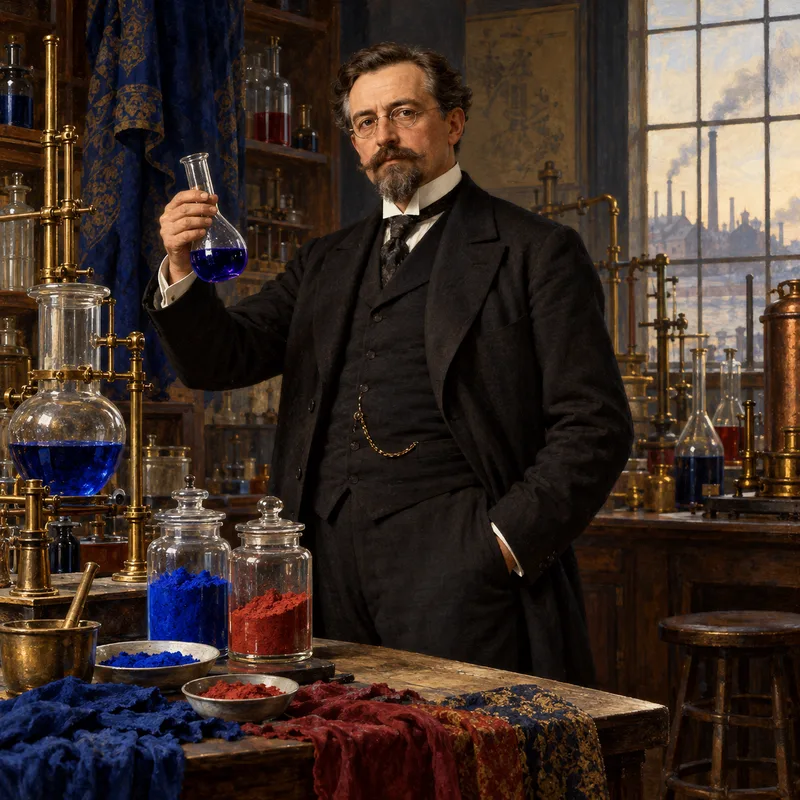
About the chemist
Heinrich Caro
1834-1910 · Germany
Synthetic dyes; BASF alizarin, methylene blue