The discovery, explained · Chemist no. 108 of 350
Heinrich Wieland: Bile Acids and the Dehydrogenation Theory
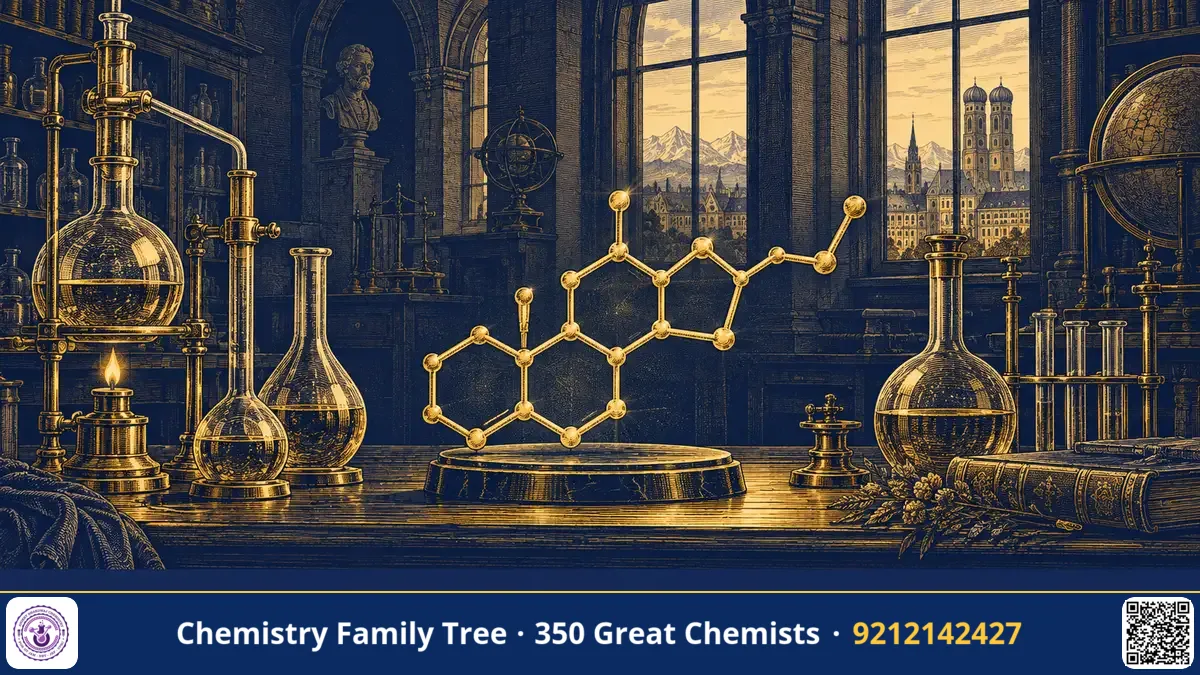
The liver makes bile, and bile contains acids that help us digest fat. In the early twentieth century, these bile acids were a chemical puzzle: they had large, complicated molecules whose skeletons nobody could draw. The German chemist Heinrich Wieland spent years breaking bile acids down, step by step, into smaller pieces and rebuilding the picture from them. His work, together with that of Adolf Windaus on cholesterol, led to the four-ring steroid skeleton that underlies cholesterol, sex hormones, cortisone and vitamin D. Wieland was also the author of a bold idea about how living cells burn food: oxidation, he said, is mainly the removal of hydrogen. He received the Nobel Prize in Chemistry (the prize for 1927, awarded in 1928) for his investigations of the constitution of the bile acids and related substances.
The Scientific Problem Before the Discovery
Bile acids were isolated in the nineteenth century. Cholic acid, with formula C24H40O5, was known to be a monocarboxylic acid with several hydroxyl groups, but the carbon skeleton remained unknown. Chemists could determine the functional groups using standard reactions, such as acetylation of the OH groups and oxidation to ketones. The skeleton, however, could not be found with classical tools, since the molecule was large and the available methods for degradation were crude.
Cholesterol was equally mysterious. Early proposals were wrong, and for years there was no agreement on the number of rings or the way they were joined. Without the skeleton, no one could explain how bile acids were related to cholesterol, or how the body made them. The second problem, biological oxidation, was a major debate: did cells oxidise food by "activating" molecular oxygen (the view of Otto Warburg), or by "activating" the substrate and removing hydrogen from it (the view of Wieland)?
The Discovery: Step by Step
- Isolation and purification. Wieland obtained pure cholic acid and deoxycholic acid from bile and studied their reactions carefully, with a series of oxidations that converted OH groups to C=O groups and then broke rings.
- Stepwise degradation of the side chain. He developed a degradation method, now called the Barbier–Wieland degradation, to shorten the carboxylic acid side chain by one carbon at a time. The acid is converted to its methyl ester, treated with phenylmagnesium bromide to give a diphenyl carbinol, dehydrated to a diphenylethylene and oxidised to a ketone or acid with one less carbon.
- Relationship to cholesterol. The degradation products showed that cholic acid shares the same ring system as cholesterol and the sterols, as Windaus was finding independently.
- Locating the hydroxyl groups. Oxidation of cholic acid gave dehydrocholic acid, with three keto groups. This helped to show where the OH groups sit on the rings (3, 7 and 12 positions).
- The skeleton. By 1932, Wieland and Windaus, along with other chemists, recognised that earlier ring structures were wrong. After X-ray crystallographic work by J. D. Bernal and Dorothy Crowfoot, and Rosenheim and King, the final structure of the steroid nucleus was fixed: three six-membered rings and one five-membered ring, the cyclopentanoperhydrophenanthrene system.
The dehydrogenation theory came from a different set of experiments. Wieland showed that many biological oxidations can proceed in the absence of oxygen if a suitable hydrogen acceptor is present. He used methylene blue, which is reduced to colourless leuco-methylene blue. For example, in the presence of palladium catalyst or enzyme, alcohols and aldehydes lose hydrogen.
The Chemistry Behind It
The steroid skeleton has four fused rings labelled A, B, C and D. In cholic acid, the molecule has OH groups at C-3, C-7 and C-12, a methyl at C-10 and C-13, and a five-carbon side chain ending in a carboxylic acid at C-17. In summary:
Cholic acid: C24H40O5
3α, 7α, 12α-trihydroxy-5β-cholan-24-oic acid
In bile, the acids are conjugated with the amino acids glycine or taurine to form glycocholic and taurocholic acid, which are amphiphilic and form micelles that emulsify fats. The combination of a rigid hydrophobic steroid face and hydrophilic OH groups on the other face makes bile salts effective natural detergents.
The Barbier–Wieland degradation can be summarised:
R-CH2-COOMe + 2 PhMgBr → R-CH2-C(OH)Ph2
R-CH2-C(OH)Ph2 → (−H2O) R-CH=CPh2
R-CH=CPh2 → (CrO3) R-COOH + Ph2C=O
The net result is that R-CH2-COOH becomes R-COOH, with one carbon less.
The dehydrogenation theory states that oxidation of a substrate is often the removal of hydrogen:
AH2 + acceptor → A + acceptor-H2
AH2 + methylene blue → A + leuco-methylene blue
The truth turned out to lie between Wieland and Warburg. Cells use dehydrogenase enzymes with the coenzymes NAD+ and FAD to remove hydrogen (Wieland's view), but the hydrogen finally passes through the electron transport chain, including cytochromes, to oxygen (Warburg's view, as developed by Keilin). Both are parts of the same pathway.
Applications Today
- Steroid drugs: the structure of the steroid skeleton leads to corticosteroids, oral contraceptives, anabolic steroids and many anti-inflammatory drugs. Indian pharmaceutical companies make large amounts of steroid intermediates from plant sources such as diosgenin.
- Bile acid medicines: ursodeoxycholic acid is prescribed for gallstones and liver diseases; bile acid sequestrants (such as cholestyramine) lower cholesterol.
- Biochemistry of respiration: the role of dehydrogenases, NAD+ and FAD in the citric acid cycle and electron transport chain.
- Organic synthesis: the Barbier–Wieland degradation is still used for shortening side chains in steroid and natural product chemistry.
- Detergent chemistry: bile salts are studied as natural surfactant models.
Exam Corner
- Heinrich Wieland won the Nobel Prize in Chemistry (1927 prize, awarded 1928) for studies of the constitution of bile acids and related substances.
- The steroid nucleus is cyclopentanoperhydrophenanthrene: three fused six-membered rings (A, B, C) and one five-membered ring (D); 17 carbons.
- Barbier–Wieland degradation shortens a carboxylic acid chain by one carbon via a diphenyl carbinol.
- Dehydrogenation theory: biological oxidation is mainly removal of hydrogen, with acceptors such as methylene blue; Warburg proposed oxygen activation. Both are partly right.
- Bile salts: sodium glycocholate and taurocholate emulsify fats by forming micelles.
Common Misconceptions
- "Bile contains digestive enzymes." It contains bile salts, pigments and cholesterol, not enzymes; salts only emulsify fats.
- "Wieland discovered the steroid structure alone." It was a collective effort of Wieland, Windaus, Bernal, Rosenheim, King and others.
- "Oxidation always involves oxygen." In biology, it is often dehydrogenation, with NAD+ as the acceptor.
Quick Revision Box
- Cholic acid: C24H40O5, OH groups at C-3, C-7, C-12.
- Steroid skeleton: 17 carbons in four fused rings (6-6-6-5).
- Barbier–Wieland: shortens acid chain by one carbon using PhMgBr, dehydration and CrO3.
- Dehydrogenation theory: AH2 + acceptor → A + acceptor-H2.
- Nobel Prize in Chemistry (1927 prize, awarded 1928).
- Windaus won the 1928 Nobel Prize in Chemistry for sterols.
FAQ
What is a bile acid?
It is a steroid carboxylic acid made from cholesterol in the liver. It is secreted as a conjugate with glycine or taurine and helps to emulsify and absorb fats.
Why were the early structures of steroids wrong?
Chemical degradation alone gave misleading evidence about ring sizes. In 1932, X-ray data and reinterpretation of degradation products corrected the mistakes.
How did Wieland's view of oxidation compare with Warburg's?
Wieland said that the substrate loses hydrogen; Warburg said that oxygen is activated by an iron-containing enzyme. Both were right about different steps of respiration.
Is the Barbier–Wieland degradation useful for exams?
Yes, it is a name reaction in the organic chemistry syllabus, often asked as a single-step-shorter chain preparation.
Published by ABC Chemistry — IIT-JAM | CSIR-NET | GATE Chemistry Coaching. Visit abcchemistry.com
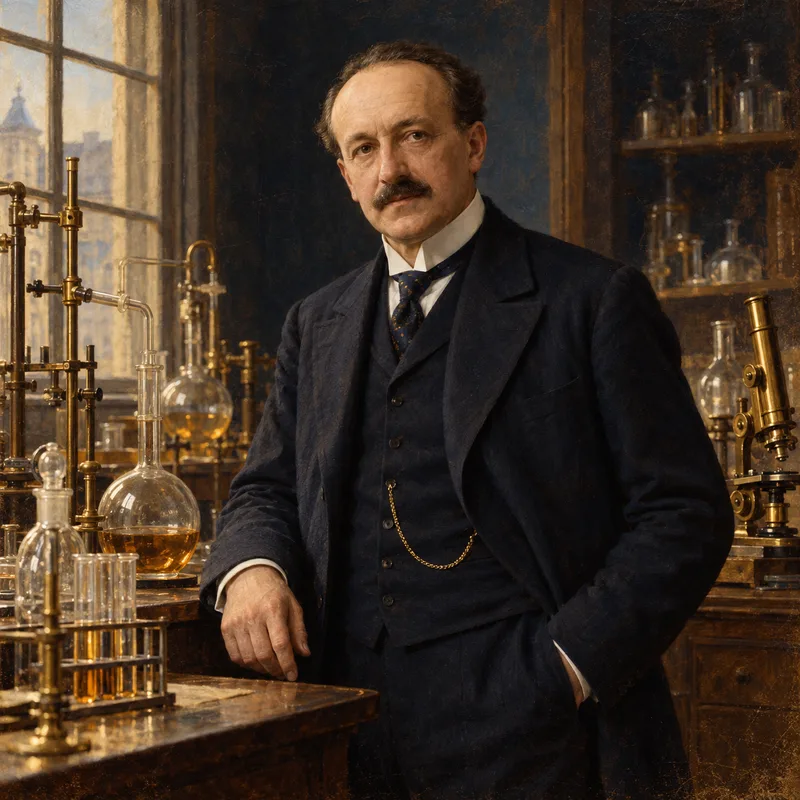
About the chemist
Heinrich Wieland
1877-1957 · Germany · Nobel Chemistry 1927
Bile acids and dehydrogenation theory