Biography · Chemist no. 108 of 350
Heinrich Wieland: Complete Life and Legacy
Introduction
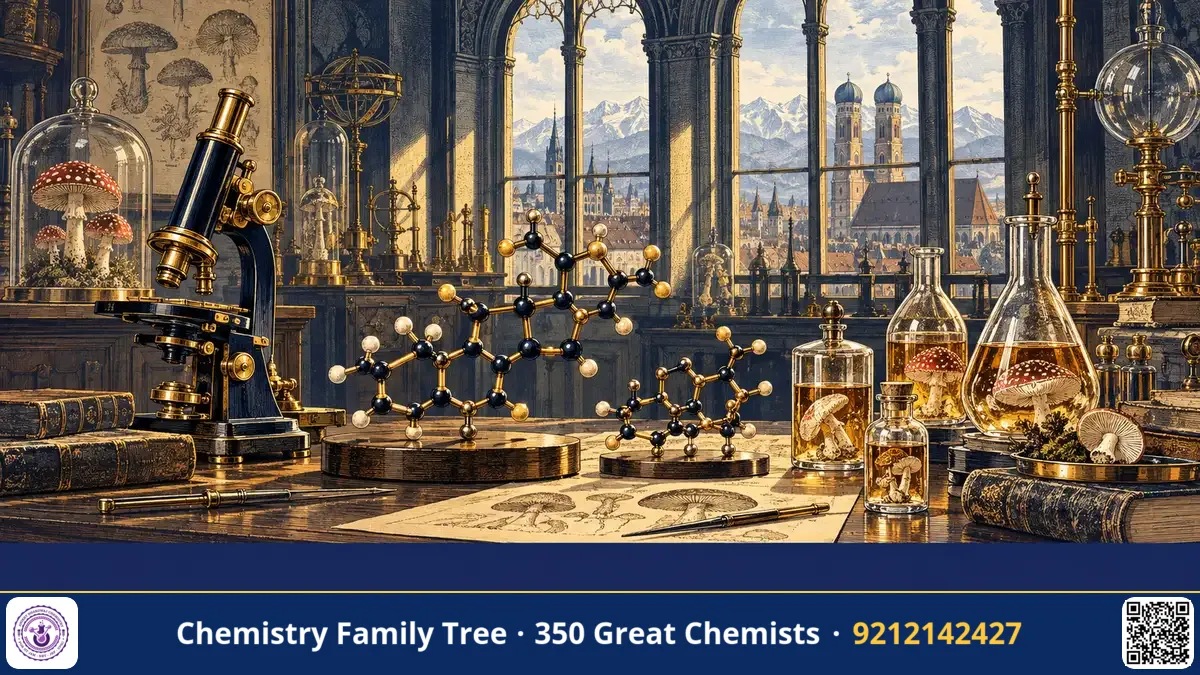
Heinrich Otto Wieland (1877–1957) was one of the most versatile German organic chemists of the twentieth century. He unravelled the structure of bile acids, proposed that biological oxidation is dehydrogenation, studied the nitrogen oxides, and worked on some of nature's strongest poisons, including morphine, strychnine and the toxins of the death-cap mushroom. He received the Nobel Prize in Chemistry (the 1927 prize, awarded in 1928). He is also remembered for his quiet courage during the Nazi period. His legacy is a body of work that links organic chemistry to physiology.
Early Life and Family
Heinrich Wieland was born on 4 June 1877 in Pforzheim, in the Grand Duchy of Baden, Germany, a town known for its jewellery and precious-metal industry. His father, Theodor Wieland, was a chemist who ran a plant for refining gold and silver. The family therefore had a chemical background, and Heinrich grew up watching chemical processes at work, in a household where science was normal conversation.
He attended school in Pforzheim, and was a good student with broad interests. In his later life he remained a lover of nature, hiking, and good company. The practical, workshop-like atmosphere of his father's plant gave him a lifelong confidence with apparatus and with materials.
Education and Mentors
Wieland studied chemistry at the Universities of Munich, Berlin and Stuttgart. In Munich he worked under Johannes Thiele, a skilled organic chemist known for his theory of partial valence and his work on conjugated systems, and he received his doctorate there in 1901. He stayed in Munich, where he came under the influence of Adolf von Baeyer, the great teacher of organic chemistry, and he qualified as a lecturer in 1904.
This Munich schooling shaped his approach: patient experimentation, a love of reaction mechanisms, and confidence with unusual compounds such as free radicals and nitrogen oxides. He had a particular talent for interpreting why complex natural substances behave as they do.
Career Timeline
| Year | Event |
|---|---|
| 1877 | Born in Pforzheim on 4 June. |
| 1901 | Doctorate at Munich under Johannes Thiele. |
| 1904 | Becomes lecturer (Privatdozent) in Munich. |
| 1913 | Professor at the Technical University of Munich. |
| 1921 | Professor of chemistry at the University of Freiburg. |
| 1925 | Succeeds Richard Willstätter at the University of Munich. |
| 1928 | Receives the Nobel Prize in Chemistry (the 1927 prize). |
| 1930s | Studies toad poisons, alkaloids, pterins and later the mushroom toxins. |
| 1957 | Dies in Starnberg on 5 August. |
Major Scientific Contributions
- Bile acids and steroids: determined the structure of cholic acid and related compounds; the Barbier–Wieland degradation for shortening side chains. See our discovery post.
- Dehydrogenation theory: biological oxidation as removal of hydrogen by dehydrogenases, using acceptors such as methylene blue.
- Morphine and strychnine: worked for decades on the structures of these alkaloids; the Wieland–Gumlich aldehyde is a key degradation product of strychnine, named after him and his co-worker Gumlich.
- Toad and mushroom toxins: studied the poisons of toads (bufotoxins) and, later, the cyclic peptides phalloidin and amanitin from the death-cap mushroom, Amanita phalloides.
- Pterins: with Clemens Schöpf, worked out the structure of pigments found in butterfly wings.
- Free radicals and nitrogen chemistry: investigated nitrogen oxides, fulminic acid and organic nitrogen free radicals, including diphenylnitrogen radicals.
Awards, Honours and Nobel Prize
The Nobel Prize in Chemistry for 1927 was awarded to Heinrich Wieland "for his investigations of the constitution of the bile acids and related substances". The prize for 1927 was announced in 1928, and he shared the occasion with Adolf Windaus, who received the prize for 1928 for sterols. The two friends, working along parallel lines, had effectively laid the foundations of steroid chemistry.
He was a member of scientific academies and received honorary doctorates. In 1964, his son-in-law Feodor Lynen received the Nobel Prize in Physiology or Medicine for his work on the regulation of cholesterol and fatty acid metabolism. Wieland did not live to see it.
Personality, Struggles and Lesser-Known Facts
- Courage under the Nazi regime. Wieland did not support the Nazi regime. He was known to have helped students and colleagues who were persecuted, and he refused to follow political pressure in the university. He was reportedly watched by the authorities.
- Wartime strain. During the Second World War, his laboratory in Munich was damaged by bombing, and he moved his work to Starnberg, near the Starnberger See, where he lived in his later years.
- Dangerous research. Mushroom toxins and alkaloids are deadly, and he worked with them with great care. His investigation into the death-cap toxins helped to explain why this mushroom is so poisonous.
- A family of scientists. His son Theodor Wieland became a well-known biochemist and also worked on the death-cap toxins, and his daughter Eva married Feodor Lynen.
- Love of mountains. He enjoyed Alpine hiking.
Legacy and Influence on Modern Chemistry
Wieland's steroid work, together with Windaus', paved the way for the great steroid discoveries of the 1930s and 1940s: sex hormones (Butenandt, Ruzicka), cortisone (Kendall, Reichstein), and the biosynthesis of cholesterol (Bloch and Lynen). Without the correct skeleton, none of this would have been possible. Steroids today are one of the most important classes of drugs, with annual use in the millions of doses.
His dehydrogenation theory, though partly corrected, influenced the study of enzymes. It anticipated the discovery of NAD+-dependent dehydrogenases and their central role in metabolism. His later work on the death-cap mushroom led to a deeper understanding of how amanitin blocks RNA polymerase II, and phalloidin is now a standard fluorescent probe for actin in cell biology. He showed what organic chemistry can do for medicine.
Lessons for Students
- Work on problems that connect chemistry with life; the best discoveries happen at boundaries.
- Be willing to challenge established views, as Wieland did in the debate on biological oxidation.
- Remain ethical under pressure. His conduct under dictatorship is an example.
- Be careful with dangerous materials. Good safety habits are part of good science.
- Build on others: his steroid work depended on collaboration and competition with Windaus.
Quick Facts Box
- Born: 4 June 1877, Pforzheim, Germany.
- Died: 5 August 1957, Starnberg, Germany.
- Nationality: German.
- Field: Organic chemistry, natural products, biochemistry.
- Famous for: Structure of bile acids; dehydrogenation theory; Barbier–Wieland degradation; mushroom toxins.
- Nobel: Chemistry (1927 prize, awarded 1928).
FAQ
Why did Wieland get the Nobel Prize?
For his investigations of the constitution of the bile acids and related substances, which helped to establish the structure of steroids.
Who was Wieland's famous son-in-law?
Feodor Lynen, who won the Nobel Prize in Physiology or Medicine in 1964, shared with Konrad Bloch, for work on cholesterol and fatty acid metabolism.
What is the Wieland–Gumlich aldehyde?
It is a key intermediate obtained from strychnine degradation and used in the synthesis and structure study of Strychnos alkaloids.
Did Wieland work with Windaus?
They worked independently but on closely related problems, and together their results gave the correct structure of the steroid skeleton. Windaus received the following year's Chemistry Nobel Prize.
Published by ABC Chemistry — IIT-JAM | CSIR-NET | GATE Chemistry Coaching. Visit abcchemistry.com
About the chemist
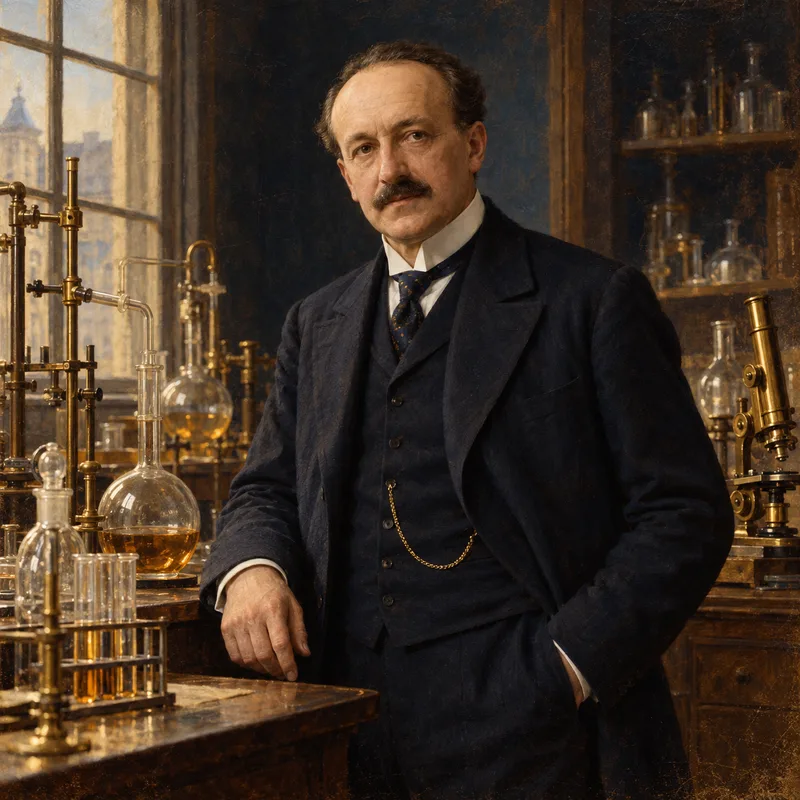
Heinrich Wieland
1877-1957 · Germany · Nobel Chemistry 1927
Bile acids and dehydrogenation theory