Biography · Chemist no. 271 of 350
Henri Becquerel (1852–1908): The Third-Generation Scientist Who Found Radioactivity
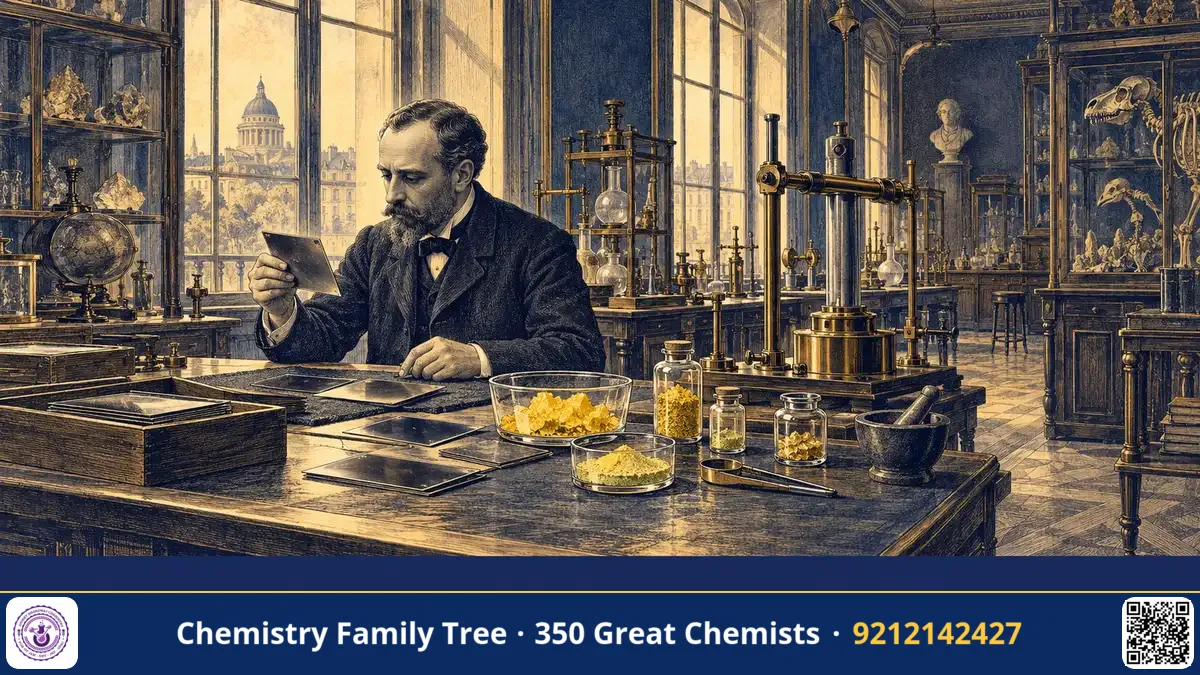
Antoine Henri Becquerel was a French physicist from a famous scientific family. In 1896, he discovered radioactivity, a result that changed physics and chemistry and led to the nuclear age. He shared the 1903 Nobel Prize in Physics with Pierre and Marie Curie. This article follows his life from a Paris family of scientists to the discovery that bears his name in the unit of radioactivity, the becquerel.
Early Life and Family
Henri was born on 15 December 1852 in Paris. He belonged to the third generation of a scientific dynasty. His grandfather Antoine César Becquerel was a pioneer in electrochemistry and a professor at the Muséum national d'histoire naturelle. His father, Alexandre-Edmond Becquerel, studied phosphorescence and photochemistry and also held a chair at the Muséum. Henri grew up among laboratories and discussions of light and matter, and his own son Jean also became a physicist, making the family one of the most distinguished in French science. The family also had a collection of uranium salts, which Edmond had used to study phosphorescence.
Education and Mentors
Henri studied at the Lycée Louis-le-Grand in Paris and then at the École Polytechnique, one of France's most prestigious schools. He went on to the École des Ponts et Chaussées to train as an engineer, and he worked as an engineer in the government's bridges and roads service for some years while continuing his scientific work. In his early research he studied the polarisation of light, the absorption of light in crystals and the Earth's magnetic field. He received his doctorate in 1888.
Career Timeline
| Year | Event |
|---|---|
| 1852 | Born in Paris (15 December). |
| 1872–1877 | Studies at the École Polytechnique and then the École des Ponts et Chaussées. |
| 1888 | Doctorate in science; research on light absorption in crystals. |
| 1889 | Elected to the Académie des sciences. |
| 1892 | Becomes professor of physics at the Muséum national d'histoire naturelle, the third in the family to hold the chair. |
| 1895 | Appointed professor at the École Polytechnique. |
| 1896 | Discovers radioactivity (reported in the first days of March). |
| 1900 | Shows that beta rays are electrons. |
| 1903 | Shares the Nobel Prize in Physics. |
| 1908 | Becomes permanent secretary of the Académie des sciences; dies in Le Croisic, Brittany (25 August). |
Major Scientific Contributions
Radioactivity. After Röntgen's announcement of X-rays, Becquerel tested uranium salts for emission of penetrating rays. In March 1896, he found that the plates were fogged even when the salts had not been exposed to sunlight. He then showed that the radiation came from uranium itself, was steady, and could ionise air and discharge an electroscope. The full story is in our discovery article.
Nature of the rays. In 1899–1900, he found that part of the radiation is deflected by a magnetic field and measured the charge-to-mass ratio of these particles, showing that they are electrons. This made the beta particle identical to the cathode ray particle discovered by J. J. Thomson.
Early work. His work on the phosphorescence of uranium salts, polarised light and magnetism gave him the experimental skill needed to see that the uranium effect was something new.
U-238 → Th-234 + α      t½ ≈ 4.5 × 10⁹ years
N = N₀ e^(−λt)
Awards, Honours and Nobel Prize
The 1903 Nobel Prize in Physics was awarded in two parts: half to Henri Becquerel "in recognition of the extraordinary services he has rendered by his discovery of spontaneous radioactivity", and half jointly to Pierre and Marie Curie for their work on the radiation phenomena. It was a Physics prize, not a Chemistry prize. He also received the Rumford Medal of the Royal Society in 1900. The SI unit becquerel (Bq) was named for him in 1975, and a crater on the Moon bears his name.
Personality, Struggles and Lesser-Known Facts
- The famous drawer. Becquerel's story of the cloudy Paris days and the drawer of plates is the classic example of a prepared mind making use of an accident. He did not stop at a surprising result, but ran many follow-up tests over the next months.
- The radium burn. In 1901, he carried a tube of radium salt, lent by the Curies, in his waistcoat pocket and found a skin burn afterwards. Pierre Curie then exposed his own arm deliberately to study the effect. This led to the study of the biological effects of radiation.
- Inspired others. His uranium rays were the starting point of Marie Curie's doctoral research, which led to polonium and radium.
- Earlier fame was modest. Before 1896, he was a respected but not widely famous physicist, and many people considered him lucky. His later work on beta rays showed his experimental skill.
- Short life. He died at only 55, and some historians think radiation exposure may have contributed to his health problems. This is not firmly established.
Legacy and Influence on Modern Chemistry
The discovery of radioactivity led to the idea of the atomic nucleus, isotopes and transmutation. It enabled radiochemistry: tracing reactions with radioisotopes, nuclear power, medical imaging and radiotherapy. The Soddy–Fajans group displacement laws, the first-order kinetics of radioactive decay and radiometric dating are all in the syllabus because of this field. Nuclear research institutions in India, such as the Bhabha Atomic Research Centre, work on topics that began with his observation. Moreover, the Becquerel unit used in every radiation measurement carries his name.
Lessons for Students
- Follow up unexpected results with controls and repeats.
- Scientific families and mentors help, but a good question and good tools matter more.
- A wrong hypothesis can still lead to a right discovery, if you observe honestly.
- Treat radioactive and hazardous materials with respect.
Quick Facts
- Born: 15 December 1852, Paris, France.
- Died: 25 August 1908, Le Croisic, France.
- Nationality: French.
- Field: Physics; radioactivity; phosphorescence.
- Famous for: Discovery of radioactivity (1896).
- Nobel: Physics, 1903 (shared with Pierre and Marie Curie).
FAQ
Was Becquerel a chemist or a physicist?
He was a physicist, but his discovery created radiochemistry and is a core part of chemistry courses.
What is the becquerel?
The SI unit of radioactivity, equal to one nuclear disintegration per second.
Who else in his family was a scientist?
His grandfather Antoine César, his father Edmond and his son Jean were all physicists.
When did he win the Nobel Prize?
In 1903, in Physics, together with Pierre and Marie Curie.
Published by ABC Chemistry — IIT-JAM | CSIR-NET | GATE Chemistry Coaching. Visit abcchemistry.com
About the chemist
Henri Becquerel
1852-1908 · France · Nobel Physics 1903
Discovered radioactivity