The discovery, explained · Chemist no. 271 of 350
Henri Becquerel and the Discovery of Radioactivity: An Accident in a Drawer
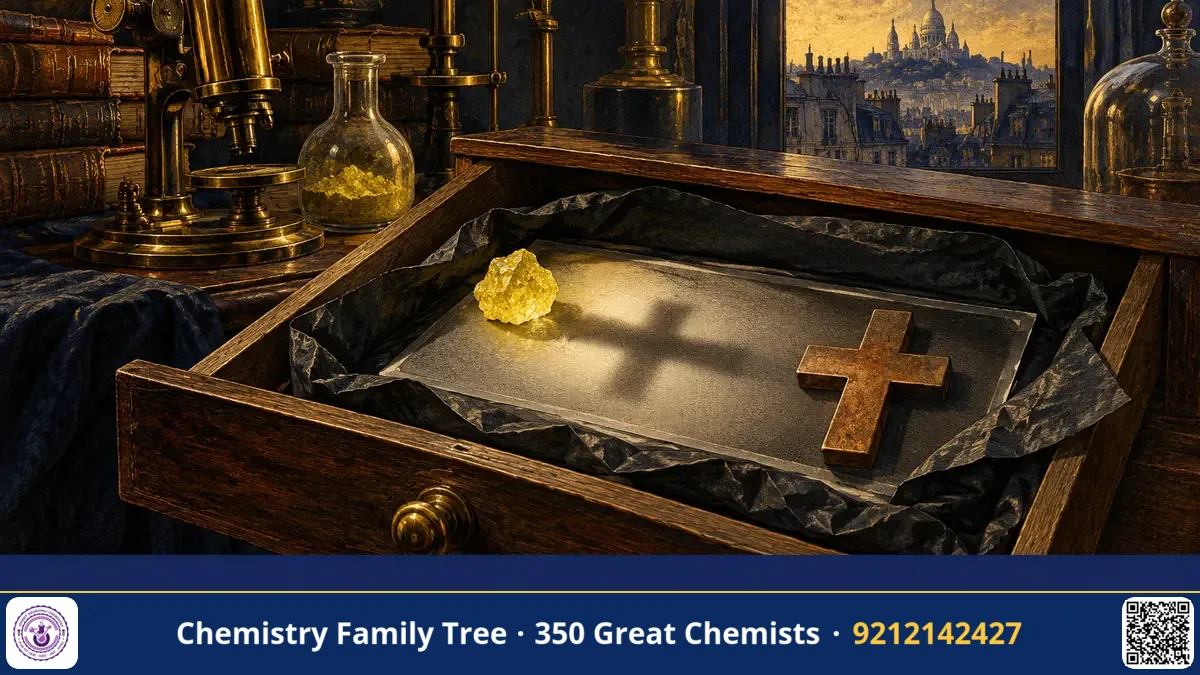
In early 1896, the French physicist Henri Becquerel put some uranium salt and a wrapped photographic plate in a dark drawer, and then found that the plate had been darkened without any light. This was the discovery of radioactivity, the spontaneous emission of penetrating radiation by certain elements. It opened the door to nuclear physics and nuclear chemistry. Becquerel shared the 1903 Nobel Prize in Physics with Pierre and Marie Curie. The SI unit of radioactivity, the becquerel (Bq), is named after him.
The Scientific Problem Before the Discovery
In November 1895, Wilhelm Röntgen announced X-rays: invisible rays from a glass discharge tube that passed through paper and flesh and affected photographic plates. The glass wall of the tube glowed (fluoresced) where the rays came out. Many scientists asked whether other fluorescent or phosphorescent materials, which glow after being exposed to light, might also give off X-rays. Henri Poincaré raised this question in France. Becquerel's family had studied phosphorescence for three generations, and he had a collection of uranium salts which glow after exposure to sunlight. It was natural for him to test them.
The Discovery: Step by Step
- Hypothesis: Phosphorescent materials may emit penetrating rays after absorbing sunlight.
- Experiment (February 1896): He wrapped a photographic plate in thick black paper so that no ordinary light could reach it. He placed crystals of potassium uranyl sulfate, K₂UO₂(SO₄)₂·2H₂O, on top of it, and put the arrangement in the sun for several hours. After developing the plate, he found an image of the crystals. This seemed to support his idea.
- Cloudy days: On 26–27 February, Paris was cloudy, so he put the prepared plates and salts into a dark drawer. On 1 March he developed one of the plates anyway, expecting only a faint image. To his surprise, the image was strong.
- Conclusion: The darkening did not need sunlight. The uranium salt itself emitted rays all the time.
- Follow-up: He found that all uranium compounds, phosphorescent or not, did the same, and that the intensity depended on the amount of uranium. Even metallic uranium worked. The rays made air conductive (they ionised it), and they could pass through thin metal sheets. A shadow of a metal Maltese cross placed between salt and plate showed up clearly.
The effect was constant over months and not affected by heating or chemical changes, so he concluded that the radiation was an atomic property of uranium. This was very different from chemical behaviour, which depends on how atoms are bonded.
The Chemistry Behind It
The "Becquerel rays" were later found to be of three kinds, named alpha (α), beta (β) and gamma (γ) by Ernest Rutherford. Becquerel himself showed in 1900 that beta rays have the same charge-to-mass ratio as cathode-ray electrons, so beta particles are fast electrons.
| Radiation | Nature | Charge | Penetration |
|---|---|---|---|
| Alpha (α) | Helium nucleus, ⁴₂He²⁺ | +2 | Stopped by paper or skin |
| Beta (β⁻) | Electron from the nucleus | −1 | Stopped by a few mm of aluminium |
| Gamma (γ) | High-energy photon | 0 | Needs thick lead or concrete |
²³⁸₉₂U → ²³⁴₉₀Th + ⁴₂He            (alpha decay)
²³⁴₉₀Th → ²³⁴₉₁Pa + ⁰₋₁e + ν̄       (beta decay)
Radioactive decay is a first-order process: the number of nuclei N falls with time as
N = N₀ e^(−λt) t½ = 0.693 / λ
Uranium-238 has a half-life of about 4.5 billion years, which is why its rays were so steady in Becquerel's drawer. The decay is not affected by temperature, pressure or chemical form, because it is a nuclear, not an electronic, process. Activity is measured in becquerels: 1 Bq = 1 disintegration per second (the older unit curie equals 3.7 × 10¹⁰ Bq).
The discovery that atoms of one element can turn into atoms of another (transmutation, shown by Rutherford and Soddy in 1902–03) overturned Dalton's idea of unchangeable atoms.
Applications Today
- Nuclear power: Understanding the decay and fission of uranium leads to nuclear reactors, which provide part of India's electricity at plants such as Tarapur and Kudankulam.
- Medicine: Radioisotopes such as technetium-99m (diagnostic scans), iodine-131 (thyroid disease) and cobalt-60 (radiotherapy) are made and used in hospitals.
- Dating: Radiocarbon dating (¹⁴C, half-life about 5730 years) and uranium–lead dating give ages of archaeological finds and rocks.
- Smoke detectors: A tiny amount of americium-241 emits alpha particles that ionise air.
- Industry and agriculture: Gamma sources are used in radiography of welds, sterilisation, and food preservation.
Exam Corner
- Radioactivity was discovered by Henri Becquerel in 1896 with potassium uranyl sulfate; he shared the 1903 Nobel Prize in Physics with the Curies.
- Radioactive decay obeys first-order kinetics: N = N₀e^(−λt), t½ = 0.693/λ, mean life τ = 1/λ.
- Alpha: ⁴₂He; beta: electron; gamma: photon. Penetration order: γ > β > α; ionising power: α > β > γ.
- SI unit of activity is the becquerel (1 decay per second); 1 Ci = 3.7 × 10¹⁰ Bq.
- Group displacement law (Soddy–Fajans): alpha emission lowers Z by 2 and mass number by 4; beta emission raises Z by 1.
Common Misconceptions
- "Becquerel discovered X-rays." No. Röntgen discovered X-rays in 1895. Becquerel discovered radioactivity in 1896.
- "The discovery was a planned success." His experiment began with a wrong idea (that sunlight was needed), and the cloudy weather led him to the correct conclusion. But Becquerel did choose to develop the plate, and he followed up with careful studies, so it was not pure luck.
- "Radioactivity depends on chemical state." Decay rate is nuclear and is independent of temperature or compound form, which is why uranium metal and its salts behaved alike.
Quick Revision Box
- Discovery: March 1896, Paris, uranium salt and a photographic plate.
- Salt used: potassium uranyl sulfate, K₂UO₂(SO₄)₂·2H₂O.
- Radioactivity is spontaneous nuclear decay, not affected by temperature or chemical state.
- Beta rays are electrons (Becquerel, 1900).
- Unit: becquerel (Bq) = 1 disintegration/second.
- Nobel Prize in Physics, 1903 (shared).
FAQ
Why did Becquerel use uranium?
He had uranium salts that were phosphorescent and was testing whether they gave off penetrating rays like X-rays after sunlight exposure.
Did he get the Nobel Prize in Chemistry?
No. The 1903 Nobel Prize in Physics was shared by Becquerel and Pierre and Marie Curie.
Who gave the name radioactivity?
Marie Curie introduced the term "radioactivity" a few years after Becquerel's discovery.
What is the half-life formula?
t½ = 0.693/λ, where λ is the decay constant.
Published by ABC Chemistry — IIT-JAM | CSIR-NET | GATE Chemistry Coaching. Visit abcchemistry.com
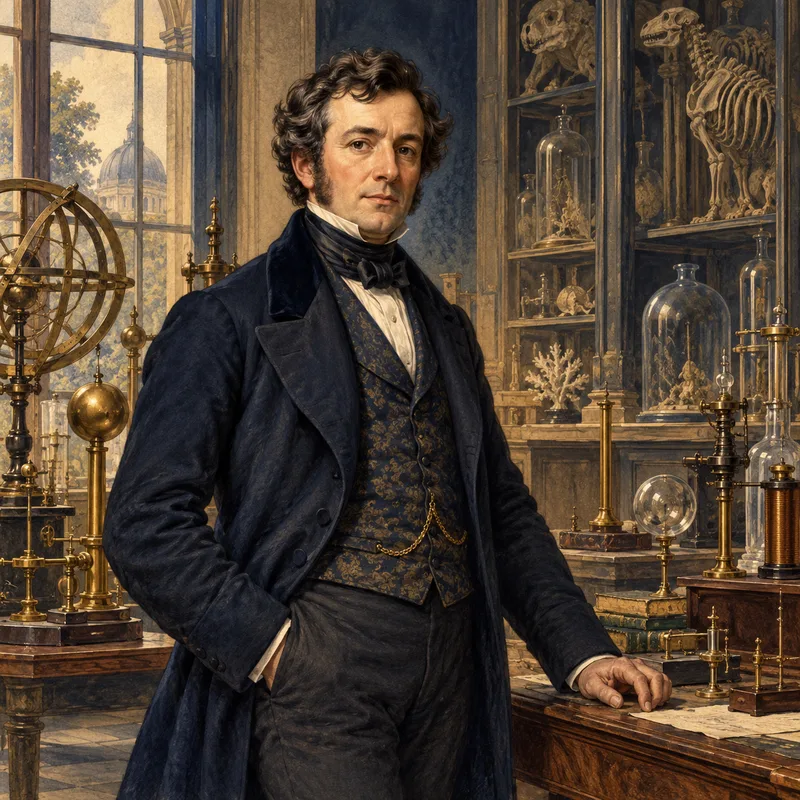
About the chemist
Henri Becquerel
1852-1908 · France · Nobel Physics 1903
Discovered radioactivity